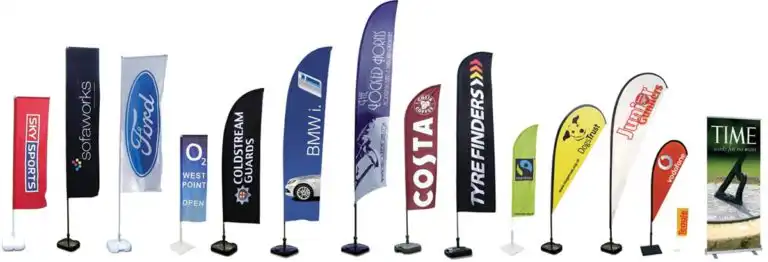

The Ultimate Feather Flags Buying Guide
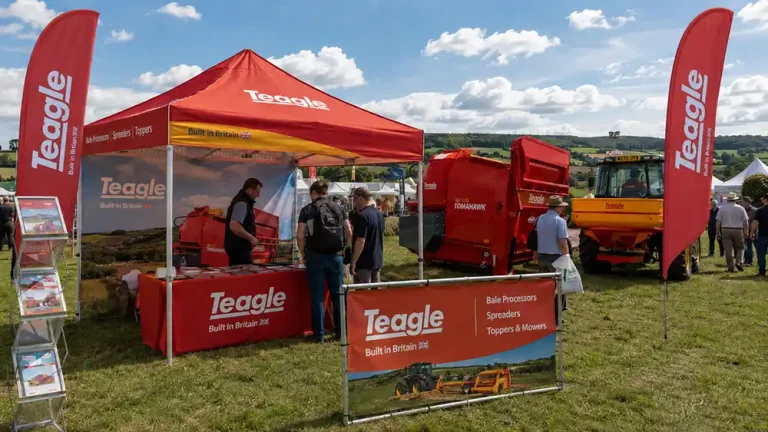
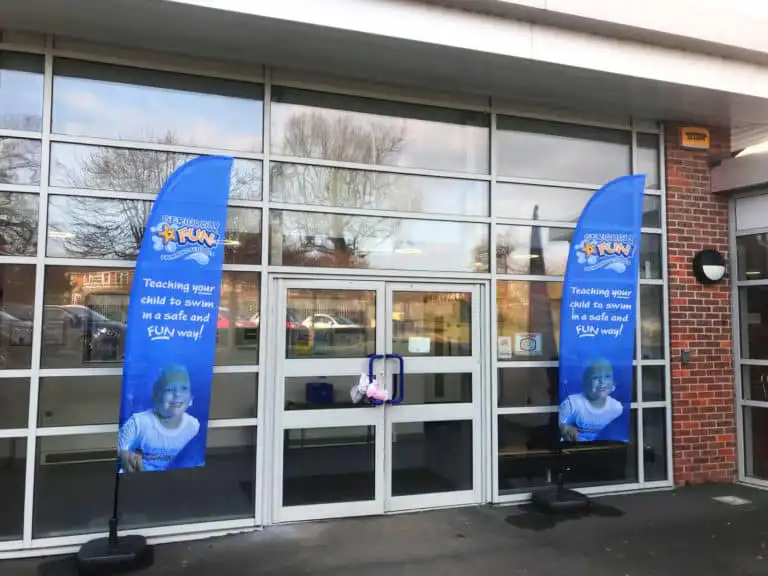
Feather flags (sometimes also referred to as sail flags or swooper flags) are one of the most effective forms of outdoor advertising when specified correctly. When chosen well, they deliver constant visibility, work in all weather, and outperform many other physical marketing tools for cost versus impact.
However, most underperforming feather flags fail for the same reasons: the wrong base, poor artwork layout, or low-quality construction that simply isn’t built for real outdoor use.
This guide is designed to help you buy once — and buy right.
1. Start with the job: what does the flag need to do?
Before choosing sizes, shapes, or print options, clarify three fundamentals:
Where will the flag be used?
- Hard ground (tarmac, concrete, paving)
- Soft ground (grass, soil)
- Indoors (exhibitions, retail)
- Or a mix of environments
How exposed is the location?
A sheltered shopfront is very different to a coastal forecourt or roadside. Wind exposure directly affects:
- Base choice
- Pole stress
- Overall lifespan
What is the one message it must communicate?
At distance and speed, less is more. The strongest feather flags usually communicate:
- OPEN
- SALE
- FOOD
- CAR WASH
- A simple brand name or logo
If the message can’t be understood in three seconds, the design is doing too much.
2. Feather flag shape and size: clarity beats scale
Why feather flags work so well
The curved top of a feather flag naturally draws the eye upwards, while the vertical shape allows text to be read from top to bottom — ideal in busy environments with visual noise.
For most businesses, feather flags offer the best balance of:
- Readability
- Movement
- Stability
You can view the full range of options on our
👉 Feather Flags main page
Choosing the right height
There’s no universal “best size” — the correct height depends on surroundings.
- Close-range foot traffic: clarity and placement matter more than height
- Roadside or forecourts: additional height helps cut through clutter
- Indoor use: smaller flags prevent wobble and ceiling interference
A taller flag with the wrong base will always perform worse than a correctly specified, well-anchored flag.
3. Single-sided vs double-sided feather flags
This is one of the most common decision points — and one of the most misunderstood.
Single-sided (mirror-through)
- Printed on one side
- Reverse shows a mirrored image through the fabric
- Lighter weight, better movement
- Ideal for simple messages and logos
This is the most common and cost-effective option.
Double-sided feather flags
If your flag will be seen clearly from both directions, a double-sided option is often the better choice.
Double-sided feather flags are produced by printing two separate faces and stitching them together with a liner, allowing:
- Correct reading on both sides
- Stronger colour impact
- A more premium finish
You can see more detail here:
👉 Double-sided feather flags and flag printing
Important note:
Double-sided flags are heavier, so pole quality and base choice become even more important, especially in exposed locations.
4. Fabric and print quality: what really matters
Most professional feather flags are produced using knitted polyester fabric, typically around 110–115gsm. While weight matters, performance depends more on how the fabric is printed and finished.
Dye sublimation printing
High-quality feather flags use dye sublimation, where inks are heat-infused into the fabric rather than sitting on the surface. This provides:
- Excellent colour vibrancy
- Strong show-through on single-sided flags
- Better resistance to fading
Poor penetration results in dull colours and weak visibility, particularly on the reverse side.
Colour management
Consistent colour relies on:
- Proper colour profiling
- Sensible ink densities
- Experience with outdoor visibility, not just screen accuracy
5. Poles: the hidden factor in durability
A feather flag pole is a flexible structure, not a rigid stick. The pole must:
- Flex smoothly in wind
- Recover without kinking
- Distribute stress evenly along its length
Look for:
- Strong lower sections for stability
- Flexible upper sections to allow movement
- Secure joints that don’t loosen or rattle
- A rotating bearing in the base to let the flag follow the wind
Cheap poles fail early — usually at the joints or top section.
6. Bases: the most common buying mistake
The base should always be chosen for surface first, then weighted for wind.
Soft ground (grass or soil)
- Ground spikes provide excellent stability when installed properly
- Ideal for show fields, verges, and landscaped areas
Hard ground (tarmac, concrete, paving)
- Cross bases or metal plates are common
- Medium sized water filled bases
- Outdoor use usually requires additional ballast
- Best for forecourts, pavements, and indoor spaces
High-exposure areas
- Large water-filled bases or heavy steel bases offer maximum stability
- Drive-on bases are ideal for forecourts and roadside locations
If the flag will be outdoors long-term, invest in the base — not just the print.
7. Artwork that performs outdoors
The three-second rule
Your design should communicate its message instantly.
A strong hierarchy looks like this:
- Logo or brand cue near the top
- Main message in the centre
- Optional supporting detail near the bottom
Avoid placing important text too close to the curved top where distortion occurs.
Contrast over complexity
Outdoor visibility relies on contrast, not gradients or fine detail. Simple colour combinations and clear spacing outperform “busy” designs every time.
8. Finishing details that extend lifespan
Durability is heavily influenced by how the flag is finished.
Look for:
- Reinforced pole sleeves
- Strong stitching on seams
- Secure edge finishing to prevent fraying
- Reinforcement at high-stress corners
These details matter most in windy or coastal environments.
9. Indoor use and fire safety
Many exhibition venues require fire-rated materials. If you plan to use feather flags indoors, check whether a B1 fire-rated fabric option is required and allow for this during ordering.
10. How many feather flags do you actually need?
A practical guide:
- 1 flag: marks a location
- 2 flags: frames an entrance or stand
- 3 or more: creates presence and dominance
For two-way footfall, either:
- Use two single-sided flags facing opposite directions, or
- Choose a double-sided feather flag if conditions allow
11. Key questions to ask before buying
Before placing an order, it’s reasonable to ask:
- Is this single-sided mirror-through or true double-sided?
- What reinforcement is included as standard?
- Which base is recommended for my surface and wind exposure?
- Does the base include a rotating bearing?
- What lifespan should I expect for my use case?
Clear answers usually indicate a supplier who understands real-world use, not just printing.
Final thoughts
Feather flags remain one of the most cost-effective forms of outdoor advertising available — but only when specified correctly.
By choosing the right shape, base, print method, and finishing, you’ll end up with a flag that doesn’t just look good on day one, but continues to work hard in real conditions.
If you’re unsure which configuration is right for your location, start with the
👉 Feather Flags main page
and work from there using the principles in this guide.