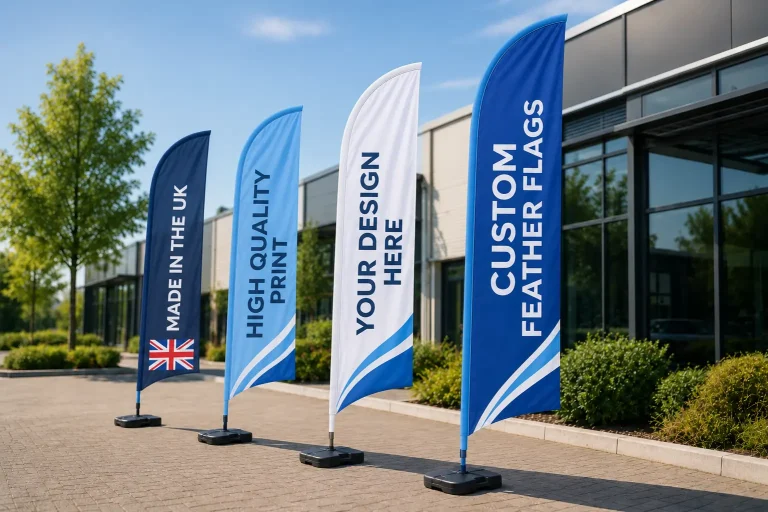

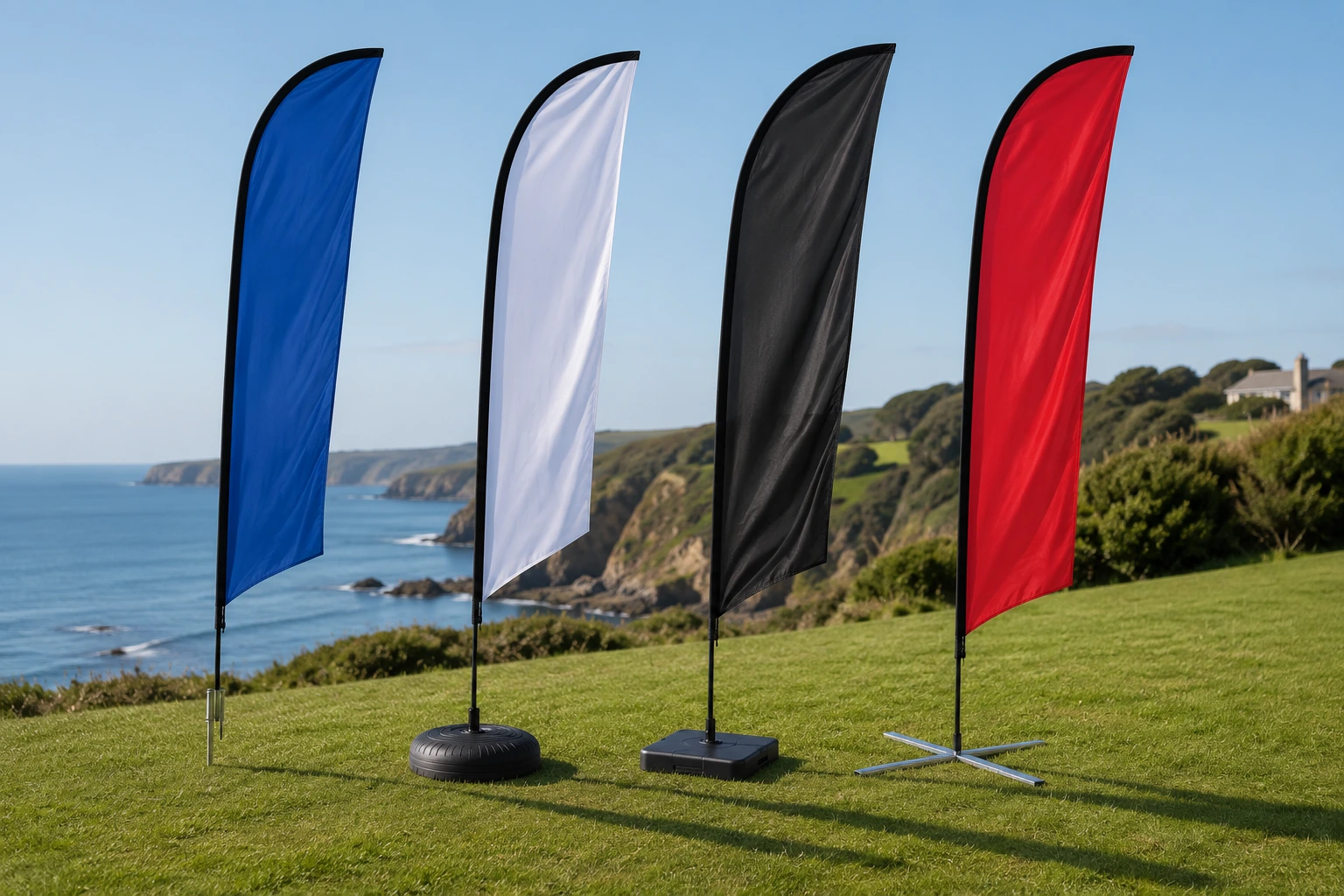
You’ve invested in a custom feather flag — vibrant print, strong fabric, great design. But the moment you set it up outside on a breezy afternoon and it topples sideways, the flag itself becomes irrelevant. The hardware holding your flag upright is just as important as the flag you print. Whether you’re displaying at a trade show, outside a retail premises, on a festival field, or at a car forecourt, choosing the right feather flag pole and base is the difference between a professional, eye-catching display and a liability waiting to happen.
This guide covers every type of feather flag base, pole material, and mounting option available — with practical guidance on which combination works best for which surface, environment, and use case. Whether you’re buying your first complete kit or replacing hardware for an existing flag, this is everything you need to know.
1. How a Feather Flag Pole System Works
A feather flag pole system is a multi-section assembly — not a single rigid rod — which is what makes it portable and practical. The typical kit contains:
- Sectional pole segments: usually 3 to 5 interlocking fibreglass or carbon fibre sections that slot together to reach the total flag height.
- A flexible top tip: the uppermost section, designed to bend with the flag rather than resist it, reducing stress on the fabric and stitching.
- A bottom spike or connector: the lowest section, which fits into your chosen base.
- A base: the weighted, ground-fixed, or surface-mounted anchor that keeps the whole assembly upright.
The pole is typically supplied with the flag already sleeved — the fabric feeds over the pole from the bottom before the sections are connected, or it clips to a spigot at the top. Most pole kits also come with a carry bag, making transport straightforward.
2. Feather Flag Pole Materials: Aluminium, Fibreglass & Carbon Fibre Compared
Not all poles are created equal. The material your pole is made from determines how it handles wind, how long it lasts, how much it weighs, and how much it costs.
|
Aluminium |
Fibreglass |
Carbon Fibre |
|
|---|---|---|---|
|
Wind flexibility |
Low — rigid |
High — flexes well |
Very high |
|
Weight |
Light |
Light |
Lightest |
|
Durability |
Good |
Good |
Excellent |
|
Rust/corrosion |
None |
None |
None |
|
UV resistance |
Good |
Degrades over time |
Excellent |
|
Best for |
Indoor / light use |
Most outdoor use |
Exposed / coastal / windy |
|
Cost |
Low |
Mid |
Premium |
For most UK businesses, fibreglass poles with a carbon fibre tip offer the best balance of cost, performance, and longevity. They flex rather than snap in strong gusts, resist corrosion, and are light enough to carry in a standard kit bag. Sailflags uses carbon fibre poles across its feather flag range — stronger, lighter, and more durable than fibreglass alternatives, with natural flex that reduces strain on the flag fabric and stitching over time.
For coastal businesses, motorway-adjacent forecourts, or any exposed outdoor location with persistent wind, carbon fibre is the recommended choice — it resists salt corrosion and UV degradation that causes fibreglass to yellow and become brittle after 1–3 years of outdoor exposure.
3. Feather Flag Bases: The Complete Guide
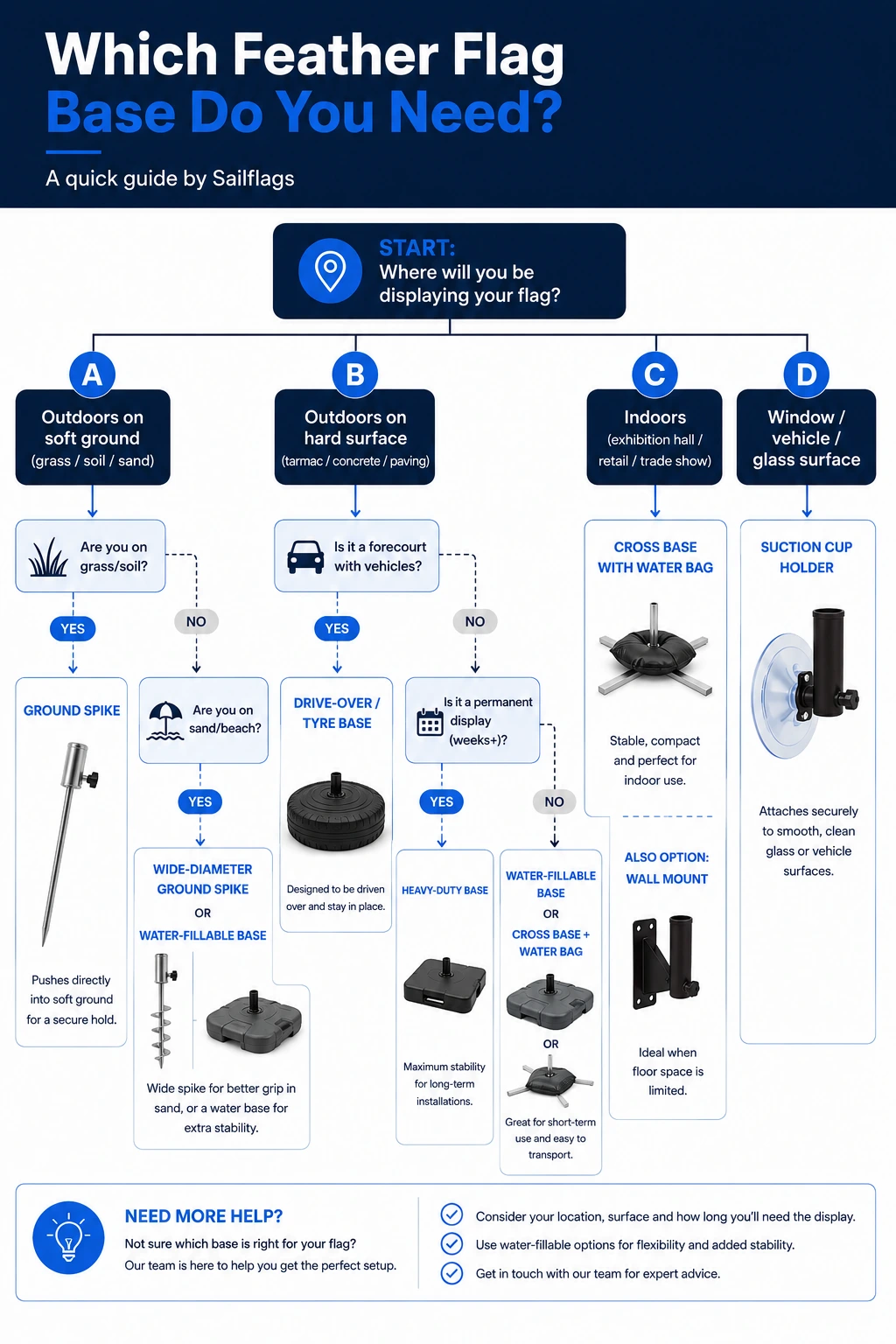
The base you choose should be driven by where and how the flag is being used. There is no single ‘best’ base — only the best base for your specific surface and situation. Here is every type available and when to use each.
3a. Ground Spike / Ground Stake
The ground spike (sometimes called a ground stake) is the simplest and most popular base option for outdoor use. It is a pointed metal rod that is pushed or screwed into soft ground — grass, soil, or sand — until it is firmly seated. The pole then slots into the top of the spike.
- Best for: festivals, outdoor events, sports grounds, gardens, and any grass or soft-ground setting.
- Advantages: the cheapest base option, extremely lightweight, and fast to install — one person, no tools, under a minute.
- Limitations: it does not work on hard surfaces like tarmac or concrete, and offers less stability than weighted bases in high winds.
- Tip: for soft sandy ground (beach setups), use a wider-diameter spike designed for sand to prevent the flag tilting under its own weight.
3b. Cross Base (Hard Surfaces & Indoor Use)
The cross base is a flat, X-shaped metal frame that sits on any hard, flat surface — concrete, tarmac, exhibition hall floors, or indoor retail floors. The pole sits in a central socket on the base. On its own, a cross base provides modest stability, but the key is the water bag that typically sits on top: this adds ballast without requiring the base to be fixed to the ground.
- Best for: trade shows, indoor retail, shopping centres, exhibitions, and any hard surface where spikes cannot be used.
- Advantages: no fixings required, easy to set up and take down, works on virtually any flat surface.
- Limitations: stability depends on the weight bag being full and properly positioned — an empty bag on a windy day is a tipping risk.
- Water bag guidance: always fill the bag completely before use. A standard cross-base water bag holds 15–20 litres and weighs 15–20 kg when full — enough for moderate wind conditions.
3c. Water-Fillable Base
A dedicated feather flag water base (also called a fillable base or water barrel base) is a self-contained weighted unit: a moulded plastic reservoir that is transported empty and filled with water on-site. Unlike the cross base + bag combination, this is a single integrated unit — the pole slots into a socket on the top.
- Best for: events where the flag needs to be moved repeatedly or set up at multiple locations on the same day.
- Advantages: very easy to transport empty (carries flat or in a bag), provides significant weight when filled — a 30-litre base weighs around 30 kg when full. Some models accept sand as well as water for additional weight.
- Limitations: slightly bulkier than a ground spike when full; needs access to water on-site.
- A note on 30L bases: Sailflags’ 30L heavy-duty water base is particularly popular for outdoor retail and restaurant forecourts — it provides a stable platform without any fixing into the ground.
3d. Heavy-Duty / Weighted Base
Where permanent or semi-permanent outdoor display is required, a heavy-duty metal or concrete-weighted base provides the highest level of stability. These bases are substantial — often 25–50 kg — and are not designed for daily transport.
- Best for: car dealership forecourts, petrol stations, supermarket entrances, and any permanent outdoor display.
- Advantages: the most stable option available; performs well in high winds; no filling or anchoring required.
- Limitations: heavy, not portable, and more expensive than other options.
- When to choose this: if your flag is staying in one place for weeks or months at a time, a heavy-duty base is far more cost-effective than replacing lighter bases that tip or wear.
3e. Drive-Over / Tyre Base
The drive-over base (sometimes called a tyre base or vehicle base) is a flat plate or bracket designed to sit under a vehicle’s tyre. The weight of the vehicle holds the base — and therefore the flag — completely firm.
- Best for: car dealerships, garages, tyre centres, auto repair shops, and any business that operates from a forecourt.
- Advantages: eliminates the need for any separate ballast — a standard car tyre exerts approximately 400–500 kg of force, making these the most stable option of all on flat surfaces.
- Limitations: the flag’s position is fixed by the vehicle’s location; not suitable for grass or soft ground.
- Tip: most drive-over bases are rated for passenger cars and light vans — check the weight rating before using with heavier vehicles.
4. Wall Mounts & Suction Cup Holders
Not every flag needs to stand on the ground. Wall mounts and suction cup holders open up a range of display positions that freestanding bases cannot achieve.
Wall Mounts
A wall bracket is a fixed bracket that attaches to an exterior wall, window frame, or fascia, holding the flag pole at an angle — usually 45° to 90° from the building face.
Suction Cup Holders
For temporary window or glass surface mounting, Sailflags’ heavy-duty suction cup flag holders provide a non-permanent solution that leaves no marks. They accept pole diameters up to 26mm and can be positioned vertically or horizontally — useful for vehicle windows, shopfront glass, or exhibition display panels.
- Best for: event vehicles, taxi and delivery fleets, or temporary window displays.
- Advantages: attaches and removes in seconds, leaves no residue on the surface.
- Limitations: not suitable for outdoor high-wind use and should not be used with large, heavy flag systems.
5. Quick Reference: Which Base for Which Surface?
| Surface / Location | Recommended Base | Alternatives | Avoid |
| Grass / soft soil | Ground spike | Water-fillable base | Cross base alone |
| Sand / beach | Wide-diameter ground spike | Water-fillable base | Standard spike |
| Tarmac / concrete (outdoor) | Water-fillable base or heavy-duty base | Cross base + water bag | Ground spike |
| Indoor / exhibition hall | Cross base + water bag | Water-fillable base | Ground spike |
| Car forecourt | Drive-over / tyre base | Heavy-duty base | Ground spike |
| Shopfront (limited pavement) | Wall mount | Cross base + bag | Ground spike |
| Vehicle / glass surface | Suction cup holder | Wall mount | Freestanding bases |
| Permanent outdoor display | Heavy-duty / weighted base | Drive-over base | Water base (long-term) |
6. Matching Pole Height to Flag Size
Sailflags’ feather flags come on adjustable pole systems ranging from 1.6m to 5.2m in total height. Choosing the right height matters not just for visual impact but for structural stability — a flag that is too large for its pole will increase wind load significantly and may cause the pole to bow or the base to tip.
- 1.6m–1.7m (Super Saver / Mini): ideal for indoor retail, reception areas, or cramped outdoor spaces where a compact footprint matters.
- 2.7m–3.2m: the most versatile range — suitable for shop fronts, trade shows, outdoor events, and most forecourt positions.
- 4.2m–4.9m: best for large outdoor environments, car parks, and roadside visibility where the flag needs to be seen from a distance or from a moving vehicle.
- 5.2m+: specialist applications — large forecourts, event perimeters, or sites where maximum long-range visibility is required. Pair with a heavy-duty or weighted base only.
| Rule of thumb A flag visible from 20–50 metres should be at least 4m tall. For on-foot visibility in a contained retail environment, 2.7m–3.2m is usually the sweet spot. |
If you use a double-sided flag, note that double-sided prints are heavier than single-sided. This means the base needs to be one grade up — if you would normally use a cross base with water bag, upgrade to a 30L fillable base for double-sided flags in outdoor settings.
7. Wind, Weather & Safety: What You Need to Know
Feather flags are designed to work in the wind — the movement is part of what makes them effective at attracting attention. But there are limits, and understanding them keeps people safe and your display looking professional.
Wind Ratings
Standard feather flag pole kits are rated for winds up to approximately 35 mph (Beaufort Scale 7 — near gale). At this wind speed, you should see flags and unfurled fabric beginning to stretch fully. Above this, you should bring flags in.
For exposed coastal locations or motorway-adjacent sites where sustained winds regularly exceed 25–30 mph, Sailflags recommends:
- ToughTex heavy-duty flag fabric — engineered to last up to twice as long as standard flag fabric in tough outdoor environments.
- Regularly inspect the pole for cracks or wear to prevent structural failure.
- Ensure the base is fully weighted or secured correctly for the specific surface before every daily setup.
| Safety note The Health and Safety Executive (HSE) considers wind speeds above 23 mph (Beaufort Scale 5) sufficient to affect balance and stability of temporary structures. In public areas, ensure all flag hardware is correctly weighted and inspected before each day of use. |
8. Care & Maintenance: Making Your Hardware Last
Good maintenance extends the life of both the pole and the base significantly — and avoids the frustration (and cost) of hardware failing mid-campaign.
Poles
- Rinse with fresh water after use in coastal or salty environments to prevent corrosion.
- Inspect sections for hairline cracks or splintering before each assembly.
- Wipe down with a damp cloth to remove grit or dirt before packing away in the carry bag.
Bases — Water-Fillable
- Ensure the cap is screwed on tightly to prevent leaks.
- Empty completely before transport to reduce weight and avoid water damage in transit.
- Do not drop or drag the base when full, as this can crack the plastic reservoir.
Bases — Ground Spikes
- Clean off mud or soil from the spike before storage to prevent rust.
- Use a rubber mallet for installation if the ground is hard; avoid hammering directly on the pole connector.
- Store in a dry place to maintain the integrity of the metal coating.
General
- Store all hardware in a cool, dry environment away from direct sunlight when not in use.
- Regularly check all connections for tightness to ensure stability throughout the display period.
- If you need to order replacement poles or parts, Sailflags stocks spares across its full range — always quote your flag model when ordering to ensure compatibility.
Ready to Choose Feather Flag Pole and Base?
Choosing the right feather flag pole and base is not complicated once you know the rules: match the base to the surface, match the pole material to the exposure level, and always size the base up when using double-sided flags or displaying in exposed locations.
The right hardware turns a good-looking flag into a reliable, professional display that works all day, every day. The wrong hardware turns that same flag into something that embarrasses rather than advertises.
At Sailflags, every complete feather flag kit comes supplied with a pole as standard — and we offer the full range of bases, spikes, and accessories to match your specific location and use case. Our team, based in Cornwall and manufacturing in-house since 1999, can advise on the right combination for your site before you order.