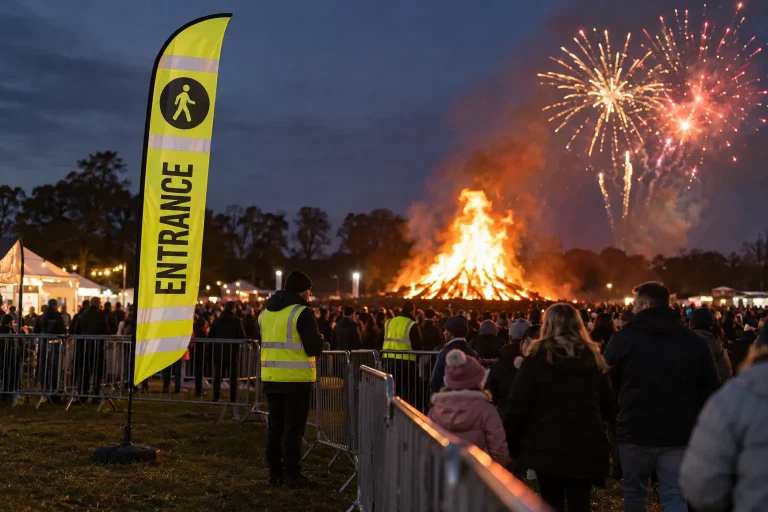

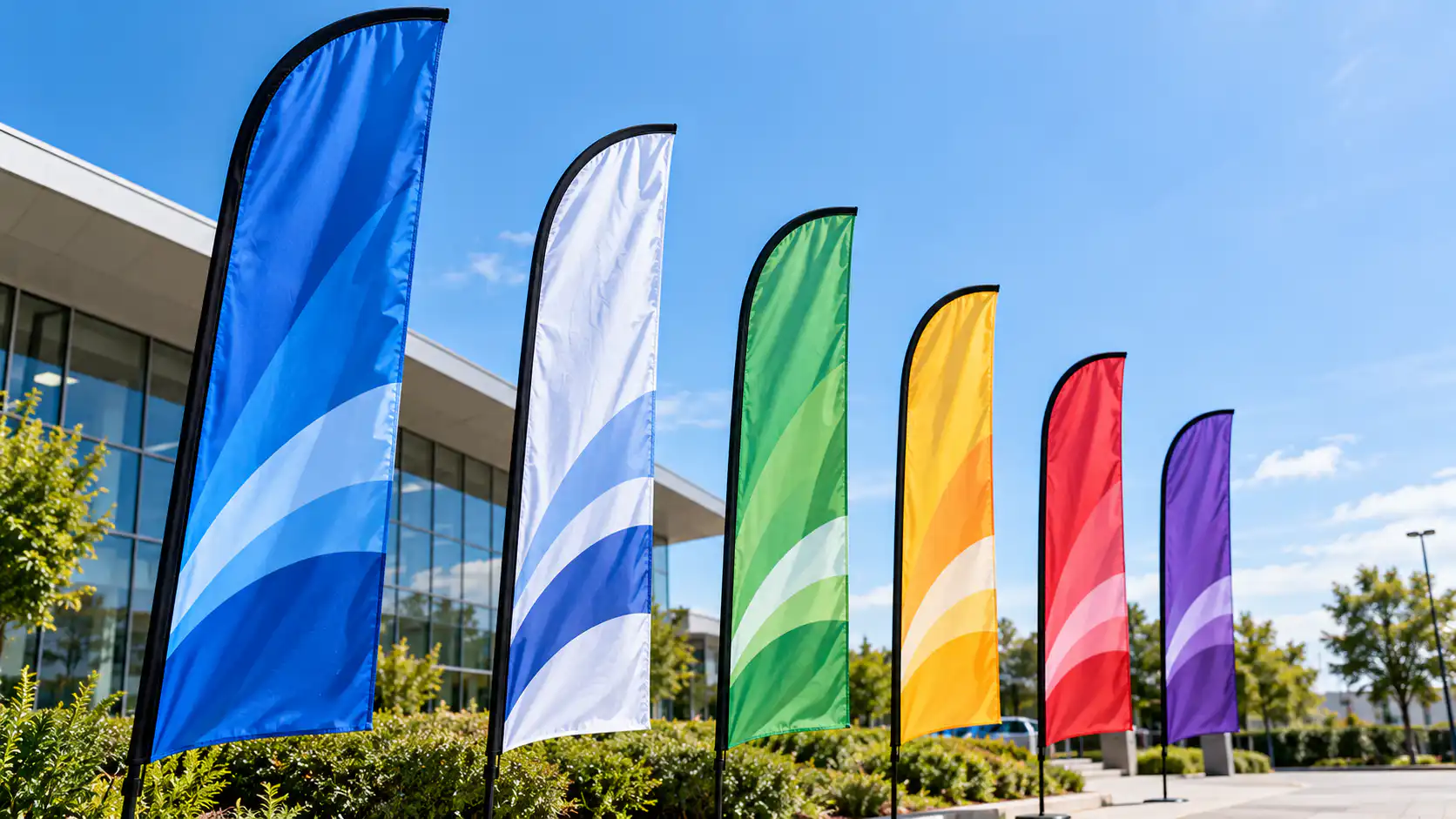
Ask ten people what their feather flag is made from and nine will say polyester. That is true, and it is also almost useless, because polyester can be knitted or woven, and the two behave very differently once they are up a pole in a British breeze.
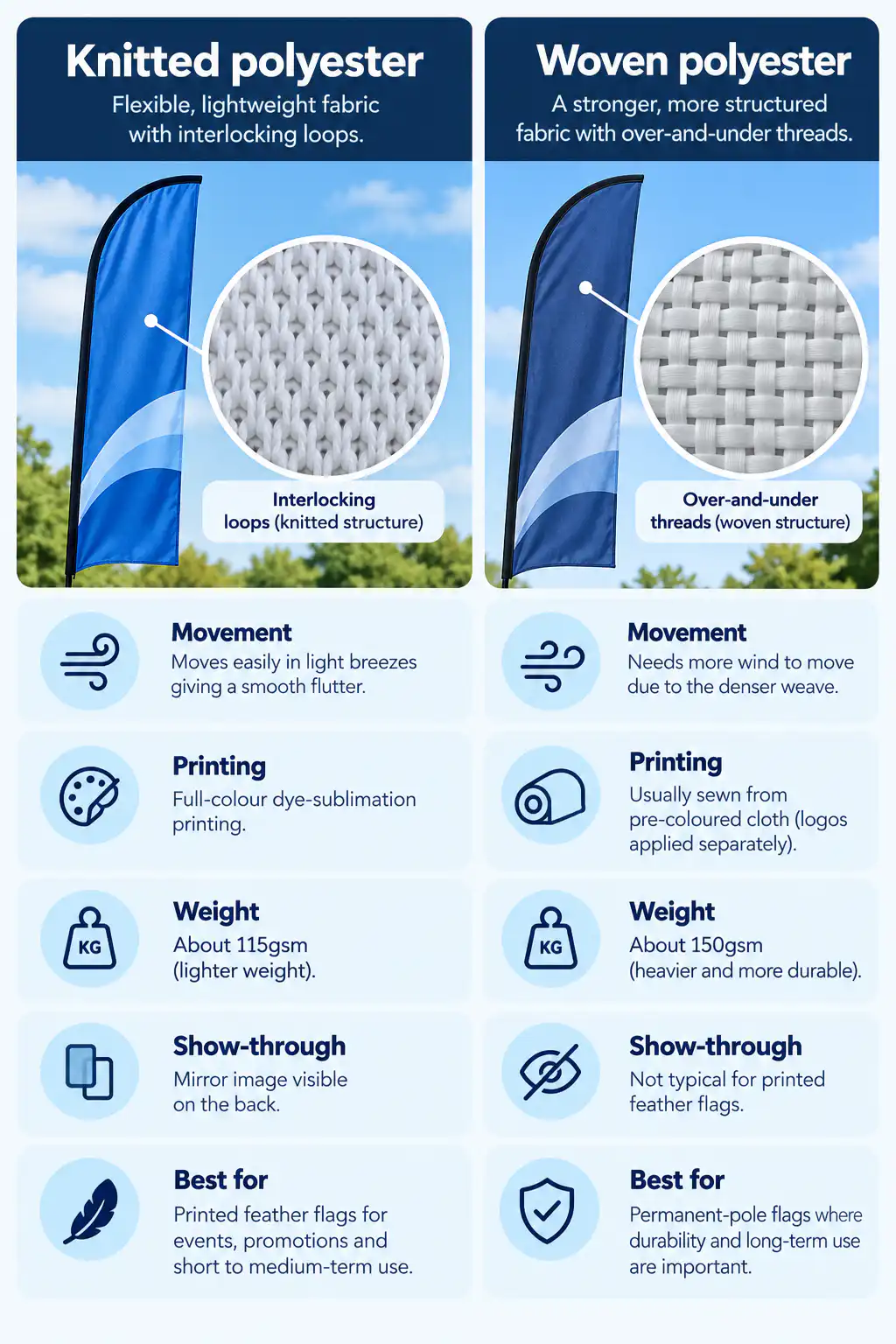
The short version: most printed feather flags are made from knitted polyester, and for good reason. It moves in light wind, takes dye-sublimation print beautifully and shows the design on the reverse. Woven polyester is the heavier, firmer, more traditional cloth, the kind you would expect on a flag flying from a permanent pole outside a town hall. It has its place. It just is not usually on a promotional feather flag.
This guide explains the difference in plain terms, where each fabric wins, and how to choose for your own site. Sailflags has been making flags in Cornwall since 1999, and everything below reflects how we print, sew and specify them today.
| The short answer: Knitted polyester: lighter and more flexible. It lifts in a gentle breeze and prints with a mirror image on the back. This is the standard cloth for printed feather flags. Ours is 115gsm and made from 100% recycled polyester. Woven polyester: denser and stiffer. It holds colour and shape well on flags that fly permanently, but it needs more wind to move and is not how printed feather flags are usually made. Exposed site, flag up most of the time? The answer is usually a tougher fabric such as our ToughTex heavy-duty option, rather than a conventional woven flag. |
What do “knitted” and “woven” actually mean?
Both fabrics start from the same raw material: polyester yarn, made from PET plastic. The difference is how that yarn is turned into cloth.
Woven fabric is made on a loom. Two sets of yarn cross at right angles, one running the length of the cloth and the other running across it, passing over and under each other in a regular pattern. Think of a tea towel or a basket. The result is tight and stable, with very little stretch.
Knitted fabric is made from a continuous yarn looped through itself, rather like a jumper, only much finer. Those loops can open and close slightly, so the cloth flexes in every direction and drapes more freely. It is also a more open structure, which matters a great deal once you start printing on it.
Weight is the other half of the story. It is measured in grams per square metre (gsm). Printed flag fabrics in the knitted family generally sit at around 110 to 117gsm, and our own feather flags are 115gsm. Woven flag cloth is usually heavier, commonly in the region of 145 to 155gsm. That is around a third more material in the same area, and you feel it in how the flag behaves.
Knitted vs woven polyester at a glance
| Knitted polyester | Woven polyester | |
|---|---|---|
| Structure | Looped yarn, flexible in all directions | Yarn interlaced at right angles, firm and stable |
| Typical weight | Around 110–117gsm (ours is 115gsm) | Often 145–155gsm |
| Movement in light wind | Responsive, flutters easily | Slower to lift, needs more wind to fly |
| Printing | Excellent for full-colour dye-sublimation, including photos and gradients | Traditionally pre-coloured and sewn, so less suited to detailed print |
| Reverse side (single layer) | Design shows through as a mirror image | Not typically how printed feather flags are made |
| Long-term UV and fray resistance | Good with care; ages faster if left up constantly | Generally stronger for permanent, year-round flying |
| Cost | Lower | Typically higher |
| Best for | Printed feather flags, events, shopfronts, exhibitions | Traditional flags on permanent poles, formal and ceremonial use |
How the two fabrics behave on a feather flag
Movement
A feather flag lives or dies on movement. The curved edge and tall, narrow shape are there to catch the eye, and a flag that hangs limp on a calm day is not doing its job. Knitted polyester is light enough to lift in a gentle breeze and to keep moving as the wind drops and rises again. Woven cloth, being heavier and stiffer, needs more wind to get going. On a sheltered high street that can mean a flag that spends half the day hanging against its pole.
Print quality and show-through
We print every flag using dye-sublimation. The design goes onto transfer paper first, then the paper is pressed against the fabric under heat, at which point the ink turns to gas and bonds with the polyester fibres. The colour becomes part of the cloth rather than a coating sitting on top of it, which is why it does not crack or peel.
That process suits a knitted base. Because the fabric is a single, open layer, colour passes through to the reverse and you see a mirror image of the design on the back. It is completely normal, and for a flag that faces one direction it is perfectly acceptable, although any text will read backwards from behind. If your design needs to read correctly from both sides, that is a job for a double-sided flag, which is built from two printed panels with a blockout liner sewn between them. Our single-sided vs double-sided guide walks through the choice.
Woven flags are made differently. The traditional method takes pre-coloured woven cloth and sews panels together to build the design. It gives a lovely, premium finish, but it is not practical for a detailed logo, a photograph or a gradient.
Wind and tear resistance
Neither fabric makes a flag wind-proof. A feather flag’s resilience comes from the whole system: pole, base, flag size and fabric. We cover that properly in our guide to feather flags for windy conditions. The short version is that fabric is one of four variables, and rarely the biggest one.
Within that, the two cloths tend to wear in different ways. A knitted flag flexes with a gust, and the damage usually shows up at the edge or the seam rather than as a sudden split across the cloth. Woven polyester is tighter and generally resists fraying along the fly edge, but it passes more load into the seams and the pole sleeve, and a tear that does start can run along the line of the yarn.
UV, colour and lifespan
Woven polyester has a reputation for holding its colour and shape over long periods, which is why it is the traditional choice for flags that fly every day on a permanent pole. Dye-sublimation prints on knitted polyester hold colour well too, because the dye sits inside the fibre, but UV damage is cumulative whatever the cloth.
A flag left outside around the clock will age faster than one that comes in at night, and that difference in habit is usually bigger than the difference between the two fabrics. Our flag care page puts it simply: bring flags in each day and rest them gently on a flat surface.
Weight, cost and what it does to your pole
Heavier fabric costs more to make, and it adds weight at the very top of a flexible pole, which is the worst place for it. A feather flag pole is designed to bend. Hang a heavier flag from it and you increase the leverage on the base, especially on a taller flag. It is one reason we point anyone ordering a heavier or double-sided flag towards a sturdier base. Our poles, bases and hardware guide covers which base suits which surface.
Why we print feather flags on knitted fpolyester
Our standard printed feather flags use 115gsm knitted polyester. That is not a cost-cutting choice. It is the cloth that lets a feather flag do what it is built for: move, print vividly and stay light on the pole.
Since 2022 every flag and banner fabric we use has been made from 100% recycled post-consumer PET, with up to 60% of that recycled content sourced through the SEAQUAL® Initiative, which funds beach clean-ups. The fabric carries Global Recycled Standard certification, plus Ökotex Class I and II and REACH compliance. The detail is in our eco-friendly feather flags guide, so we will not repeat it here. The point worth taking away is that “knitted” and “recycled” are not alternatives. Ours is both.
Flags are printed, sewn and checked in our own Cornwall factory, and every order includes a free design proof before anything goes to print. Your artwork gets a second pair of eyes first, which matters more than most people expect when a logo is going to be seen from thirty metres away.
When woven is the right choice
Woven polyester earns its place in a different kind of flag. If you are flying a national, county or organisational flag from a permanent pole, day in and day out, a sewn flag made from woven cloth is the traditional answer. Our traditional flags range is the place to start, and the team can tell you which fabric suits that job.
For a promotional feather flag, though, woven is usually the wrong tool. The format wants movement, the pole is flexible, and the artwork is normally a full-colour logo that needs printing. Putting heavy woven cloth on a feather pole gives you a flag that moves less, loads the base more and costs more.
What if my site is genuinely tough?
This is the moment people reach for the words “heavy duty”. The answer is usually not a conventional woven flag but a tougher fabric made for the purpose. ToughTex is our exclusive heavy-duty flag and banner fabric. It uses a unique weave, and we designed it for coastal sites, forecourts and anywhere a flag is outside most of the time. It is built to last up to twice as long as standard flag fabric in those conditions.
ToughTex is available on request across our feather flag sizes. For the construction details, the ToughTex technical data sheet is the place to look, and our ToughTex introduction explains where it fits.
Which fabric for which location?
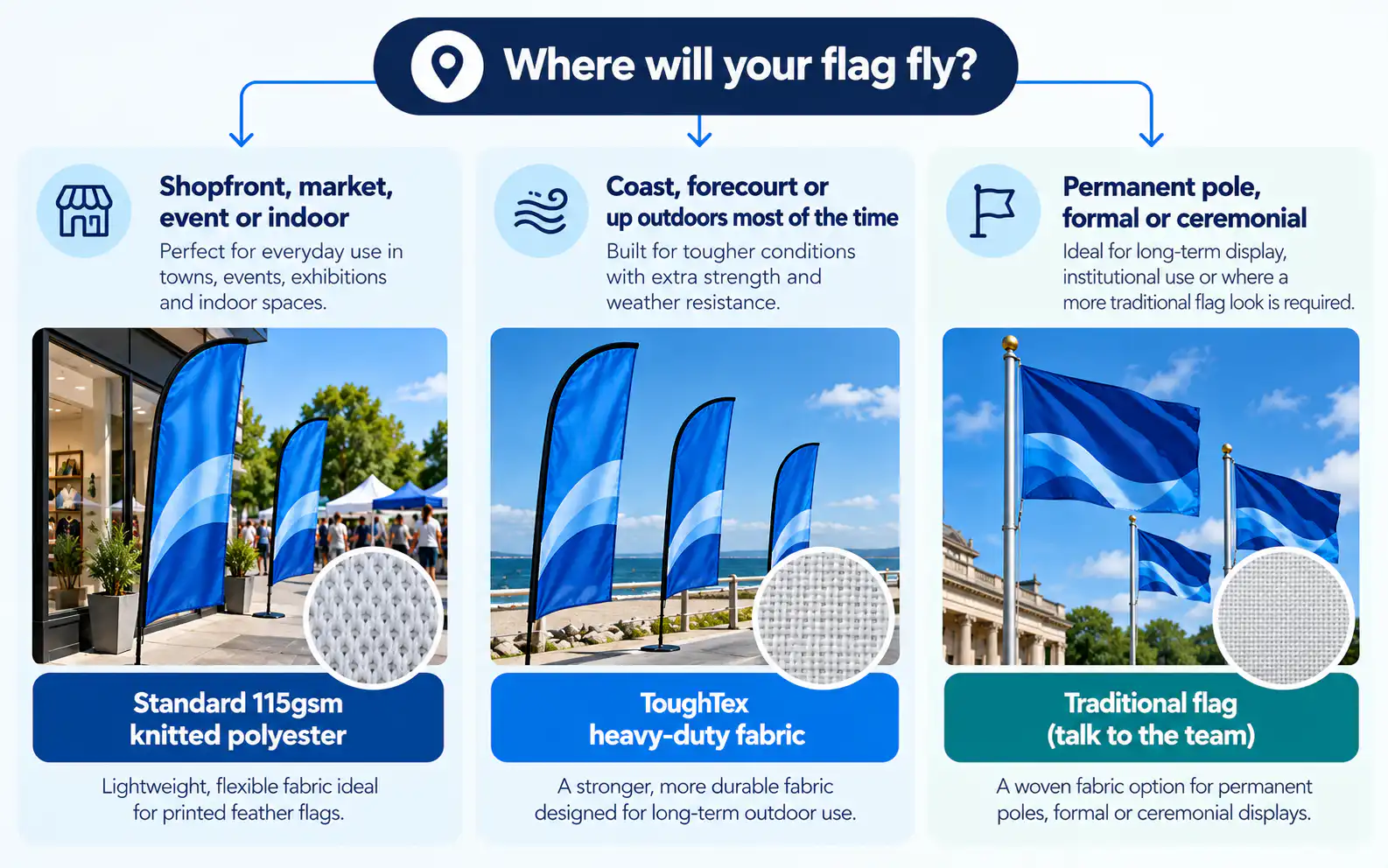
| Location | What it faces | Fabric to ask for |
|---|---|---|
| High street shopfront, taken in at close | Daily set-up, sheltered to moderate wind | Standard knitted polyester |
| Markets, fetes, festivals and one-off events | Occasional use, changeable weather | Standard knitted polyester |
| Indoor exhibition or showroom | No weather, some foot traffic | Standard knitted polyester |
| Coastal seafront, marina or beach bar | Salt, strong UV and persistent wind | ToughTex heavy-duty fabric |
| Forecourt or car dealership | Outdoors all day, gusts from passing traffic | ToughTex heavy-duty fabric |
| Permanent pole, formal or ceremonial | Flown daily for months at a time | A traditional flag; ask us about the fabric |
Fabric is only part of the specification. Size matters too, so have a look at our feather flag sizes guide before you settle on a height.
Does fabric change the base you need?
It can. A double-sided flag adds a second printed panel and a blockout liner, which makes it noticeably heavier than a single-sided flag of the same size. A heavier flag generates more load on the pole and the base, so the base should step up a tier. The same logic applies to a heavy-duty fabric on a tall flag. Treat fabric, size and base as one decision, not three separate ones.
Making either fabric last
Whichever cloth you choose, the habits below do more for its lifespan than almost anything you can specify at the order stage.
- Bring the flag in each day and rest it on a flat surface. This is the single biggest factor in how long a flag lasts.
- Take it down in rough weather. The Met Office describes a “fresh breeze”, Force 5 on the Beaufort scale, as 17 to 21 knots, roughly 20 to 24 mph. That is where a flag needs real attention, and sooner on exposed ground. Our windy-conditions guide has the full breakdown.
- Let a wet flag dry fully before it goes back in its bag. Damp fabric stored tightly is how mildew starts.
- Let the pole turn freely in the base or on the ground spike. Trying to stop it moving puts the strain somewhere it should not be.
- Check edges and seams regularly. Our care page notes that repairs to flag material and stitching are free of charge, and catching a small fray early keeps it small.
- Replace the fabric, not the whole kit. The pole and base usually outlast several flags, and our replacement parts guide explains what to buy.
Common mistakes when choosing feather flag fabric
- Assuming heavier is always better. A heavier cloth moves less, costs more and puts more load on the pole. It helps where exposure demands it and hinders where it does not.
- Choosing on fabric alone. A good cloth on an undersized base will still end up on the pavement. Pole, base and flag size matter just as much.
- Paying for heavy-duty on a flag that only comes out for events. If it is up for a weekend at a time and stored dry, standard knitted polyester is usually the sensible choice.
- Expecting a single-sided print to read correctly from behind. It will not, because it is a mirror image. If text on the reverse matters, order double-sided.
- Comparing prices without comparing the fabric. Weight, print method and recycled content all affect cost and lifespan. A cheaper flag that needs replacing each season is the more expensive one.
Frequently asked questions
What fabric are feather flags made from?
Most feather flags are made from polyester, and most printed ones use knitted polyester. Ours is 115gsm knitted polyester made from 100% recycled post-consumer PET, printed with dye-sublimation in our Cornwall factory.
Is knitted polyester good enough for outdoor use?
Yes, for the great majority of outdoor uses. It copes well with regular outdoor display when it is brought in each day and kept out of rough weather. For sites where a flag is outside most of the time, such as the coast or a forecourt, a heavy-duty fabric is the better investment.
Is woven polyester better for feather flags?
Not usually. Woven polyester is tougher over long periods, but it is heavier, moves less and is not well suited to detailed printing. Those trade-offs make sense for a flag on a permanent pole and rarely make sense for a promotional feather flag.
Why can I see my design on the back of a single-sided flag?
Because the ink passes through a single, open layer of knitted fabric during dye-sublimation, leaving a mirror image on the reverse. If you need the design to read correctly from both sides, choose a double-sided flag, which uses two printed panels with a blockout liner between them.
Does the fabric affect which pole and base I need?
It can. Heavier fabric, double-sided construction and taller flags all increase the load on the base. Match the base to the surface and step up a tier if the flag is heavy, tall or exposed.
Can I get a heavy-duty feather flag?
Yes. ToughTex, our exclusive heavy-duty fabric, is available on request across our feather flag sizes. Get in touch with the team and tell us where the flag will be flying, and we will recommend what suits the site.
Are your feather flags made from recycled polyester?
Yes. Since 2022, all of our flag and banner fabrics have been made from 100% recycled post-consumer PET, including material recovered through the SEAQUAL® Initiative.
The bottom line
For nearly every promotional feather flag, knitted polyester is the right cloth. It moves, it prints brilliantly and it keeps the weight off the pole. Woven polyester is excellent at its own job, which is flying a sewn flag from a permanent pole, and it is a poor fit for a feather flag that needs to catch the eye on a changeable day. If your site is truly harsh, specify a tougher fabric designed for it rather than reaching for a conventional woven one.
If you are still weighing it up, the quickest route is to tell us where the flag will fly. Sailflags is an employee-owned business, rated 4.9 on Trustpilot from over 1,200 reviews, and the person who answers the phone can talk fabric all day. You can get a free quote, start designing in our online flag creator, or call us on 01736 719111. Take a look at our full range of custom feather flags when you are ready.