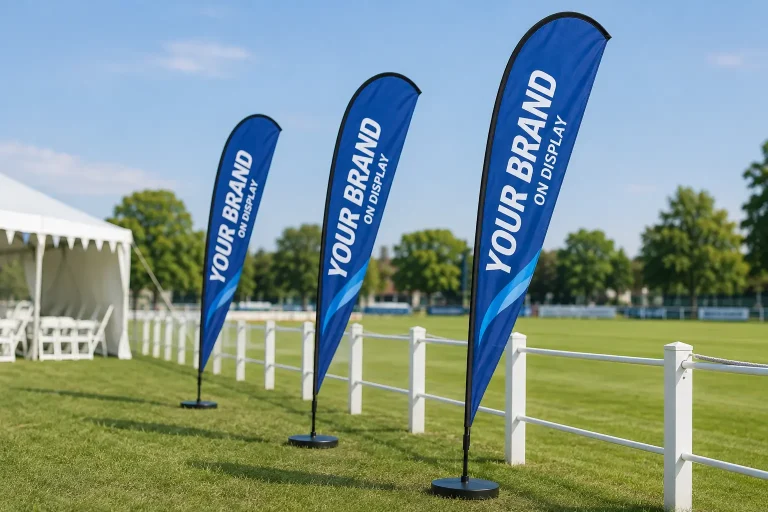


A feather flag looks spectacular in a gentle breeze. In a gusty British coastal wind or a blustery open-field festival, it can topple, wrap around its pole, or shed years of lifespan in a single bad weekend. The difference between a flag that performs reliably in high-wind conditions and one that does not comes down to four variables: fabric weight, pole material, base ballast, and flag size.
This guide explains each variable, how they interact, and what to specify when ordering feather flags for exposed or consistently windy locations — from coastal businesses and motorway forecourts to open festival fields and elevated rural sites. It also covers what happens at each Beaufort scale wind level and when flags should come in for safety.
1. How Feather Flags Interact With Wind
A feather flag works with the wind, not against it. Unlike a rigid sign that takes wind load full-on, a feather flag is designed to flex, rotate, and move continuously. This dynamic response is precisely what makes it effective at attracting attention — the movement catches the eye far more readily than a static display.
But that same dynamic response creates mechanical stress that accumulates over time. Every flex of the pole transfers force to the flag fabric at the pole pocket seam. Every rotation transfers torque to the base socket. In moderate conditions, these stresses are well within the design tolerances of a quality flag system. In sustained high winds — or in conditions that regularly exceed 20–25 mph — the accumulated mechanical stress determines which components fail first and how soon.
The goal of a high-wind flag specification is not to make the flag rigid — that would increase force and accelerate failure. It is to ensure every component is rated for the forces generated at your specific site, so that the flag continues to perform and remain safe across the full operational season.
2. The Four Variables That Determine Wind Performance
2a. Fabric Weight and Weave
Flag fabric is measured in grams per square metre (GSM). The relationship between GSM and wind performance is not simply ‘heavier is better’ — it is more nuanced:
- Too light (under 90gsm): flag tears more readily at pole pocket stress points, shows more transparency, and degrades faster under UV and salt exposure.
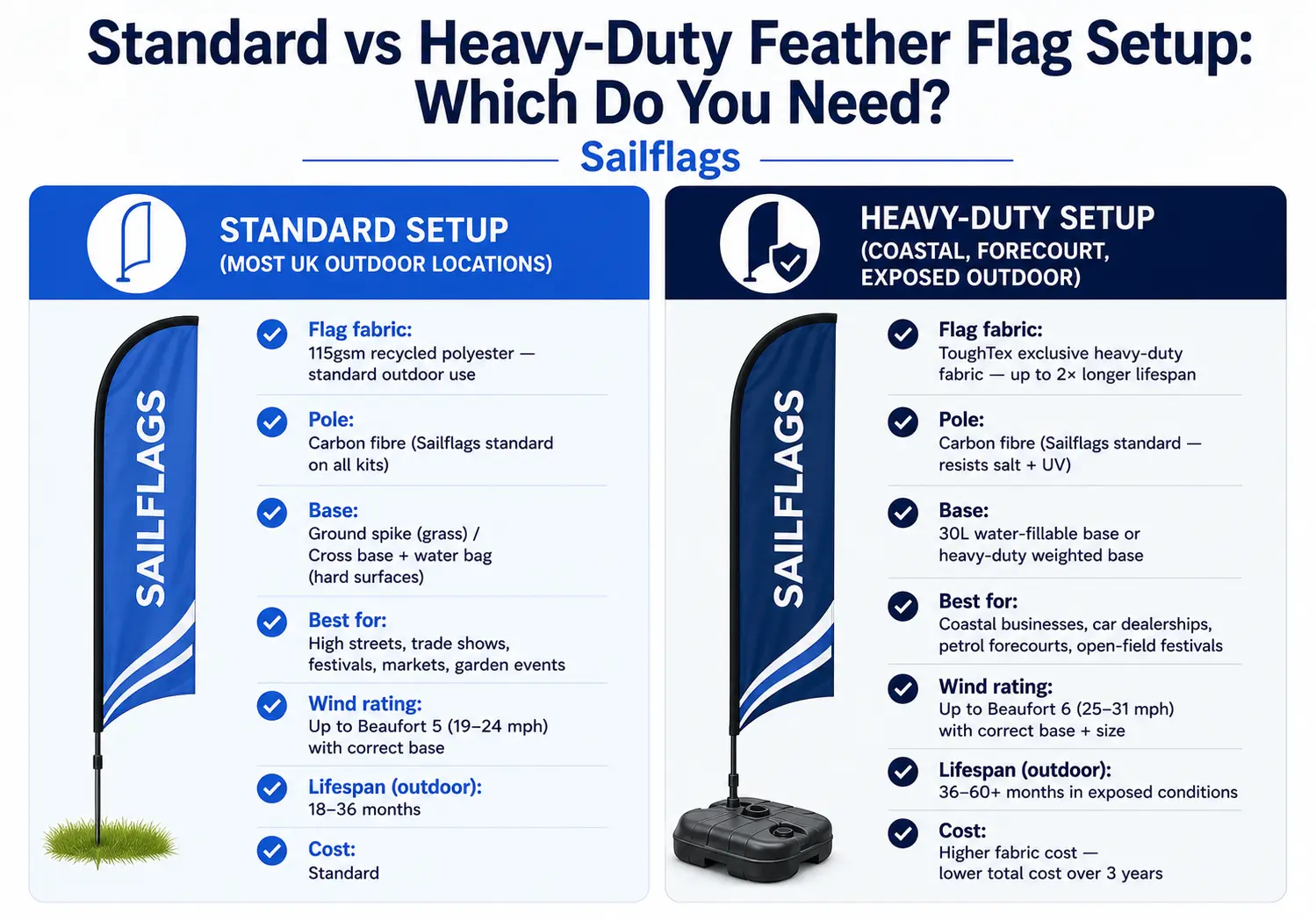
- Standard (115gsm knitted polyester): the industry standard. Light enough to move freely in a gentle breeze, dense enough to hold colour and resist fraying under regular outdoor use. Rated for sustained outdoor use in most UK conditions.
- Heavy-duty (ToughTex — higher GSM, tighter weave): Sailflags’ proprietary heavy-duty fabric. Uses a unique weave construction that provides greater tear resistance, higher UV stability, and better salt-air performance than standard polyester. Lasts up to twice as long as standard fabric in exposed conditions.
The weave construction matters as much as the GSM. A tighter, more structured weave distributes stress more evenly across the fabric, preventing the localised stress concentration at seams and corners that leads to tearing. ToughTex is engineered specifically for this: higher tear resistance and tensile strength without adding weight that would reduce the flag’s movement in light winds.
2b. Pole Material and Flex Characteristics
The pole’s role in high-wind conditions is to flex controllably rather than transfer force rigidly. A pole that does not flex transmits wind load directly to the base socket and the flag fabric attachment points — accelerating failure at both. A pole that flexes too freely provides no structural support and allows the flag to collapse around itself.
Three materials are used for feather flag poles:
- Aluminium: lightweight and inexpensive, but the most rigid of the three. Does not flex well, transmitting high wind loads directly to the flag fabric and base. Suitable for light indoor or sheltered outdoor use only.
- Fibreglass: flexible and corrosion-resistant. The minimum specification for outdoor flag use. Flexes controllably in wind, reducing stress at attachment points. Degrades under sustained UV and salt air over 1–3 years — yellowing and becoming brittle.
- Carbon fibre: the strongest, lightest, and most flexible of the three. Flexes further than fibreglass without snapping, resists UV degradation and salt corrosion, and weighs less. The correct specification for any exposed outdoor or coastal installation. Sailflags uses carbon fibre poles across its full feather flag range.
2c. Base Type and Ballast
In wind, the base is the most critical component. A flag system that is perfectly specified for the wind load generated by the fabric and pole becomes a tipping hazard the moment the base cannot provide adequate counter-force. The base must be matched to both the surface type and the wind load generated by the flag size and site exposure.
See the full surface-by-surface base guide in the feather flag bases and hardware blog. The key principle for windy conditions is: upgrade the base one tier beyond what you would use in calm conditions. A cross base with a water bag that works on a calm shopfront becomes inadequate for a 3.2m flag on a coastal forecourt.
2d. Flag Size and Wind Load
Wind load increases with the square of wind speed and in proportion to the surface area of the flag. A 4.2m flag in a 25 mph wind generates roughly 75% more wind load than a 3.2m flag in the same conditions. This relationship is non-linear — doubling flag height dramatically increases the force the base and pole must manage.
In consistently windy locations, size down the flag relative to what you would use in a sheltered environment. A 3.2m flag performing excellently on a wind-exposed forecourt is doing the same branding job as a 4.2m flag on a sheltered high street — at significantly lower wind load and with a longer lifespan.
3. Fabric Comparison: Standard 115gsm vs ToughTex
| Property | Standard 115gsm polyester | ToughTex heavy-duty |
| Weight / construction | 115gsm knitted polyester | Higher GSM, unique tight weave |
| Tear resistance | Good for standard outdoor use | Significantly higher — reinforced weave |
| UV resistance | Good — colour stable for 18–36 months | Superior — engineered for high UV exposure |
| Salt air / coastal | Adequate for moderate exposure | Specifically engineered for coastal use |
| Lifespan (exposed outdoor) | 18–36 months regular outdoor | 36–60+ months — up to 2× longer |
| Movement in light wind | Excellent — very responsive | Good — slightly heavier, still moves well |
| Best for | Most outdoor applications | Coastal, forecourt, permanent outdoor, high-wind |
| Cost premium | Standard | Higher — worth it for long-term outdoor |
For the majority of UK businesses using flags at outdoor events, markets, or for seasonal shopfront display, standard 115gsm is the right specification. It performs well in typical UK outdoor conditions, including moderate wind and rain, for 18–36 months with correct storage.
For businesses displaying flags continuously outdoors — a petrol station forecourt, a coastal hospitality venue, a car dealership on a busy A-road — ToughTex is the economically correct choice. The per-unit cost premium over standard fabric is modest; the lifespan extension in high-exposure conditions means the total cost over three years is significantly lower.
| ToughTex real-world applications Coastal businesses (seafronts, marinas, beach bars): year-round salt air and wind exposure — ToughTex is the only viable long-term option. Car dealerships and petrol forecourts: permanent outdoor display, constant road-spray and UV. Festival and event operators with semi-permanent displays. Anywhere the flag will be outside most or all of the time. |
4. Pole Comparison: Aluminium vs Fibreglass vs Carbon Fibre
| Property | Aluminium | Fibreglass | Carbon fibre |
| Flex in wind | Low — rigid | Good | Excellent |
| Weight | Light | Light | Lightest |
| UV resistance | Good | Degrades — yellows in 1–3yrs | Excellent |
| Salt/coastal | Moderate | Good — but brittle with age | Excellent |
| Snap risk in gusts | Higher — rigid | Low | Lowest |
| Lifespan (outdoor) | 3–5 yrs | 3–5 yrs (less coastal) | 7–12 yrs |
| Recommended for | Indoor / light use | General outdoor | All exposed outdoor |
| Sailflags standard? | No | No | Yes — all kits |
Sailflags uses carbon fibre poles as standard across the full feather flag range. This is not a premium upgrade option — it is the default specification. The reasoning is straightforward: carbon fibre is lighter than aluminium, more flexible than fibreglass, resists UV and salt degradation, and lasts significantly longer in exposed conditions. For a manufacturer focused on long-term outdoor performance, it is the only defensible pole material.
5. Base Selection for Windy Conditions
The base selection for windy conditions follows the same surface-by-surface logic as normal flag deployment, with one universal principle added: in wind, always use one base tier heavier than you think you need.
| Surface | Calm conditions | Windy / exposed | High wind (25mph+) |
| Grass / firm soil | Ground spike | Longer/wider spike or 30L water base | 30L water base + ToughTex |
| Sand / beach | Sand screw anchor | 30L water base (flat area) | 30L water base mandatory |
| Tarmac / concrete | Cross base + 15L bag | 30L water-fillable base | Heavy-duty weighted base |
| Car forecourt | Drive-over base | Drive-over base (always adequate) | Drive-over base — most stable |
| Coastal exposure | 30L water base min. | Heavy-duty weighted base | Heavy-duty + size down the flag |
For the most exposed sites — coastal, elevated, motorway-adjacent — the 30L heavy-duty water-weighted base provides 30kg of ballast on any hard surface without requiring any ground fixing. On tarmac or concrete at particularly exposed coastal sites, the heavy-duty weighted metal base provides even greater stability, particularly for larger flags.
| Ballast check tip Water evaporates. A 30L water base left outside in warm weather loses water to evaporation and condensation cycling — particularly overnight. Check the water level each morning before the flag goes up. A base that was full yesterday may be 20% lighter today (especially if a fill cap is left removed). A lighter base tips earlier in wind. |
6. Flag Size and Wind Load
The wind load a feather flag generates increases significantly with height. Here is the practical relationship, using a 3.2m Standard as the baseline:
| Flag size | Approx. fabric area | Relative wind load (at same wind speed) | Minimum base for exposed outdoor |
| 1.7m | 0.53 m² | 35% of 3.2m | Cross base + water bag |
| 2.4m | 0.93 m² | 62% of 3.2m | Cross base + full water bag |
| 3.2m | 1.20 m² | Baseline | 30L water-fillable base |
| 4.2m | 2.02 m² | 168% of 3.2m | Heavy-duty weighted base |
| 5.2m | 2.98 m² | 248% of 3.2m | Heavy-duty base only |
The implication is clear: a 5.2m flag generates over twice the wind load of a 3.2m flag. In exposed conditions, choosing the 3.2m over the 4.2m is not a compromise on visibility — it is a rational engineering decision that extends flag life, reduces base requirements, and eliminates the safety risk of a tipping large-format flag.
For guidance on which size is appropriate for your location and audience distance, see the complete feather flag sizes guide.
7. High-Wind Locations: Specific Setups
Coastal and Seafront Businesses
Coastal locations present the most demanding combination of conditions for feather flags: persistent wind, salt-laden air, high UV intensity, and often soft or sandy ground. The full coastal specification is:
- ToughTex fabric — standard polyester degrades significantly faster in salt air due to the hygroscopic action of salt on the polyester fibres and UV amplification over water.
- Carbon fibre pole (Sailflags standard) — resists salt corrosion and UV yellowing that fibreglass suffers after 12–18 months of coastal exposure.
- 30L water-fillable or heavy-duty weighted base — ground spikes are unsuitable for coastal promenade tarmac or decking; cross bases must be fully ballasted.
- 3.2m flag maximum at genuinely exposed seafront positions in persistent wind. If 4.2m visibility is needed, use ToughTex and a heavy-duty base.
- Daily fresh-water rinse on the pole sections after use — salt accumulation at the pole joints accelerates joint degradation. Rinse and dry before storage.
Car Dealership and Petrol Station Forecourts
Forecourts present two specific challenges: the turbulence created by passing traffic at speed, and the near-continuous outdoor exposure with no rest periods between uses. Traffic turbulence is characterised by sharp gusts from a variable direction as vehicles pass — different in character from a steady coastal wind but equally demanding on the flag system.
- ToughTex fabric for semi-permanent forecourt flags — the near-continuous outdoor deployment means standard fabric reaches end-of-life significantly faster than for flags used seasonally.
- Drive-over base for forecourt positions — the most stable base available on tarmac, completely immune to ballast evaporation, and requires no maintenance.
- 4.2m or 5.2m flags are common on forecourts for maximum road visibility. At these heights, the heavy-duty base is not optional — it is mandatory.
- Carbon fibre pole (standard in Sailflags kits) handles traffic turbulence significantly better than aluminium, which can develop hairline cracks under repeated directional load changes.
Open Festival Fields and Event Sites
Festival fields differ from coastal and forecourt conditions in one important way: the wind is usually variable in direction rather than consistent. Flags at an exposed festival site may be hit from the side, from behind, and from multiple angles within a single afternoon as weather systems pass. The flag system needs to be omnidirectional in its wind resistance.
- Use 4.2m or 5.2m flags for reliable visibility above crowd head height in open, crowded environments.
- Use ground spikes on firm grass, but upgrade to 30L water-fillable bases on heavily trafficked, churned, or loose ground, particularly for multi-day events.
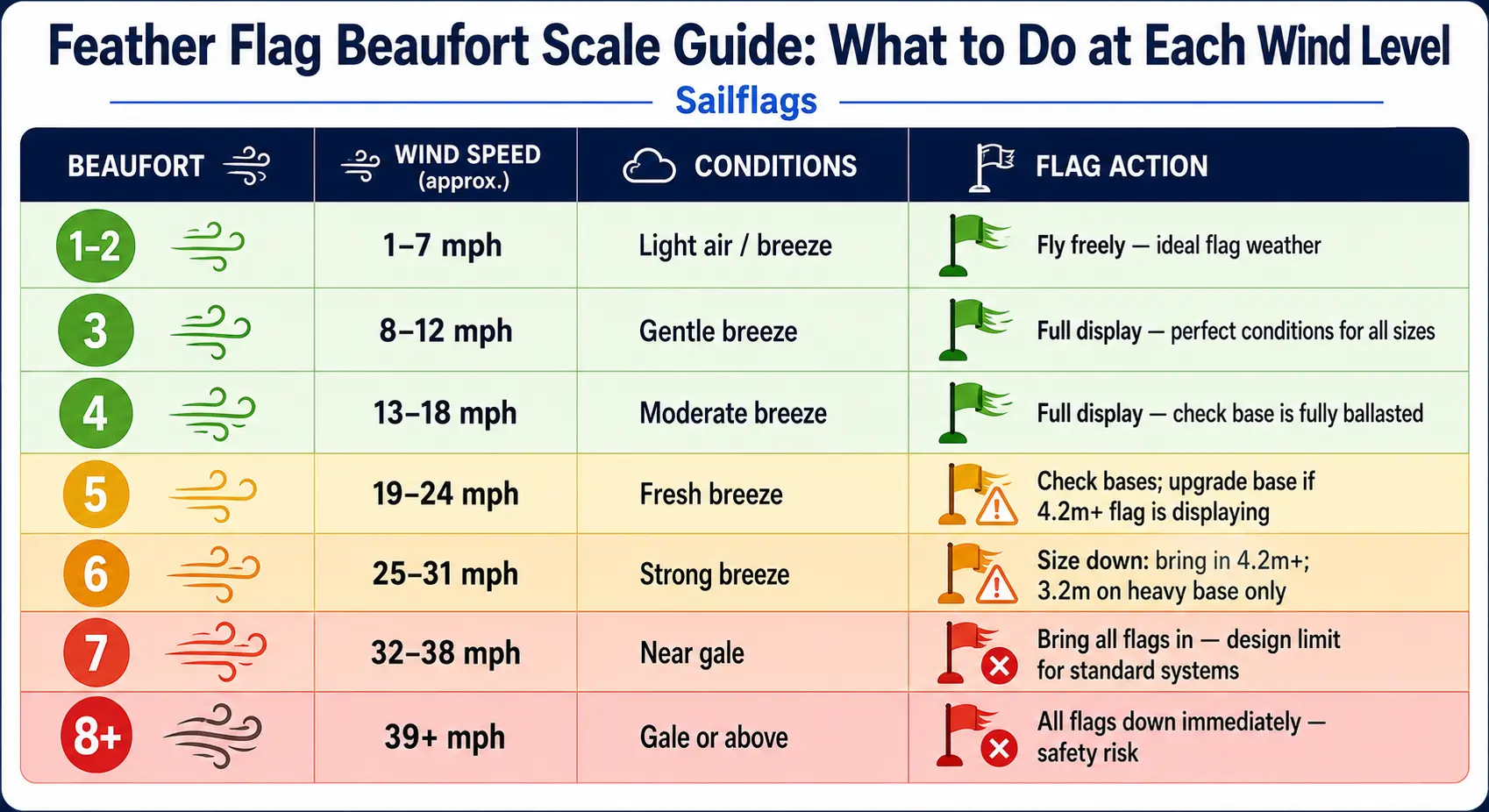
- In sustained Beaufort 6 (25–31 mph) or above, bring 4.2m and 5.2m flags in. Continue displaying 3.2m flags on 30L bases if conditions allow. See the outdoor event setup guide for the full festival flag setup protocol.
8. Beaufort Scale Reference: What to Do at Each Wind Level
| Beaufort | Speed | Description | Standard flags | ToughTex / exposed |
| 1–2 | 1–7 mph | Light air/breeze | Fly freely — ideal | Fly freely |
| 3 | 8–12 mph | Gentle breeze | Full display — best conditions | Full display |
| 4 | 13–18 mph | Moderate breeze | Full display — monitor bases | Full display |
| 5 | 19–24 mph | Fresh breeze | Check bases; 4.2m+ needs heavy base | Full display with correct base |
| 6 | 25–31 mph | Strong breeze | Size down or bring in 4.2m+. 3.2m: heavy base | Monitor — ToughTex handles this well |
| 7 | 32–38 mph | Near gale | Bring all flags in | Bring in 4.2m+; 3.2m on heavy base only |
| 8+ | 39+ mph | Gale | All flags down — safety risk | All flags down |
| Met Office wind warnings and flagsThe UK Met Office issues wind warnings at Yellow, Amber, and Red levels. At a Yellow wind warning, reduce flag height or bring larger flags in and assess conditions. At Amber, all flags should come down regardless of base type. At Red, no outdoor flags of any type should be displayed. |
9. Design Choices That Affect Wind Performance
The physical specification of the flag system is the primary wind performance variable — but two design choices also affect how a flag handles high-wind conditions:
Single-Sided vs Double-Sided
As covered in the single-sided vs double-sided guide, a double-sided flag uses a three-layer construction (two printed panels plus a blockout liner) and is approximately 40–60% heavier than a single-sided flag of the same size. In high-wind conditions, this additional weight means a double-sided flag generates more wind load and puts greater stress on the base. For exposed outdoor locations where wind is a primary concern, single-sided is the lower-risk specification unless two-directional display is genuinely required.
Flag Size Relative to Environment
A flag that is proportionally too large for its environment does not just look wrong — it generates more wind load than the base and pole can safely manage in gusts. The most common cause of flag failures in wind is not inadequate hardware specification, but inadequate hardware specification for the flag size chosen. Review the size and base combination together, not independently.
Colour and Pattern
High-contrast designs — particularly full-coverage dark backgrounds — appear to stretch more in wind due to the visual effect of a flat dark surface moving against a light sky. This is perceptual rather than physical, but it is worth noting for clients who interpret flag movement as structural stress: a vibrant full-coverage flag in heavy wind is not necessarily close to failure, even if it looks dramatic.
10. When to Bring Flags In: Safety Guidance
A feather flag that falls onto a pedestrian or vehicle is a liability issue, not just a product failure. The HSE considers winds above 23 mph (Beaufort 5) sufficient to affect the stability of temporary structures in public areas. The following thresholds apply:
- Beaufort 6 (25–31 mph): larger flags (4.2m and above) should be reduced in height or brought in. 3.2m flags on adequate bases can remain up with monitoring.
- Beaufort 7 (32–38 mph): all flags should be taken down or secured. No standard feather flag system — regardless of specification — is designed for sustained operation at this wind speed.
- Met Office Amber/Red wind warning: all flags down. Do not rely on visual assessment of conditions — if a warning has been issued for your region, bring flags in before the forecast conditions arrive.
- Unattended flags: never leave flags unattended overnight at an exposed site without monitoring. UK overnight wind peaks regularly exceed daytime readings, particularly at coastal and elevated locations. If you cannot monitor the flags, they should come down at the end of the event day.
11. Care and Maintenance for Long-Term Wind Resistance
The right maintenance practices extend the wind resistance of a flag system significantly by preventing the degradation that leads to failure under load.
Fabric
- Regularly inspect the flag fabric for small tears or snagging, especially at pole pocket stress points; repair immediately to prevent spreading.
- After exposure to salt air or rain, rinse with fresh water and allow to dry completely before storing to prevent mildew.
- Avoid folding or creasing for long periods; hang or roll loosely in a dry place.
Pole
- Rinse with fresh water after coastal use to prevent salt buildup and joint corrosion.
- Periodically check all joint connections to ensure they seat firmly and are free of grit.
- Store clean and dry in the provided carry bag when not in use to avoid damage.
Base
- Regularly inspect bases and ballast components for cracks, leaks, or signs of wear, and ensure they are clean and dry before storage.
- Never store fillable bases with water in cold weather — frozen water expands and cracks the reservoir. Full maintenance guidance is in the replacement parts guide.
12. Frequently Asked Questions
Are feather flags wind resistant?
Yes — feather flags are specifically designed to work in wind. Unlike rigid signage, they flex and move with gusts rather than resisting them, which significantly reduces the peak structural forces involved. Standard feather flag systems are rated for sustained winds up to approximately 35 mph (Beaufort 7). For sites with consistently higher wind exposure, a heavy-duty specification (ToughTex fabric, carbon fibre pole, heavy-duty base) extends the operational wind range and the product lifespan significantly.
Are feather or teardrop flags better in the wind?
For high-wind environments, feather flags generally perform better than teardrop flags. The feather flag’s open curved shape allows wind to move through and around the flag, creating movement rather than maximum resistance. Teardrop flags have a tensioned shape that holds its form in still air — this same tensioning makes them less forgiving in sustained strong wind, as the structure cannot flex as freely as a feather flag. For genuinely exposed outdoor locations in regularly windy UK conditions, a correctly specified feather flag on a carbon fibre pole and heavy-duty base is the more resilient choice.
What makes a feather flag heavy duty?
A heavy-duty feather flag specification combines: (a) ToughTex heavy-duty fabric with its unique high-resistance weave, (b) carbon fibre poles that flex without fatiguing, and (c) a base rated for the wind load generated by the flag size at the site’s typical wind speed. No single component makes a flag heavy-duty — it is the combination that determines overall performance.
How do I stop my feather flag from wrapping around the pole in wind?
A flag that consistently wraps around its pole is usually caused by one of two things: the wind direction is directly in line with the narrow edge of the flag (so the flag has nowhere to fly and wraps instead), or the base socket is not preventing the pole from rotating. Repositioning the base 45–90 degrees relative to the wind direction is the most effective fix. For bases with a rotating spigot, tighten the spigot or replace the base if the socket has become loose.
Can I use a standard feather flag at a coastal location?
Yes, with the caveat that standard 115gsm polyester will degrade faster in coastal conditions than in sheltered environments — expect 12–18 months of outdoor coastal use rather than the 18–36 months achievable inland. For any coastal installation that will be permanent or semi-permanent, ToughTex is the more economical choice over a 2–3 year period, because its extended lifespan more than offsets the price premium on the first order.
What is the best base for a windy beach location?
A 30L water-fillable base placed on a flat, firm area of the beach — avoiding loose dry sand where the base may sink unevenly. On genuinely loose sand, a wide-diameter sand screw anchor provides better ground purchase than a standard spike but should still be combined with a water-fillable base in high-wind conditions for maximum stability. Full guidance on beach setups is in the festival and outdoor event setup guide.
Specify for Your Site, Not the Average
The best feather flag for windy conditions is not simply the heaviest or the most expensive — it is the flag specified correctly for the wind loading generated by the combination of size, site exposure, and base surface at your specific location. A 3.2m flag on a 30L water base in ToughTex fabric at a coastal seafront business will outperform and outlast a 5.2m standard flag on an undersized cross base at the same site, every time.
The specification decision is straightforward once you know the four variables: fabric weight, pole material, base ballast, and flag size relative to wind load. Sailflags’ carbon fibre pole, 100% recycled polyester, and ToughTex heavy-duty fabric option address the first two variables as standard. The base and size decision depends on your specific site — and the team can advise before you order.
At Sailflags, every custom feather flag is made in Cornwall and dispatched with a carbon fibre pole and carry bag. ToughTex fabric is available on request across all flag sizes. The full range of bases and accessories — ground spikes, water-fillable bases, heavy-duty weighted bases, and drive-over options — is available to order alongside any flag.