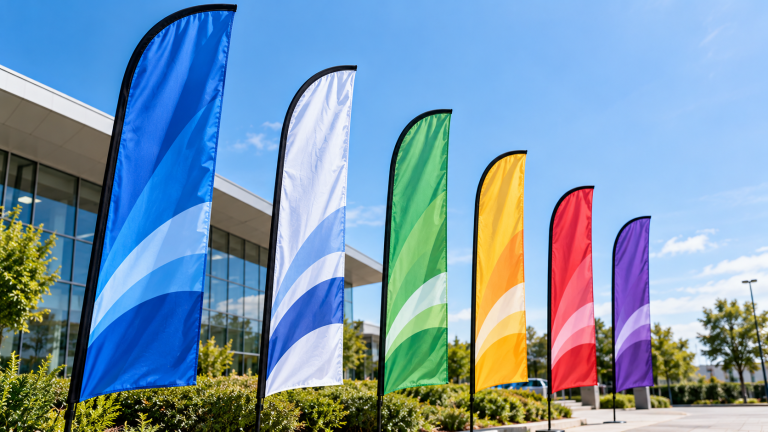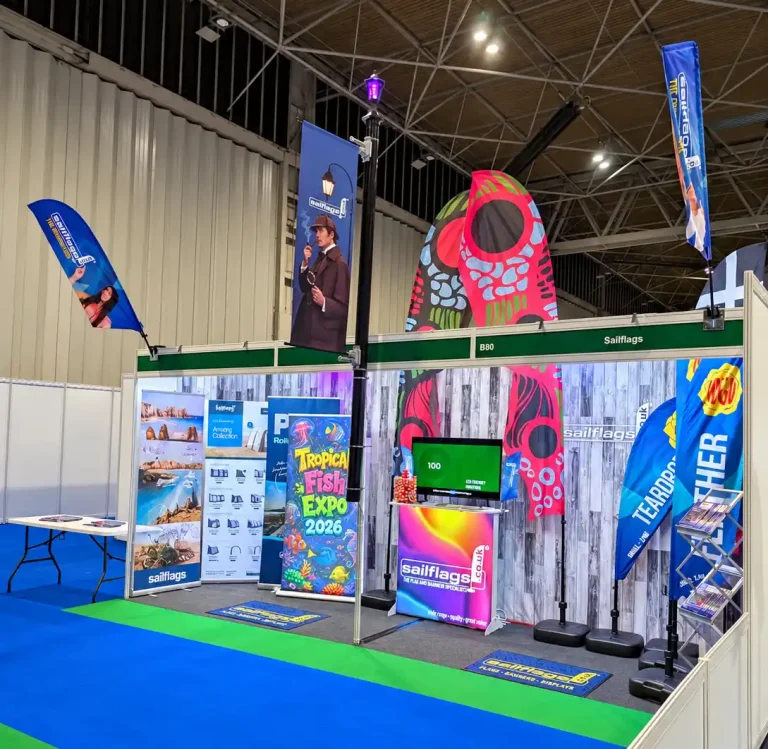


When you configure a custom feather flag order, one of the first choices you face is print type: standard (single-sided) or double-sided. It affects the price. It affects the weight. It affects what your flag looks like from the back. And it affects the base you should order.
Most buyers pick one without fully understanding what the difference means in practice. This guide explains exactly what each option involves — how the flag is physically constructed, what it looks like in use, which situations call for which option, and when the extra cost of double-sided is genuinely worth it.
1. What Single-Sided (Standard Print) Actually Means
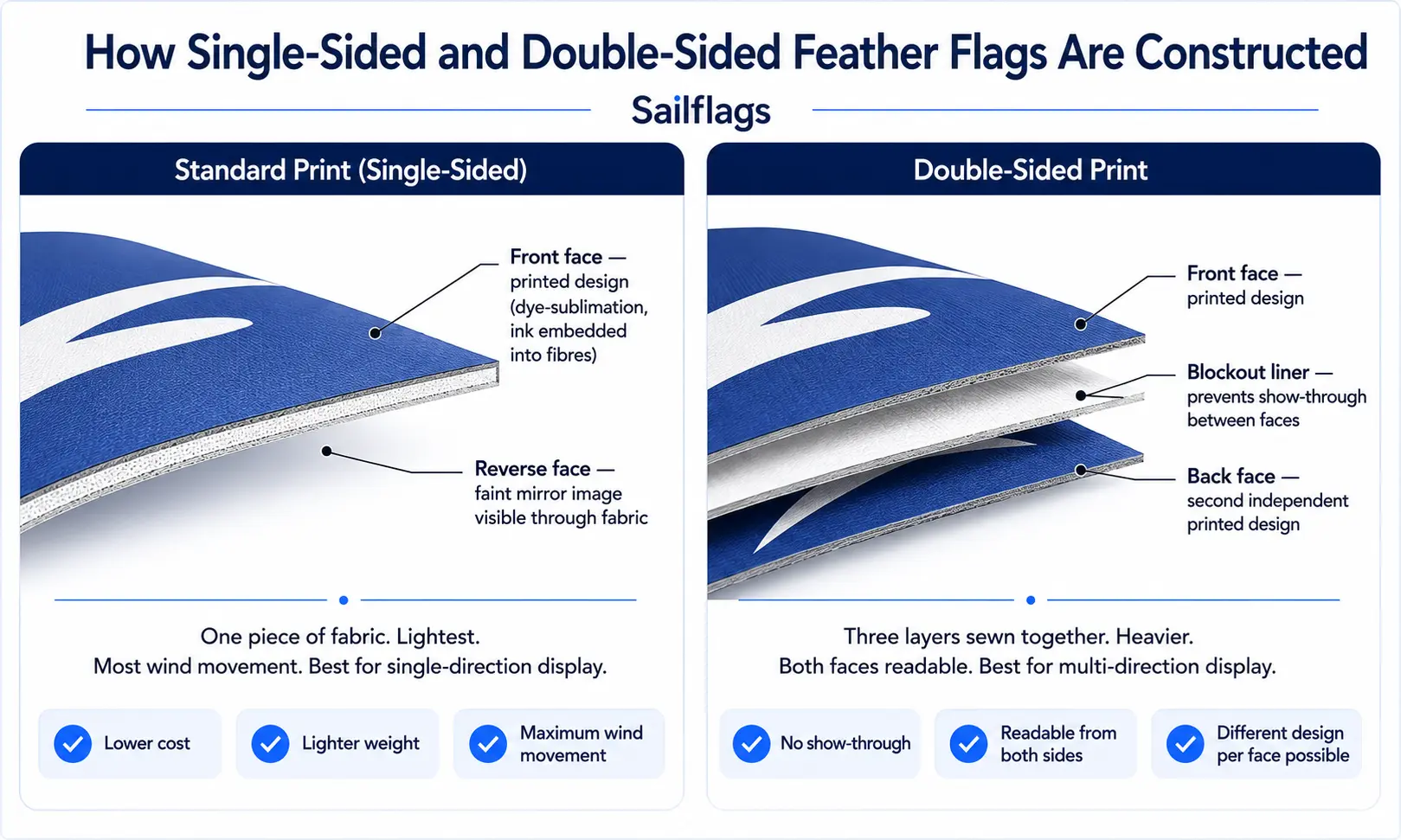
A single-sided feather flag is made from one piece of flag fabric. The design is printed on one face using dye-sublimation printing — a process where ink is heat-pressed into the polyester fibres at a molecular level, embedding the colour permanently into the material.
Because the ink penetrates the fabric rather than sitting on its surface, the design shows through to the reverse side as a faint mirror image. This is not a defect — it is a fundamental property of dye-sublimation on lightweight polyester, and it is completely normal.
What ‘Show-Through’ Looks Like in Practice
From the front, the flag looks exactly as designed: bold, vibrant, full-colour. From the back, the same design is visible but reversed — as if you are reading a printed page held up to the light. Text reads backwards on the reverse; logos appear mirrored.
The intensity of show-through depends on the design and the viewing conditions:
- Bold colours, simple graphics: show-through is faint and largely unnoticeable from a normal viewing distance.
- Dark backgrounds on white or pale fabric: show-through is more visible and may slightly reduce the apparent brightness of colours on the reverse.
- Backlit conditions (facing the sun, or a bright indoor light behind the flag): show-through is more pronounced. Colours may appear slightly washed out from behind.
- Text and detailed graphics: reversed text on the back is generally not a problem unless someone is actively reading the flag from behind, which is rarely the case in standard display positions.
| The single-sided flag in plain terms One piece of fabric. Print on one face. The reverse shows a faint mirror image of the design. Standard practice for the majority of outdoor feather flag applications. |
2. What Double-Sided Actually Means
A double-sided feather flag is an entirely different physical product. It is not a single-sided flag with better print quality — it is a three-layer construction manufactured from the ground up for two-sided display.
The Three-Layer Construction
Here is what you are actually buying when you order a double-sided flag:
- Layer 1 — Front flag panel: a full printed flag fabric with your front design.
- Layer 2 — Blockout liner: a specialist fabric interliner stitched between the two printed panels. This layer prevents any colour from showing through between the two faces, so neither side can ‘see’ the other’s print.
- Layer 3 — Back flag panel: a second full printed flag fabric with your back design (which can be identical to the front, or completely different).
All three layers are sewn together as a single unit. The flag poles through the sleeve as normal, and from the outside it looks like a standard flag. The difference is entirely in what you see from behind — instead of a mirrored show-through, you see a clean, correctly oriented version of your chosen back design, completely independent of the front.
| The double-sided flag in plain terms Three layers: front print + blockout liner + back print, sewn together. Both sides display the design correctly with no show-through. Higher cost, heavier weight, stronger base required. |
The Exclusive Blockout Liner at Sailflags
Sailflags uses an exclusive blockout interliner in its double-sided flags — developed in-house to optimise the balance between opacity (preventing show-through) and weight (keeping the flag light enough to move in the breeze). A heavier liner provides better blockout but reduces the flag’s movement; too light a liner and show-through remains visible in bright conditions. The Sailflags liner is engineered specifically for feather flag applications.
One important limitation to note: in very bright sunshine or when a strong light source is directly behind the flag, the white or very pale areas of both faces may show slightly through even a blockout liner, appearing as a very pale grey tint. This is inherent to any fabric-based blockout system and is visible only in extreme backlit conditions.
3. Single-Sided vs Double-Sided: Side by Side
| Single-Sided (Standard) | Double-Sided | |
| Construction | 1 layer of flag fabric | 3 layers: front print + blockout liner + back print |
| Reverse side | Mirror image of front (faint) | Correct orientation — independent design |
| Different design each side | Not possible | Yes — full flexibility per side |
| Weight | Lightest | Approximately 40–60% heavier |
| Wind movement | Maximum — moves freely | Slightly less movement due to added weight |
| Base requirement | Standard base for size | One grade heavier base recommended |
| Cost | Lower | Higher (approx. 20–40% premium) |
| Best for | Single-direction display | Multi-direction / high-footfall display |
| QR codes / fine text | Not recommended on reverse | Fully legible on both sides |
| Backlit conditions | Show-through more visible | Blockout liner reduces show-through |
4. When Single-Sided Is the Right Choice
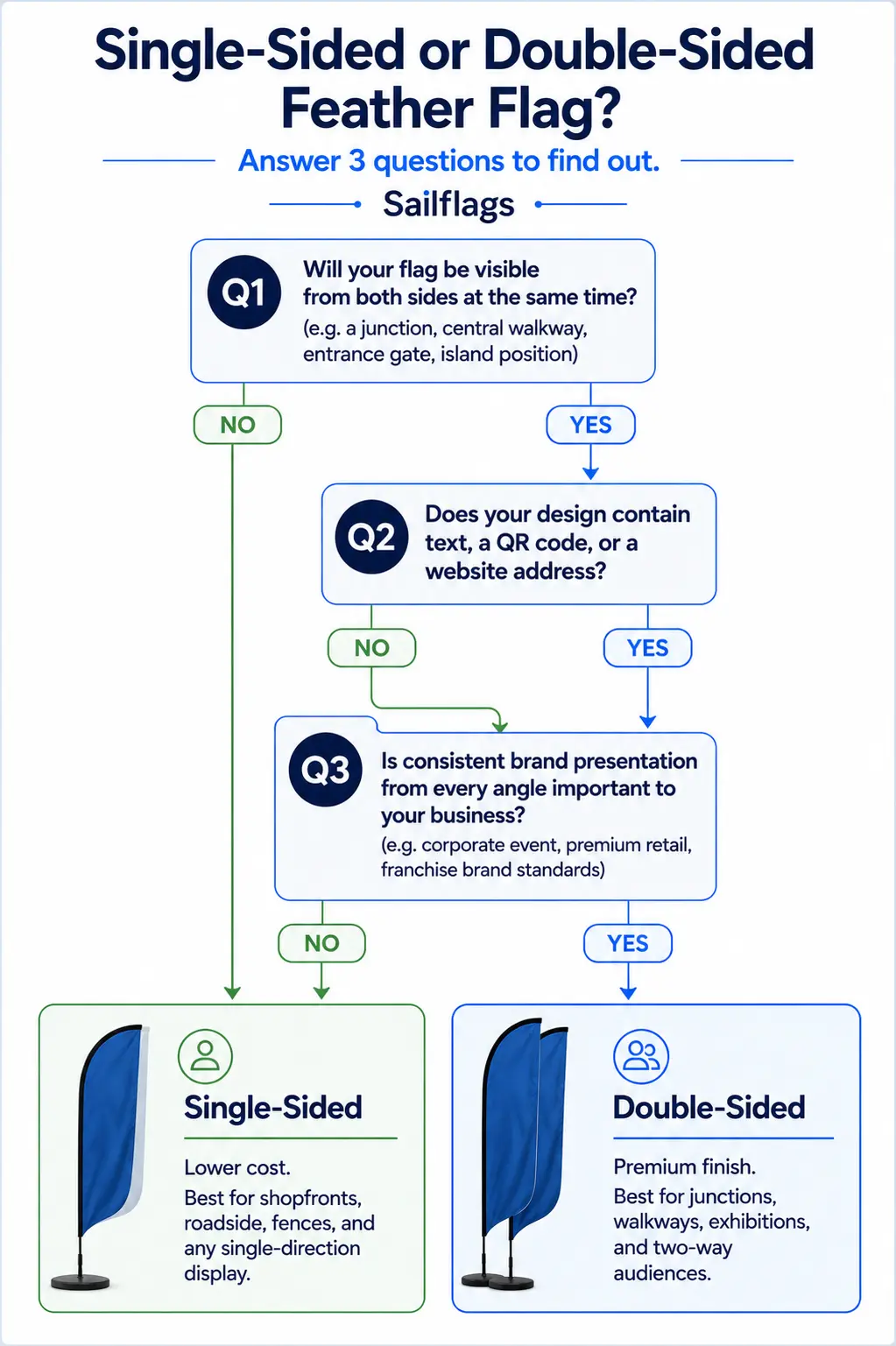
| ✓ Single-sided works best when: The flag faces one primary direction Audience approaches from one side only Design is simple: bold logo, text, one main graphic Budget is a consideration Maximum wind movement is desired The reverse side is against a wall, fence, or building Used for roadside display where viewers are on one side of the road Short-term promotional campaigns where cost per use matters See the full feather flag range: https://www.sailflags.co.uk/product/feather-flag-purchase | ✗ Single-sided is NOT ideal when: Flag is visible from both sides at a junction or walkway Design contains QR codes that need to scan from both sides Text needs to read correctly in both directions Flag will be at the centre of a two-way pedestrian route Display area is an enclosed space with audiences on all sides Brand guidelines specify consistent presentation from every angle Not sure? Call 01736 719111 for guidance. |
Common single-sided scenarios include: a shopfront flag against a building façade where pedestrians only approach from the pavement side; a festival perimeter flag along a fence line; a roadside flag positioned so that traffic only sees one face; and any indoor exhibition stand display where the back of the flag faces into the stand.
5. When Double-Sided Is the Right Choice
| ✓ Double-sided works best when: Flag is visible from multiple directions simultaneously Located at a junction, entrance gate, or island position Busy two-way pedestrian walkways QR codes or scannable elements need to work from both sides Text must be readable in both directions High-end retail or corporate branding requires consistent presentation Indoor exhibitions where visitors circulate the flag Forecourt position where customers arrive from multiple angles Order double-sided flags: sailflags.co.uk/double-sided-flag-printing/ | – Double-sided is probably overkill when: Flag is positioned against a wall or building back Only one direction of approach is possible Design is purely graphical with no text or QR codes Budget is tight and single-sided serves the display purpose The flag is for very short-term use (one-day event) Use our online flag creator to plan your design: sailflags.co.uk/online-flag-creator/ |
Double-sided is particularly compelling for any position where the flag can be seen from both sides simultaneously — a central island in a car park, a flag at the end of a retail aisle, an entrance gate at an event, or a flag on a walkway where visitors travel in both directions past the display.
6. The Special Case: Different Designs on Each Side
One of the most underused features of double-sided flags is the ability to print a completely different design on each side. Because both printed panels are manufactured and proofed independently before being sewn together, the front and back face of the flag can carry entirely separate artwork.
This opens up several useful applications:
- Two languages: a business serving both English and Welsh customers can print the English version on one side and the Welsh on the other, with a single flag serving both audiences.
- Two messages: ‘SALE NOW ON’ on the front and ‘ENDS SUNDAY’ on the back, for example — both visible as visitors enter and exit.
- Two brands: a venue hosting two simultaneous events can use both sides of a single flag to represent each.
- Direction markers: ‘ENTRANCE →’ on one face and ‘← CAR PARK’ on the other, using a single flag at a junction.
- Seasonal rotation: ‘SUMMER SALE’ on one side and ‘NEW COLLECTION’ on the other — rotate the flag on its pole to switch messaging without ordering a replacement.
Each side requires its own artwork file and its own proof. Both are included in the standard free design service. The only practical limit is that both sides must use the same flag size — you cannot have a 3.2m print on one side and a 4.2m print on the other, since both panels are sewn together to the same dimensions.
| Creative tip Using complementary colours on the front and back — rather than the same design on both sides — makes a double-sided flag more dynamic. As it rotates in the breeze, the alternating colour faces create movement and variety that catches the eye more effectively than a repeated identical print. |
7. Does Double-Sided Affect Your Base Choice?
Yes — and this is a practical point that is often overlooked at the point of ordering.
A double-sided flag is significantly heavier than a single-sided flag of the same size. The three-layer construction — two printed panels plus the blockout liner — adds approximately 40–60% to the fabric weight. This extra weight generates more wind resistance and more downward load on the pole and base.
The practical implication is that you should order a heavier base for a double-sided flag than you would for the equivalent single-sided flag:
- Single-sided 3.2m outdoor: cross base with 15-litre water bag or 30L fillable base is adequate in most conditions.
- Double-sided 3.2m outdoor: 30L fillable base is the minimum; in exposed or windy locations, upgrade to a heavy-duty weighted base.
- Double-sided 4.2m+ outdoor: heavy-duty weighted base or drive-over base is strongly recommended. Never use a standard cross base with a water bag for large double-sided flags in open outdoor locations.
- Double-sided indoor (exhibition): the large flat metal flag base (10kg with rotating spigot) is well suited — the rotating spigot prevents the flag from twisting on the pole as it is heavier and slower to self-correct.
See our complete guide to feather flag bases and hardware for detailed base specifications and surface-by-surface recommendations.
8. Does Double-Sided Affect Artwork or File Specs?
The file format and technical specifications for double-sided artwork are the same as for single-sided: PDF, AI, or EPS for vector artwork; PSD at 250–300 dpi for photographic designs; CMYK colour mode; fonts outlined. The artwork templates are available in both single-sided and double-sided variants — use the double-sided template when designing, as it includes the correct bleed lines and pole pocket positions for both faces.
The key practical differences when supplying artwork for double-sided flags:
- Two separate files: supply a front artwork file and a back artwork file as two separate documents. Label them clearly — ‘front’ and ‘back’ — to avoid proofing errors.
- Two separate proofs: you will receive a proof for each face and need to approve both before production begins. Review them independently — the front and back are produced as separate panels before being joined.
- Mirror image not needed: do not mirror your back artwork. The Sailflags production team handles the correct orientation for each panel during the proofing stage. Supply both designs as they should appear when viewing the flag from outside — let the team manage the technical orientation.
- Different designs add no extra artwork charge: supplying two different designs does not incur an additional design fee. The free design service covers both faces as a single order.
| Ordering tip: mention your QR codes upfront If your flag design includes QR codes or scannable elements, tell the design team at the start of the order. QR codes must be tested at the size they will appear on the flag to confirm they scan reliably at normal viewing distance. The team can advise on minimum size requirements and flag which positions are most readable. |
9. Is Double-Sided Worth the Upgrade?
This is the most commonly asked question — and it has a genuinely simple answer: it depends entirely on where the flag will be positioned, not on quality.
Double-sided is not a ‘premium’ version of single-sided in the sense that it makes a single-direction flag look better. Single-sided flags from Sailflags look excellent — the dye-sublimation print on 100% recycled polyester produces vibrant, fade-resistant colour that performs in real outdoor conditions. From the correct viewing direction, there is no visible quality difference between the two.
The question is purely about the viewing environment:
- Flag viewed from one side only → single-sided. Save the budget. The back-face show-through makes no visible difference from the correct viewing direction.
- Flag viewed from two sides → double-sided. The mirrored show-through on a single-sided flag looks unprofessional when read from the back, particularly if it contains text or brand-critical graphics. The additional cost is completely justified.
- Flag contains text, QR codes, or directional content → double-sided, regardless of viewing direction, if there is any chance the flag will be seen from behind.
- Flag is purely decorative or colour-based → single-sided is almost always sufficient. Show-through of a simple colour wash or abstract design is largely imperceptible at normal viewing distances.
| The honest answer on cost Double-sided feather flags typically cost 20–40% more than single-sided equivalents of the same size. For a flag that genuinely needs to perform from both directions, that is excellent value. For a flag that will only ever be seen from one side, it is unnecessary expenditure. The right answer depends on your specific setup, not on an assumption that double-sided is always better. |
10. Frequently Asked Questions
Can I see what the show-through looks like before ordering?
Yes. Ask the Sailflags team for a fabric sample or request that your digital proof includes a reverse-side simulation. For most standard designs on the 115gsm polyester used for Sailflags feather flags, show-through at normal viewing distances is faint enough that it is not a concern.
Is double-sided heavier to carry and transport?
Yes, but not significantly for most sizes. A 3.2m double-sided flag adds roughly 200–300g to the flag fabric weight — the carry bag and pole system remain the same. The difference is most noticeable with larger flags (4.2m and above) where the additional fabric weight is proportionally greater.
Can I convert a single-sided flag to double-sided later?
No. Single-sided and double-sided flags are entirely different physical products. A single-sided flag cannot be upgraded to double-sided — the construction is fundamentally different, requiring a separate production run. If you are unsure which you will need long-term, double-sided at the outset is the more future-proof choice.
Does the blockout liner affect the flag’s movement in wind?
Slightly. The additional weight of the blockout liner and second panel means double-sided flags respond a little less freely to light winds compared to single-sided flags. In moderate to strong winds, both perform similarly. If maximum movement and animation in light breezes is important to your application, single-sided has a small advantage.
Are teardrop flags the same — single or double-sided?
Yes, the same choice applies to teardrop flags. Because the teardrop shape keeps both faces consistently presented and visible (unlike feather flags, which flutter and rotate), double-sided is particularly well suited to teardrop flags used in high-footfall multi-directional environments like exhibitions and busy forecourts.
What if I only need double-sided on some of a large order?
Sailflags can mix single-sided and double-sided flags within a single order. For example, a retailer equipping multiple sites might specify double-sided for corner or junction positions and single-sided for flags set against walls. Specify the print type per flag when placing the order.
Does double-sided cost more to print artwork for?
No. The free design service covers artwork for both faces of a double-sided flag as part of a single order at no extra charge.
Single-Sided or Double-Sided — Make the Right Call First Time
The choice between single-sided and double-sided feather flags comes down to one question: will your audience see the flag from both sides? If the answer is yes — or if your design includes text, QR codes, or any content that needs to read correctly in both directions — double-sided is the right product. If the flag faces one direction and the back will never be the primary view, single-sided delivers the same visual impact at a lower cost and with better wind movement.
If you are still unsure, the Sailflags team will ask you the right questions to help you decide before anything is committed to print. The free design service means you can see both options proofed before placing an order.
At Sailflags, every double-sided feather flag uses our exclusive blockout liner — developed in-house and exclusive to our production process — to deliver the cleanest possible reverse-face presentation. Every flag is manufactured at our Cornwall factory, with in-house design, printing, sewing, and quality checking before dispatch.