
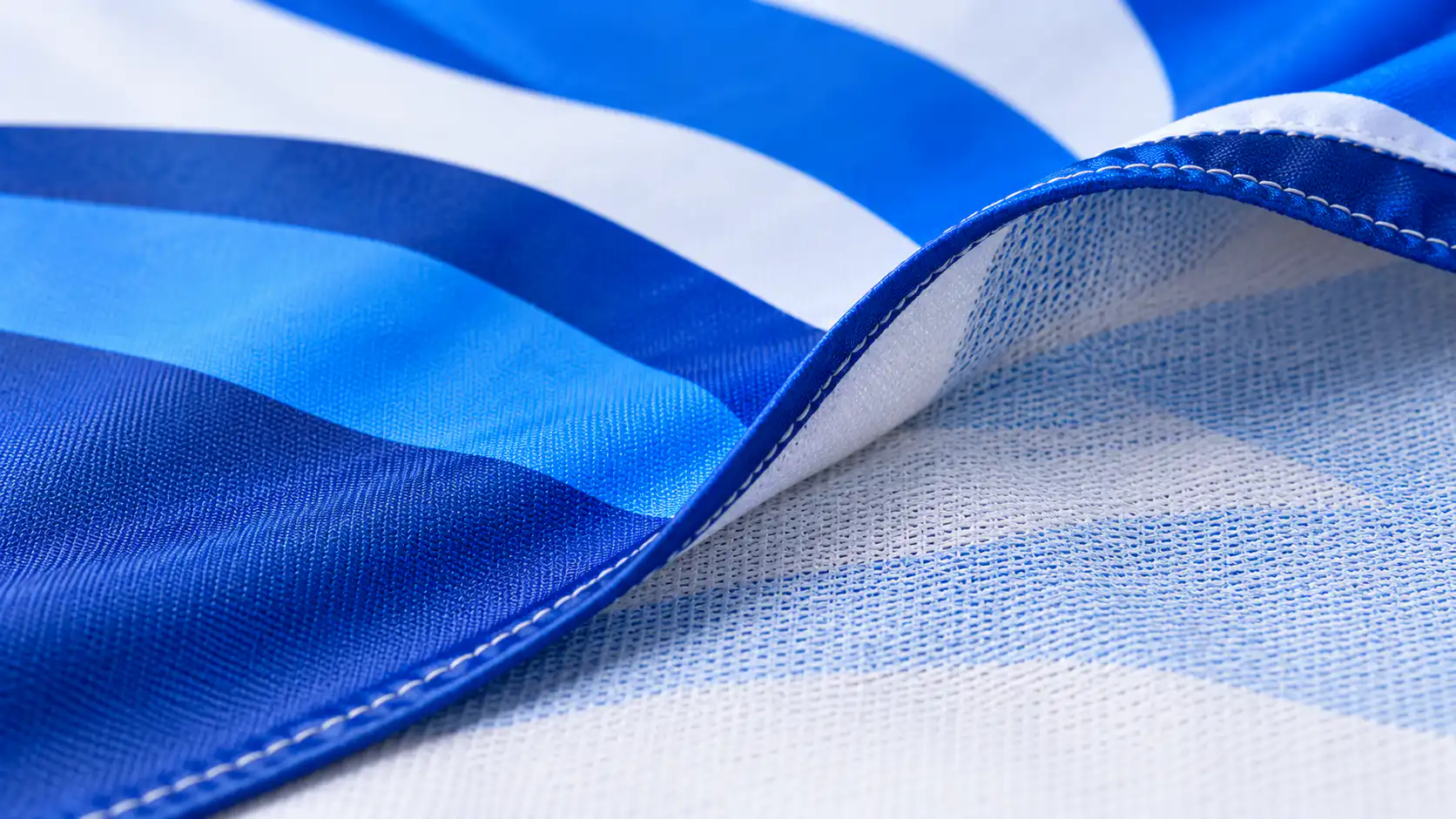
Look closely at a good printed feather flag and you will notice something odd. There is no raised layer of ink, no cracking at the folds and no plastic-y sheen. The colour looks as though it has been woven into the cloth. In a sense, it has.
Most printed feather flags are made using dye-sublimation, a process that turns solid ink into a gas and uses heat to carry it inside the fibres of the fabric. It sounds like a laboratory trick, but the steps are simple once you see them in order, and understanding them helps you order a better flag.
This guide walks through the process from artwork to finished flag, explains what the method does well and where it has limits, and shows what it means for the way you prepare your design. Sailflags has been making flags in Cornwall since 1999, and every flag we make is printed this way.
| The short answer: Dye-sublimation prints the design onto special transfer paper first. The paper is then pressed onto polyester fabric under heat and pressure. At around 200°C the ink turns from a solid into a gas and enters the polyester fibres. When the fabric cools, the colour is locked in. The colour becomes part of the fabric, not a coating on top, which is why it does not crack or peel. The limits are real but manageable: white comes from the fabric, some Pantone colours cannot be matched, and a single-sided flag shows a mirror image on the back. |
What is dye-sublimation printing?
Sublimation is the scientific word for a substance changing straight from a solid to a gas without passing through a liquid stage. Dye-sublimation printing uses that behaviour on purpose. The inks are made so that, when they are heated, they skip the liquid stage and become a gas that can move into a material.
The material has to be one that will accept it, and for flags that means polyester. Polyester fibres loosen slightly under heat, which lets the gaseous dye enter them. As the fabric cools, the fibres close up again and the dye is trapped inside. The result is colour that is part of the fibre itself.
That is quite different from most printing, where ink is laid on a surface and left to dry. It also explains almost everything about how a dye-sublimation flag looks, feels and ages, as we will see below.
Why flags are printed on polyester
Dye-sublimation and polyester suit each other for the same reason: the dye needs a synthetic fibre to bond with. Polyester is also strong, light, quick-drying and holds its shape outdoors, which are exactly the qualities a flag needs.
Our standard feather flags are printed on 115gsm knitted polyester made from 100% recycled post-consumer PET. If you want to know more about why we use a knitted construction, our guide to knitted vs woven polyester for feather flags covers it, and our eco credentials page explains where the recycled material comes from.
How feather flags are printed, step by step
Here is the full journey, from a file on your screen to a flag in its bag. The first step happens before anything is printed at all.
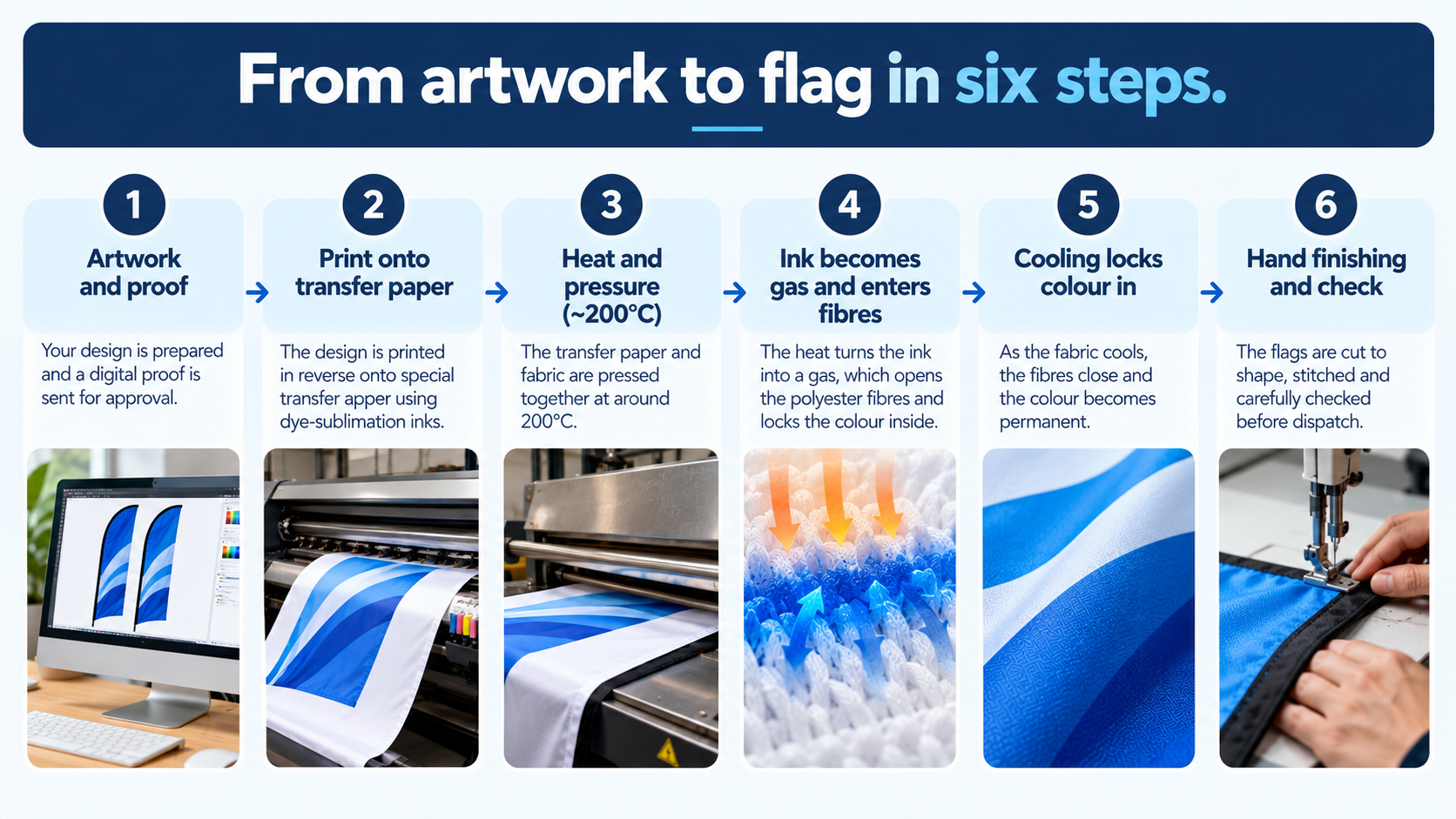
Step 1: Artwork and proof
Everything starts with your design. You can supply print-ready artwork, build it in our online flag creator, or use our free design service, which checks that your artwork fits the print area, works around the sleeve and stitching, and is sharp enough for a large print. If you have no high-resolution logo, we can redraw one, from £15.
We then prepare a digital proof for you to approve. Approval matters more than it sounds, because it is the point where the specification is fixed. Production does not start until you have confirmed it, and once a flag is printed it cannot be changed. File requirements are covered in full in our guide on how to order custom printed feather flags and on our artwork page, so we will not repeat them here.
Step 2: The design is printed onto transfer paper
Once the proof is approved, the design is printed onto transfer paper using sublimation inks. The artwork is reversed on the paper, so that it reads the right way round once it has been pressed onto the fabric, rather like an iron-on transfer.
At this stage the ink is dry on the paper and the colours can look slightly dull and flat. That is normal. The vivid colour only appears once the heat has done its work.
Step 3: Heat and pressure
The printed paper is laid face down on the polyester and pressed under heat and pressure, at around 200°C. This is the stage that makes dye-sublimation different from every other method, and it is also the energy-hungry part of the process, which we come back to later.
Step 4: The ink becomes a gas and enters the fibres
At that temperature the ink converts from a solid to a gas and penetrates the polyester fibres. Because the dye goes into the fibre rather than sitting on top of it, nothing is left on the surface to crack, flake or rub off. Almost all of the ink moves into the fabric, so very little residue is left behind on the transfer paper.
Step 5: Cooling locks the colour in
When the fabric cools, the fibres close up and the colour is permanently trapped inside. The paper is peeled away and what is left is a printed fabric with no extra layer on top of it. If you run a finger over the print, you feel only the cloth.
Step 6: Finishing, checking and packing
A printed sheet of fabric is not yet a flag. Each one is finished by hand: seamed on all edges and sewn into the pole pocket. It is then quality-checked before it is packed. That hand finishing is where a flag gets its durability at the edges and seams, which are the places a flag is most likely to wear first.
Double-sided flags add one more stage. Each side is printed on its own panel, and the two are stitched together with an inner blockout liner between them to reduce show-through. Our double-sided flag printing page explains the construction.
What dye-sublimation does well
- Vivid, full-colour print. Photographs, gradients and fine detail all reproduce well, because the process is not limited to a small set of spot colours.
- Colour that does not sit on the surface. Because it is inside the fibre, there is no ink layer to crack at the folds, which matters on a flag that flexes all day.
- A soft finish. You get the feel of the fabric, not a coated surface.
- Good colour retention. The print gives vibrant, fade-resistant colour. No printed colour lasts forever in strong sun, but a colour inside the fibre holds up better than one sitting on top.
- Little waste. The ink moves almost entirely into the fabric, and there is no water used in the colouring stage and no solvent-based ink carriers.
Where dye-sublimation has limits
It is worth being straight about the limits, because most disappointments with printed flags come from expecting something the process cannot do. None of these is a flaw. They are simply how the method behaves, and each has an easy answer.
| Limit | Why it happens | What to do |
|---|---|---|
| White is not printed | White comes from the fabric itself, not from ink. A bright white area can look a very light grey in certain light or bright sun. | Plan for a soft white. Use colour behind white text for contrast. |
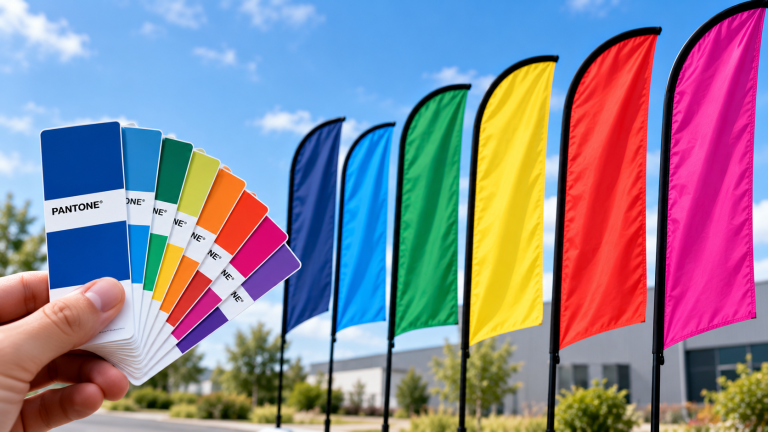
| Some colours cannot be matched | Some Pantone colours sit outside what a four-colour process can reproduce. Fluorescents, neons, some oranges and reds, metallics and certain violets are the hardest. | Send your Pantone references and we will match the closest achievable colour. Ask about a swatch for critical brand colours. |
| Screen colours look different | Screens emit light. Print reflects it. An uncalibrated screen is only an interpretation of the colour. | Treat the proof as a layout check, and use physical swatches for colour decisions. |
| Mirror image on the back | The ink passes through a single layer of lightweight polyester, so the design shows through reversed. | Choose double-sided if the reverse needs to read correctly. |
Our colour matching page goes into the detail, and our guide to single-sided vs double-sided feather flags explains the mirror image and how to preview it with a reverse-side simulation on your proof.
Dye-sublimation compared with surface printing
Surface printing, where ink is laid on top of the material, is the other broad family of methods. It has its place, particularly on materials that cannot take a dye, but for a flag that moves constantly the difference matters.
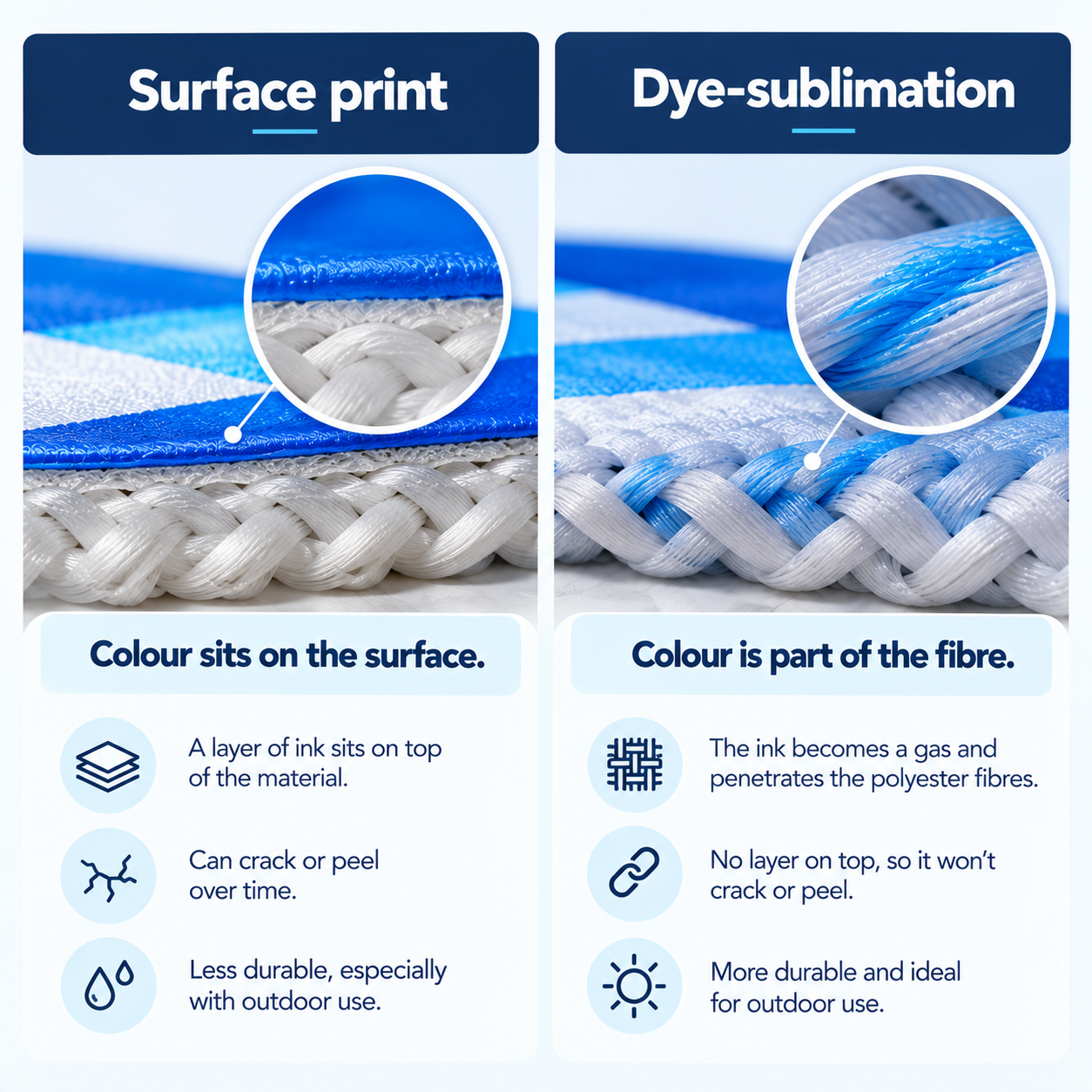
| Dye-sublimation | Surface printing | |
|---|---|---|
| Where the colour sits | Inside the polyester fibre | On top of the material |
| Feel | Just the fabric | Can feel coated or slightly raised |
| Wear at folds and edges | No ink layer to crack or scuff | A surface layer can crack or wear |
| Colouring stage | Dry heat transfer, no water | Depends on the process |
| Best suited to | Polyester flags, banners and soft signage | Materials that cannot take a dye, such as PVC |
Is dye-sublimation eco-friendly?
Partly, and it is better to say so plainly. On the plus side, the colouring stage uses dry heat rather than water, so there is no dye-laden wastewater, and the inks do not need solvent-based carriers, which are a source of volatile organic compound emissions in some printing. Almost all of the ink ends up in the fabric.
The main environmental cost is energy. Heating the press to around 200°C takes a lot of it. We cover how that is offset, along with our recycled fabric and certifications, in our guide to eco-friendly feather flags.
How to get the best result from your order
A few habits make a noticeable difference to how your printed flag turns out.
- Supply vector artwork for logos and text, with fonts converted to outlines, and the highest-resolution images you have for photos. Our artwork page has templates for each flag size.
- Read every word on the proof, including phone numbers and web addresses, before you approve. Approval fixes the specification.
- Do not rely on pure white. If white matters to your design, give it a coloured background so it stands out.
- Ask for a swatch if a brand colour has to be right. Do not judge colour from a screen.
- Choose double-sided if there is text or a logo that must read correctly from both sides.
- Keep key content inside the safe zone, so nothing important disappears into a seam or the pole pocket.
Looking after a dye-sublimation flag
Because the colour is in the fibre, a dye-sublimation flag is forgiving, but it is not indestructible. Sunlight, wind and rubbing all wear any flag over time. The best things you can do are bring it in at the end of the day and take it down in rough weather. Edges and seams tend to fray before the colour goes, which is why our flag care page notes that repairs to flag material and stitching are free of charge and help prolong the life of the product.
If you fly a flag outdoors most of the time, fabric choice matters too. Our guide to fabric weight in feather flags explains why gsm is only part of the picture.
Frequently asked questions
How are feather flags printed?
Most are printed using dye-sublimation. The design is printed onto transfer paper, which is pressed onto polyester fabric under heat and pressure. The ink turns to gas, enters the fibres and locks in as the fabric cools. The flag is then seamed, sewn into the pole pocket and checked.
Is dye-sublimation the same as digital printing?
Not quite. Digital describes how the image is produced from a file, and dye-sublimation is a way of getting the colour into the fabric. A dye-sublimation flag starts as a digital file, but the colour is transferred by heat rather than printed directly onto the cloth.
Will the colour wash out or peel?
It will not peel or flake, because there is no ink layer on the surface. Like any printed colour, it will fade gradually with long exposure to strong sun, which is why we suggest bringing flags in each day.
Why is there a mirror image on the back of my flag?
On a single-sided flag the ink passes through a single layer of lightweight polyester, so the design shows through reversed on the other side. That is normal. A double-sided flag uses two printed panels and an inner liner, so each side reads correctly.
Can you print white?
White comes from the fabric, not from ink, so it is the colour of the cloth. A bright white area can appear as a very light grey in certain light or bright sunshine. Placing white text on a coloured background gives the best result.
Does dye-sublimation use water?
Not in the colouring stage. It uses dry heat transfer, so there is no dye-laden wastewater. The process does use a lot of energy at the heat-press stage.
Where are your flags printed?
All of our flags are printed using dye-sublimation in our factory in Cornwall, and each one is finished by hand and quality-checked before it is packed.
The bottom line
Dye-sublimation is a simple idea done carefully: print onto paper, press with heat, and let the colour move into the fibre. It is why a good printed flag stays vivid, feels like cloth and does not crack at the folds. It also has honest limits, with white, some brand colours and show-through on single-sided flags being the ones to plan for.
If you would like help preparing a design, the team can talk you through it. Sailflags is an employee-owned business, rated 4.9 on Trustpilot from over 1,200 reviews. You can get a free quote, start designing in our online flag creator, or look at our full range of custom feather flags.