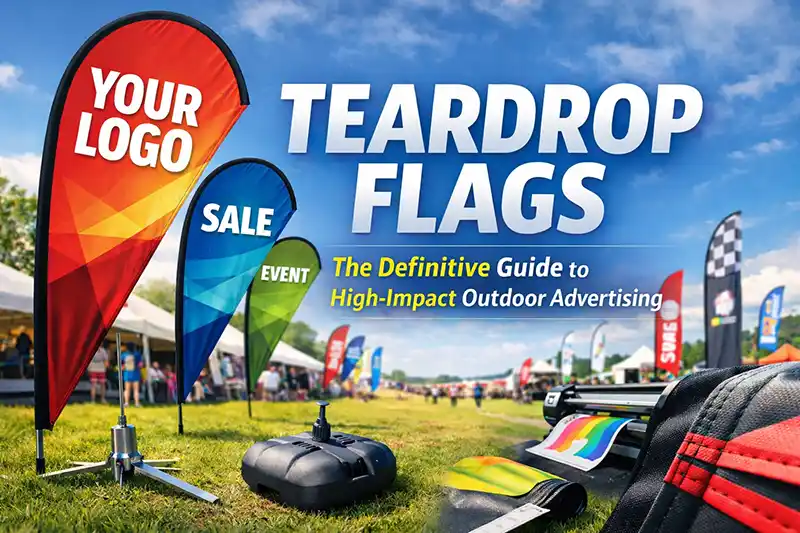
Feather flags (sometimes also referred to as sail flags or swooper flags) are one of the most effective forms of outdoor advertising when specified correctly. When chosen well, they deliver constant visibility, work in all weather, and outperform many other physical marketing tools for cost versus impact.
However, most underperforming feather flags fail for the same reasons: the wrong base, poor artwork layout, or low-quality construction that simply isn’t built for real outdoor use.
This guide is designed to help you buy once — and buy right.
Before choosing sizes, shapes, or print options, clarify three fundamentals:
A sheltered shopfront is very different to a coastal forecourt or roadside. Wind exposure directly affects:
At distance and speed, less is more. The strongest feather flags usually communicate:
If the message can’t be understood in three seconds, the design is doing too much.
The curved top of a feather flag naturally draws the eye upwards, while the vertical shape allows text to be read from top to bottom — ideal in busy environments with visual noise.
For most businesses, feather flags offer the best balance of:
You can view the full range of options on our
👉 Feather Flags main page
There’s no universal “best size” — the correct height depends on surroundings.
A taller flag with the wrong base will always perform worse than a correctly specified, well-anchored flag.
This is one of the most common decision points — and one of the most misunderstood.
This is the most common and cost-effective option.
If your flag will be seen clearly from both directions, a double-sided option is often the better choice.
Double-sided feather flags are produced by printing two separate faces and stitching them together with a liner, allowing:
You can see more detail here:
👉 Double-sided feather flags and flag printing
Important note:
Double-sided flags are heavier, so pole quality and base choice become even more important, especially in exposed locations.
Most professional feather flags are produced using knitted polyester fabric, typically around 110–115gsm. While weight matters, performance depends more on how the fabric is printed and finished.
High-quality feather flags use dye sublimation, where inks are heat-infused into the fabric rather than sitting on the surface. This provides:
Poor penetration results in dull colours and weak visibility, particularly on the reverse side.
Consistent colour relies on:
A feather flag pole is a flexible structure, not a rigid stick. The pole must:
Look for:
Cheap poles fail early — usually at the joints or top section.
The base should always be chosen for surface first, then weighted for wind.
If the flag will be outdoors long-term, invest in the base — not just the print.
Your design should communicate its message instantly.
A strong hierarchy looks like this:
Avoid placing important text too close to the curved top where distortion occurs.
Outdoor visibility relies on contrast, not gradients or fine detail. Simple colour combinations and clear spacing outperform “busy” designs every time.
Durability is heavily influenced by how the flag is finished.
Look for:
These details matter most in windy or coastal environments.
Many exhibition venues require fire-rated materials. If you plan to use feather flags indoors, check whether a B1 fire-rated fabric option is required and allow for this during ordering.
A practical guide:
For two-way footfall, either:
Before placing an order, it’s reasonable to ask:
Clear answers usually indicate a supplier who understands real-world use, not just printing.
Feather flags remain one of the most cost-effective forms of outdoor advertising available — but only when specified correctly.
By choosing the right shape, base, print method, and finishing, you’ll end up with a flag that doesn’t just look good on day one, but continues to work hard in real conditions.
If you’re unsure which configuration is right for your location, start with the
👉 Feather Flags main page
and work from there using the principles in this guide.