

A teardrop flag lives or dies by its hardware. The print might be what people notice, but it’s the pole and base doing the actual work of keeping your flag upright, stable, and safe in UK weather. This guide covers the full range of base options, how to choose between them, and what to do when something needs replacing.
This is the last post in our teardrop flags series — if you’ve read through the buyer’s guide, sizing, ordering, sidedness, events, and pricing posts already, this one ties the practical hardware side together.
Anatomy of a Teardrop Flag: Pole, Base & Sleeve
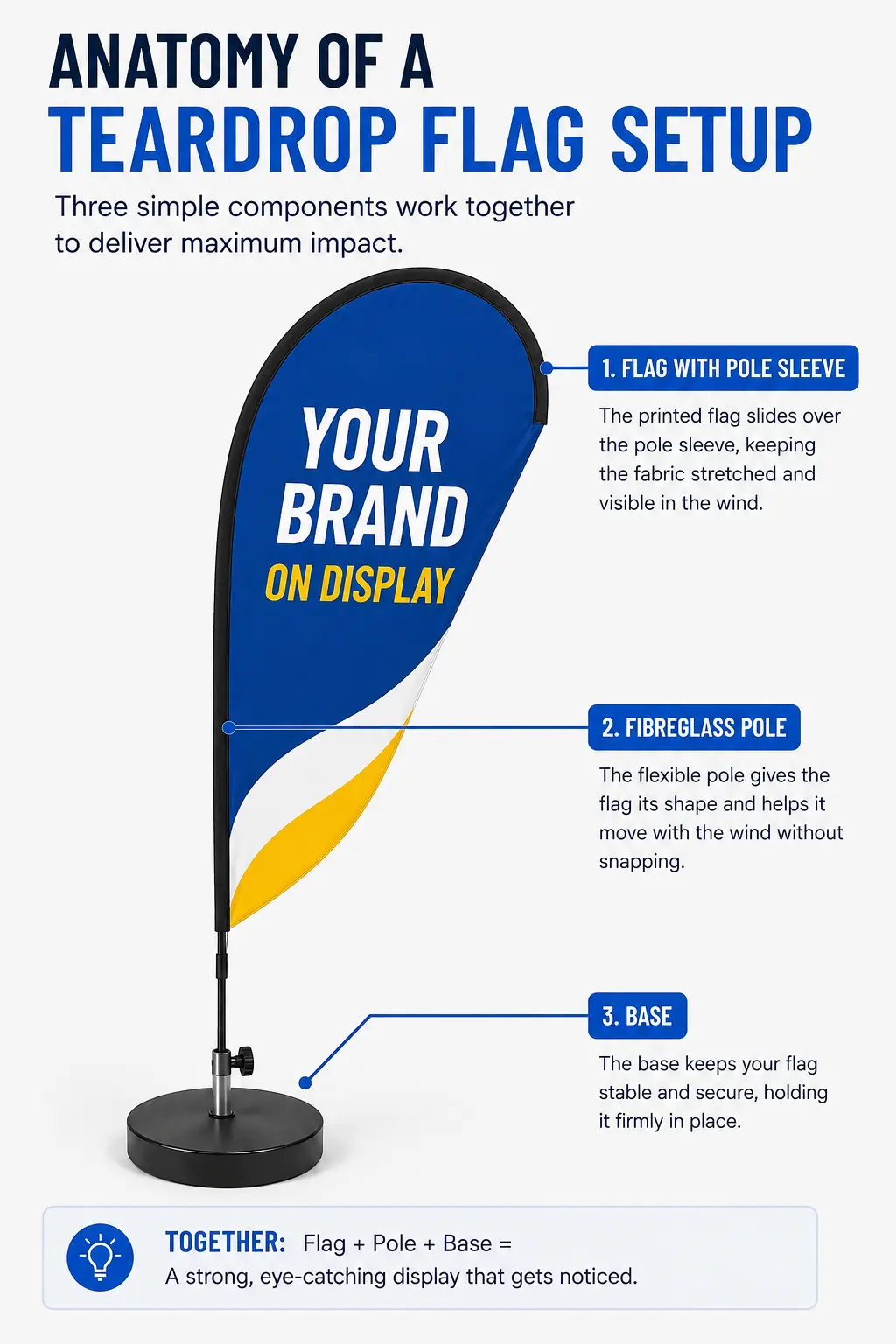
A complete teardrop flag setup has three parts working together: the flag itself, with a stitched sleeve running along one edge; a flexible fibreglass pole that threads through that sleeve and gives the flag its curved, wind-shedding shape; and a base, which anchors the whole assembly to the ground or a fixed surface. The base is the part most worth thinking carefully about, since it’s the single biggest factor in whether your flag stays upright in anything other than perfectly calm conditions.
The pole itself is usually the most overlooked part of the three, largely because it does its job quietly when everything’s working properly — flexing with the wind rather than fighting it, which is part of why teardrop flags handle UK conditions better than a rigid sign of similar height. Fibreglass is used specifically because it flexes and returns to shape rather than staying bent, which matters over repeated use far more than it might seem on day one.
How Base Choice Affects Wind Performance
It’s worth understanding why base choice matters as much as it does, rather than treating it as a box to tick. A flag catches meaningfully more wind load than its size might suggest, because it’s constantly moving rather than presenting a fixed flat surface — which means the anchoring force needed to hold it steady is higher than people often assume from looking at the flag alone. A base that’s technically ‘a base’ but under-specified for your flag’s height and site exposure is one of the most common reasons a flag ends up on the ground.
As a general pattern: taller flags need more anchoring than shorter ones, exposed sites need more than sheltered ones, and double-sided flags catch slightly more wind than single-sided ones of the same size, since there’s more fabric involved. None of this means you need to buy the heaviest base available for every situation — it means matching the base to the actual conditions your flag will face, rather than defaulting to whichever base happens to be cheapest or already in storage.
Ground Spikes & Twin Spikes: Best for Grass & Soil
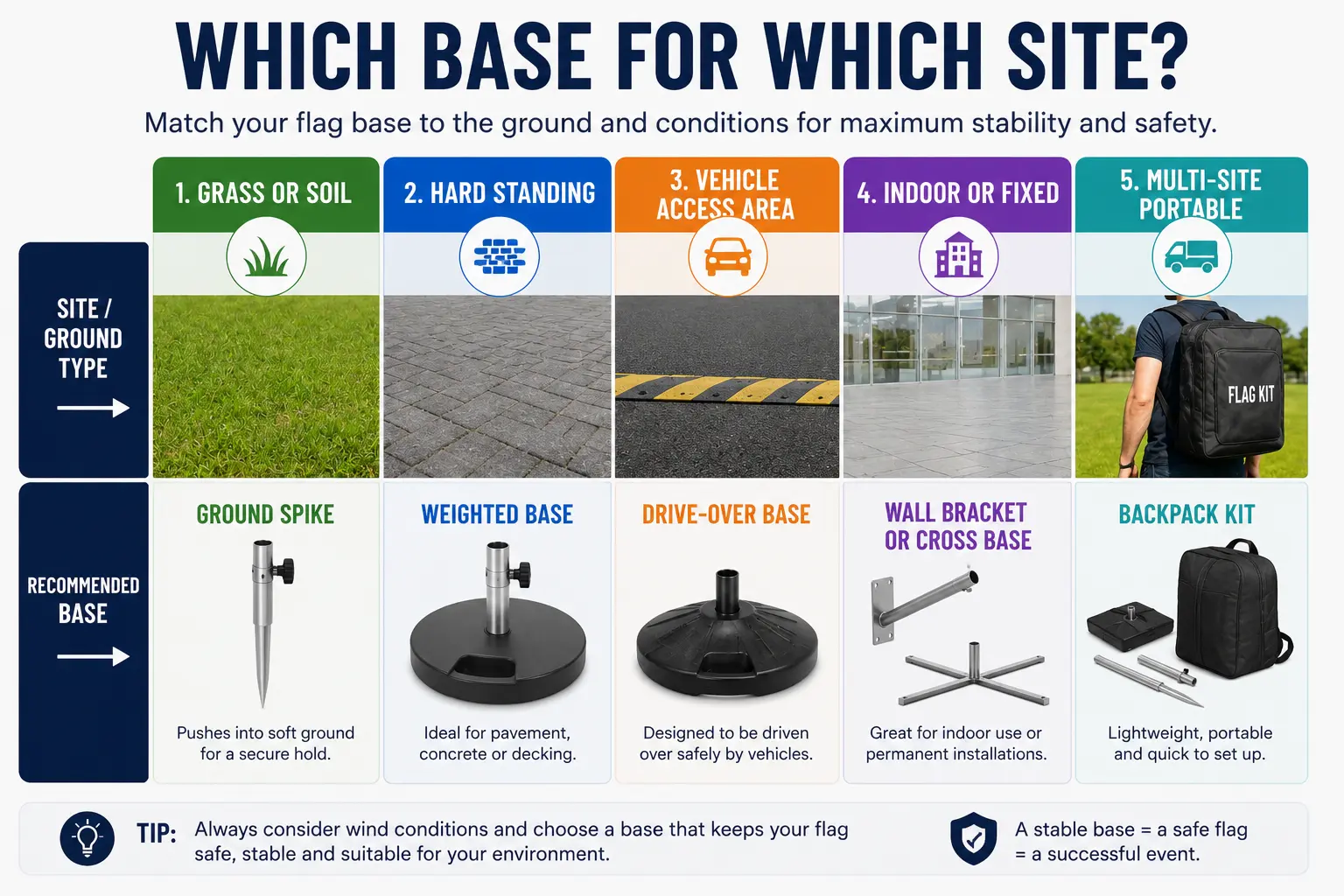
For grass, soil, or any ground you can drive a spike into, a ground spike is usually the simplest and most wind-resistant option — there’s very little for the wind to catch, and a properly driven spike holds firm even in fairly exposed conditions. Our ground twin spike adds a second anchor point for extra stability, which is worth considering for taller flags or genuinely windy sites — festival fields and open showgrounds in particular.
Ground condition matters here too — a spike drives easily into soft soil or turf but struggles on compacted or stony ground, where it’s worth checking a site in advance rather than discovering the problem on the morning of an event.
Weighted & Fillable Bases: Best for Hard Standing
On patios, forecourts, and any hard surface where a spike isn’t an option, a weighted base is the way to go. Our heavy-duty water-weighted base is a solid all-rounder — fill it on site rather than transporting a pre-weighted base, and empty it before moving on. It’s a good match for our taller sizes, where a lighter base simply won’t provide enough resistance in real wind.
Filling with water rather than sand is usually the more practical choice for most buyers — it’s easier to source on site, and emptying the base before transport is as simple as tipping it out, rather than needing somewhere to store or dispose of sand between uses.
Drive-Over Bases: A Practical Option for Vehicles & Forecourts
If your flag is sited somewhere vehicles need to pass over — a car park, a forecourt, a shared access route — a drive-over base is worth knowing about. Our drive-over folding flag base and drive-over B-base are both low-profile enough for a car to drive over without damage, while still holding the flag securely. This is a genuinely useful option for sites where a standard base would either get in the way or get knocked over.
This category of base solves a specific problem that’s easy to underestimate until you’ve actually had a flag knocked over by a delivery van reversing across a forecourt — it’s a purpose-built answer to a real, recurring issue for sites with regular vehicle movement, not just a novelty option.
Wall Brackets & Cross Bases: Fixed & Indoor Mounting
For a flag that’s staying in one place long-term, or for indoor use where a ground-standing base isn’t practical, a cross base or a wall bracket gives you a fixed, permanent mounting point. Wall brackets in particular suit shopfronts where you want the flag genuinely fixed in place rather than portable — worth checking your site can take the fitting before ordering if you’re going down this route.
A cross base is worth considering as a middle ground between fully portable and fully fixed — it’s still a freestanding unit rather than something bolted to a wall, but it’s designed for flags that are mostly staying put rather than moving between sites regularly.
The Backpack Kit: All-in-One Portability
If you’re moving between sites regularly — markets, events, multiple locations in a day — our teardrop backpack kit (also available double-sided) bundles flag, pole, and a purpose-built base into one rucksack-style carry system. It trades some of the raw wind-holding power of our heaviest bases for genuine portability, which is the right trade-off for anyone setting up and packing down repeatedly rather than leaving a flag in one place.
When to Replace vs Repair
Not every issue means starting from scratch. A pole that’s developed a slight bend usually still works fine and doesn’t need replacing on sight — genuine failure points are a pole that’s cracked or splintered (rather than just bent), a base that’s lost structural integrity (a crack in a fillable base, a spike that’s bent past the point of driving in straight), or a flag sleeve that’s torn along the seam. If in doubt about whether something’s still safe to use, it’s worth asking rather than guessing — a hardware failure mid-use is a bigger inconvenience than a five-minute question beforehand.
Regular light wear — a bit of scuffing on a base, a pole that needs a wipe-down after a muddy event — isn’t a replacement issue at all, just routine upkeep.
A useful rule of thumb: if a fault affects how the flag holds up in wind, treat it as a priority to sort before the next use. If it’s purely cosmetic — surface scuffs, minor fading on a base that’s been outdoors a long time — it can wait until it’s convenient, since it isn’t affecting safety or performance.
Getting Replacement Parts
We don’t currently sell individual spare components — poles, base fittings, and so on — as standalone parts separate from a full base or flag order. If a specific part of your setup has failed, the most straightforward route is to get in touch and describe what’s happened; in many cases a replacement base of the same type is the simplest fix, and for anything more specific, we can advise on the best way forward rather than you guessing at what to order.
It’s worth keeping a note of what you originally ordered — the base type and flag size — since that makes it much quicker for us to match a replacement correctly rather than starting from scratch working out what you’ve got.
If you’re ordering for a business with multiple flags in the field, it’s also worth keeping a simple internal record of which base and flag combination is at which site — a five-minute spreadsheet that saves considerably more time than trying to remember or guess when something eventually needs replacing a season or two down the line.
Caring for Your Hardware
- Rinse mud, sand, or salt off bases and spikes after use, particularly if they’ve been sited somewhere coastal
- Let poles dry fully before packing them away, to avoid corrosion or mould inside a carry bag
- Empty water-weighted bases before transporting them, and check for cracks before refilling each time
- Store poles somewhere they won’t be crushed or bent under other equipment between uses
- Check ground spikes for bending after use on stony or hard ground, and straighten or replace as needed
Real-World Base Recommendations by Site
- Shopfront patio or forecourt: a weighted, fillable base — no ground to spike into, and it stays put through most conditions once filled.
- Festival field or market pitch: a ground spike, or a twin spike for taller flags or exposed sites — lightest option with strong holding power in soil or grass.
- Car park activation or forecourt with vehicle movement: a drive-over base, so the flag doesn’t need to be moved every time a vehicle needs to pass.
- Permanent shopfront display: a wall bracket or cross base, if the flag is staying in exactly one spot long-term rather than being taken down regularly.
- Multi-site trader or mobile promoter: the backpack kit, prioritising quick setup and portability over maximum wind resistance.
As with sizing and sidedness, the right answer depends on the actual site rather than a single universal recommendation — these are simply the pairings that tend to work best for each situation.
Frequently Asked Questions
Can I use a feather flag base with a teardrop flag?
In many cases the base ranges are shared across flag types, but it’s worth checking compatibility with your specific flag size before assuming — ask us if you’re not sure.
What base should I use for a 3.6m flag in an exposed location?
A heavy-duty weighted base or a twin ground spike, depending on your ground type — taller flags need more anchoring, particularly somewhere genuinely windy.
Can I buy just a replacement pole?
We don’t currently sell poles as standalone spare parts — get in touch to describe the issue and we’ll advise on the best way to get you sorted.
Is the backpack kit base as stable as a standard weighted base?
It’s designed for portability first, which means it won’t match the raw holding power of our heaviest weighted bases — a fair trade-off if you’re moving between sites regularly, less so for a flag left permanently in an exposed spot.
How do I know which base I already have if I’m ordering a replacement?
Check your original order confirmation if you still have it, or describe the base’s shape and material when you get in touch — between the two, we can usually work out the right match.
Do drive-over bases work on grass as well as tarmac?
They’re designed primarily for hard surfaces where vehicles pass over — for grass or soil sites, a ground spike is generally the better-suited option.
Find the Right Base for Your Flag
Browse the full range of flag bases to find the right match for your site, or get a custom quote and tell us where your flag is going — we’ll help you pick hardware that actually holds up.
That wraps up our full teardrop flags series — from choosing a size and finish, through ordering and events, to keeping the hardware that holds it all up in good shape. Wherever you’re starting from, we’re happy to talk through the specifics of your site rather than leave you guessing at a general recommendation.