
Walk into almost any modern exhibition hall, retail store or conference and the chances are the banners you see are fabric, not PVC. Fabric has become the default choice for indoor display because it looks better, packs down smaller, and lasts through repeated use — but “fabric banner” actually covers a few different products, each suited to a slightly different job. This guide breaks down the difference between a fabric banner and a fabric banner stand, the two fabric weights available, when to choose each, and how to look after fabric display material so it keeps its finish over months or years of reuse.
Fabric Banner vs Banner Stand: What’s the Difference?
The terms get used interchangeably, but they describe two distinct products:
- A fabric banner is a flat, printed piece of fabric — essentially the fabric equivalent of a PVC banner. It is supplied with hems, eyelets or a trimmed edge, and you provide your own fixing method: hung on a wall, tied to a frame, or displayed however suits the space.
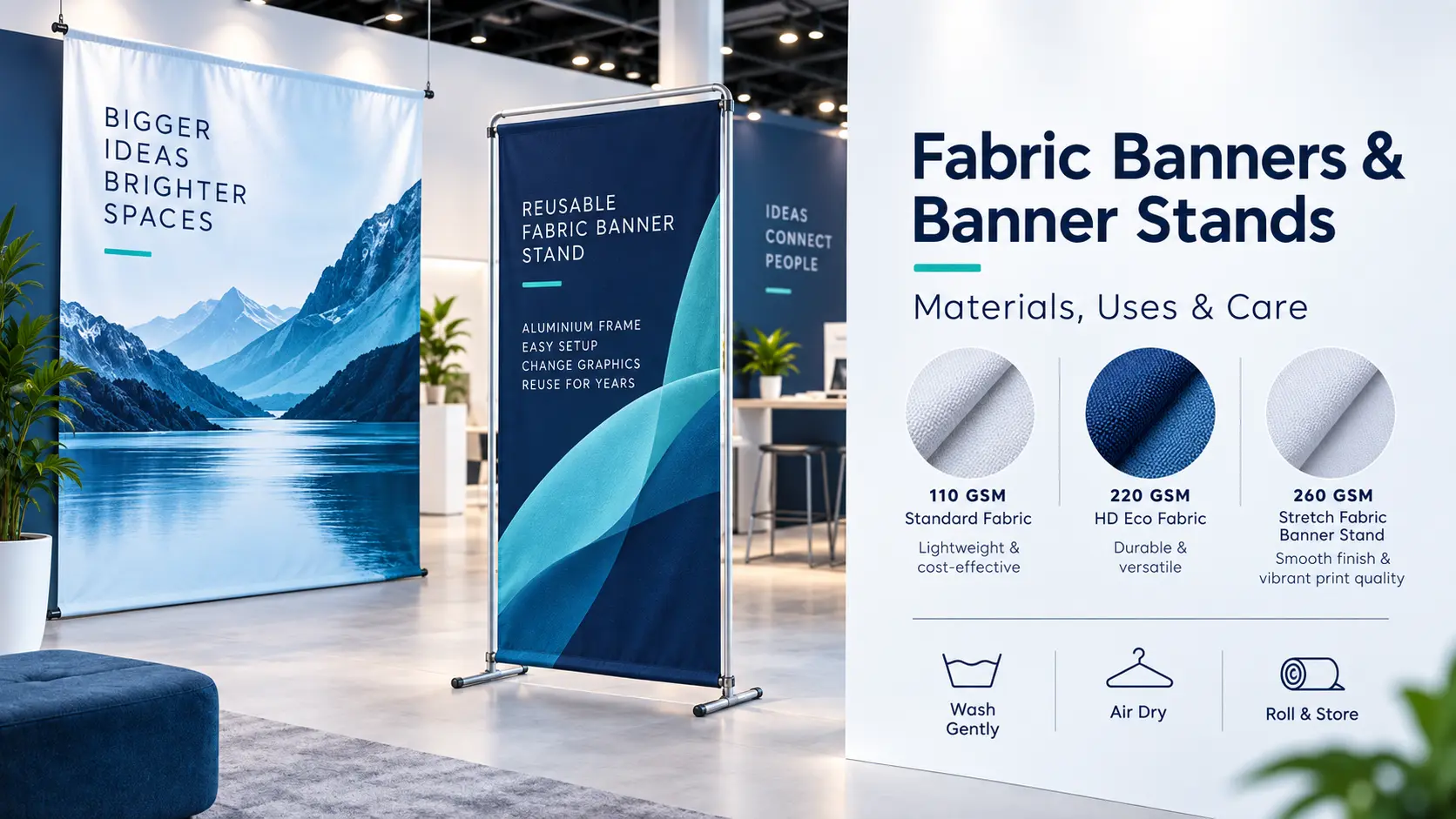
- A fabric banner stand is a complete, self-supporting display kit: a lightweight aluminium frame with a pre-tensioned, custom-printed fabric cover that zips over it. It arrives ready to stand up on its own, with no separate fixing required.
In short: choose a fabric banner when you already have somewhere to hang or fix it, and want the material itself. Choose a fabric banner stand when you need a complete, freestanding display that goes up in minutes with nothing else to source.
There is a third route worth mentioning too: a fabric roller banner, which uses the same fabric print quality but retracts into a compact base cassette rather than a snap-fit frame with a separate cover. It occupies similar ground to a banner stand — freestanding, reusable, exhibition-focused — but with a narrower footprint and a slightly different assembly method, so it is worth considering alongside a banner stand if desk or floor space is tight.
Standard Fabric vs HD Eco Fabric
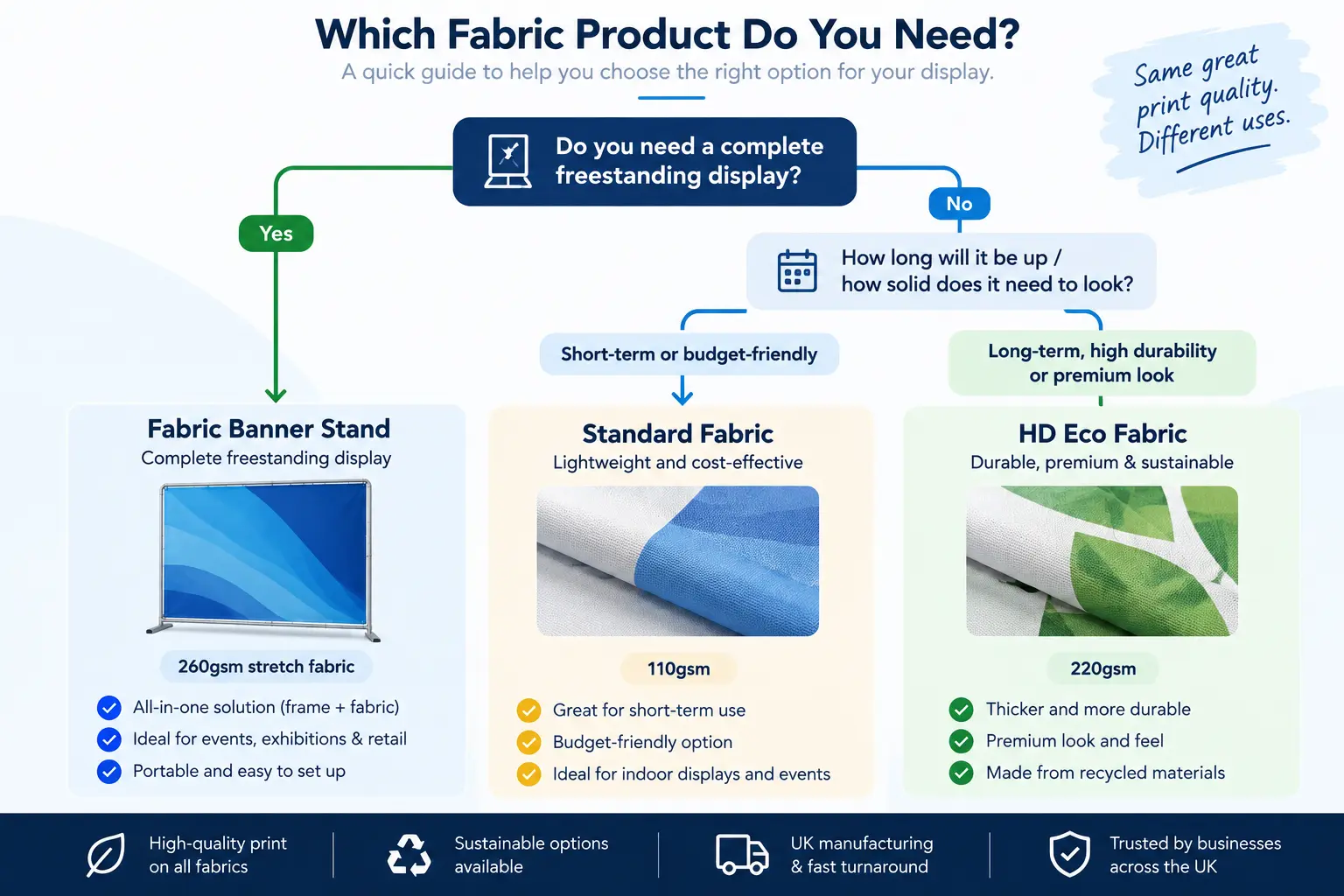
Sailflags’ flat fabric banners come in two weights, and the right one depends on how long the banner needs to work and how solid the display needs to look:
- Standard Fabric (110gsm) is lightweight, cost-effective, and delivers strong colour and clarity. It is the better choice for short-term promotions and budget-conscious indoor use. Because it is lighter, there is some natural show-through from one side to the other — which is actually a benefit for double-sided visibility, but worth knowing if a fully opaque single-sided display is the goal.
- HD Eco Fabric (220gsm) is roughly double the weight, with a tighter weave and around 56% opacity. It gives a more structured, premium finish with significantly less show-through, making it the stronger option for backdrops, exhibition stands and anywhere a solid, one-sided graphic matters.
Both fabrics are made from 100% recycled polyester and are washable, and both meet recognised fire safety standards (DIN 4102-1 B1 and related certifications), which matters for venues and events with their own compliance requirements.
Sizing works the same way for both weights: fabric banners can be produced to any custom width and height up to typical production limits, with common sizes running from 1m x 1m up to 5m x 1m and beyond, and there is no minimum order quantity. Because pricing is generally calculated per square metre, it is worth measuring the actual display space before ordering rather than rounding up to a stock size — a banner cut to the exact dimensions of a stand, wall or shell scheme frame always looks more deliberate than one that has been sized generically and doesn’t quite fit.
Fabric Banner Stands Explained
A fabric banner stand pairs a strong but lightweight tubular aluminium frame with a bespoke-printed 260gsm stretch fabric cover, tighter and heavier than either flat fabric option since it needs to hold its shape under tension over a frame rather than hang flat. The cover fits snugly over the frame and secures at one edge, with the graphic printed on advanced dye-sublimation equipment for rich, consistent colour.
Practical specifications worth knowing when planning a display:
- Available in widths from 800mm to 2500mm, at approximately 2m high
- Single-sided (with a white reverse) or double-sided print options
- Assembles in around 5–6 minutes thanks to a snap-fit system — no tools, and one person can do it alone
- Comes with a carry bag, and the fabric cover is both washable and replaceable separately, so the frame can be reused indefinitely while graphics are updated for new campaigns or seasons
This combination of quick assembly, reusability and a genuinely professional finish is what has made banner stands the standard choice for trade shows and retail pop-ups, where a display needs to go up, come down, and travel to the next venue without looking worn out after a handful of uses.
Materials at a Glance
| Factor | Standard Fabric | HD Eco Fabric | Fabric Banner Stand |
| Weight | 110gsm | 220gsm | 260gsm stretch |
| Format | Flat hanging banner | Flat hanging banner | Pre-tensioned cover over a frame |
| Best for | Short-term indoor use, budget outdoor promotions | Backdrops, exhibitions, longer-term or premium display | Exhibitions, retail, repeat-use pop-up displays |
| Opacity | Lower — some show-through both sides | Higher — approx. 56% shielding, more solid one-sided display | Solid, seamless graphic over the frame |
| Typical fixing | Hems, eyelets or trim only, hung flat | Hems, eyelets or trim only, hung flat | Snap-fit aluminium frame, zip-fastened cover |
Best Uses: Matching the Material to the Event
Rather than choosing on price alone, it helps to think about how the banner will actually be used:
- One-off event or short promotion, on a budget: Standard Fabric, hung flat
- Exhibition backdrop or premium single-sided display: HD Eco Fabric
- Trade show stand, retail pop-up, repeat use across multiple events: Fabric Banner Stand
- Reception area or permanent office signage: Fabric Banner Stand, since the frame is reusable and only the graphic cover needs replacing when messaging changes
- Outdoor promotion, short-term: Standard Fabric performs reasonably well outdoors, since its lighter weight allows airflow, but should still come down ahead of severe weather (see the care section below)
A Note on ToughTex, for Heavier-Duty Needs
If a banner needs to withstand genuinely harsh, long-term outdoor exposure — coastal sites, forecourts, or anywhere it will be up through a full British winter — Sailflags’ ToughTex fabric is built specifically for that job, engineered to last significantly longer than standard flag and banner fabrics in demanding conditions. ToughTex sits outside the scope of this guide, since Sailflags has already published two detailed pieces on it — well worth a read if durability in tough conditions is the priority rather than the indoor, exhibition-focused uses covered here.
Fabric vs PVC: Why Choose Fabric at All?
PVC remains a perfectly good choice for many outdoor and short-term uses, and it typically costs less at the point of purchase. Fabric earns its higher price in a few specific ways: the dye-sublimation printing process infuses ink directly into the material rather than sitting on the surface, so colours stay vibrant and the print won’t crack, peel or scuff the way a PVC surface eventually can. Fabric also packs down smaller without creasing as readily, feels more premium to the touch, and — being made from recycled polyester — fits more easily into a sustainability-conscious brand’s material choices.
The trade-off is largely about environment and duration: PVC generally out-performs fabric in prolonged, harsh outdoor exposure, which is exactly the gap ToughTex and air mesh materials are designed to fill. For indoor, exhibition and reusable display work, though, fabric is very much the default rather than the alternative.
There is also a practical, day-to-day argument for fabric that often gets overlooked: transport and storage. A PVC banner that has been folded for transit tends to hold a crease line that catches the light and never fully disappears, which is why installers often roll rather than fold PVC. Fabric is far more forgiving — it can be folded into a bag between events and will generally relax back into a smooth finish once hung or fitted to a frame, which matters a great deal for anyone attending several shows a year with the same display.
Caring for a Fabric Banner or Banner Stand Cover
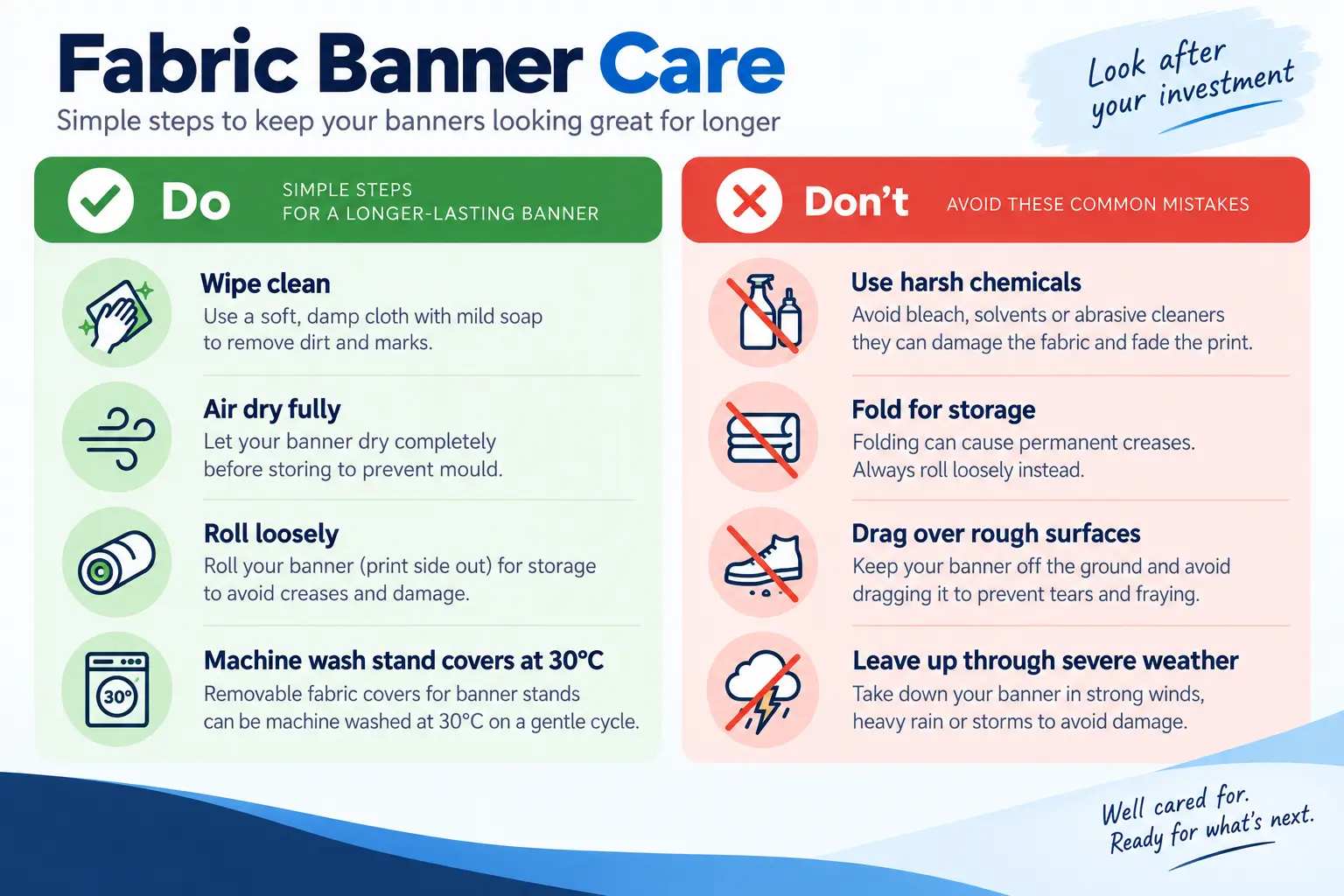
Fabric display material rewards a small amount of care with a genuinely long working life. Here is what keeps a fabric banner or stand cover looking sharp:
| Care step | What to do |
| Cleaning | Wipe or gently hand-wash with mild soapy water; avoid harsh chemicals or abrasive cleaners |
| Drying | Air dry fully before packing away, to prevent mould, odours or colour transfer |
| Storage | Keep in a dry, cool place; roll loosely rather than folding, to avoid permanent creasing |
| Handling | Avoid dragging across rough or sharp surfaces, which can snag or tear the weave |
| Outdoor exposure | Take standard and HD Eco banners down ahead of storms or sustained strong winds, even though the fabric is weather-resistant |
| Banner stand covers | Machine washable at 30°C without detergent; replacement covers can be ordered separately if a graphic needs updating |
Followed consistently, this routine is the difference between a fabric banner that still looks new after two dozen events and one that starts to look tired after three.
Frequently Asked Questions
Can fabric banners be used outdoors?
Yes — both Standard and HD Eco fabric are designed to perform outdoors with reasonable resistance to weather and UV exposure. Standard fabric’s lighter weight actually helps outdoors, since it allows a little airflow and reduces strain on the material; HD Eco is better suited to sheltered or shorter-term outdoor use given its heavier weight.
Will the print show through to the other side?
With Standard Fabric, yes, to some degree — which is actually useful for double-sided visibility. HD Eco Fabric’s higher opacity significantly reduces show-through, making it the better choice where a solid, one-sided display matters.
How long does a fabric banner stand frame last?
The aluminium frame is designed to be fully reusable — only the printed fabric cover needs replacing when a campaign or message changes, which is both more cost-effective and lower-waste than buying a new stand each time.
Are fabric banners eco-friendly?
Both fabric weights are made from 100% recycled polyester, and old covers can be recycled with other textiles at end of life, supporting a more sustainable display cycle than single-use PVC.
Do fabric banners meet fire safety standards?
Yes — Sailflags’ fabric materials meet recognised fire safety certifications (including DIN and EN standards), suitable for exhibitions, indoor venues and public spaces with their own compliance requirements.
What if I need something tougher than standard or HD Eco fabric?
For sustained harsh outdoor exposure, ToughTex fabric or an air mesh banner will outperform standard fabric weights — worth a conversation with the Sailflags team about the specific site before ordering.
Can I get a replacement graphic for my banner stand without buying a new frame?
Yes — replacement fabric covers can be ordered separately from the frame, which is the main cost advantage of a banner stand over a flat banner for anyone attending events regularly: the aluminium frame is reused indefinitely, and only the printed cover is replaced when the message, branding or season changes.
Is there a minimum order size for fabric banners?
No — Sailflags produces fabric banners to any custom size with no minimum order, whether that is a single banner for a one-off event or a set for an ongoing campaign.
Choosing the Right Fabric Product
For most indoor, exhibition and repeat-use display needs, the decision comes down to two questions: how solid does the graphic need to look, and do you need a complete freestanding display or just the fabric itself? Standard Fabric suits short-term, budget-conscious indoor use; HD Eco Fabric suits backdrops and premium single-sided displays; and a Fabric Banner Stand suits anyone who wants a professional, reusable display that goes up in minutes with nothing else to buy.
Not sure which is right for your next event or space? Sailflags’ team can talk through sizing, single vs double-sided printing, and which fabric weight fits your use case — with a free design service included either way. Explore the full Fabric Banner range or get a free, no-obligation quote to get started.