

Anyone who has watched a banner balloon, tear at the eyelets, or come loose from Heras fencing in a stiff coastal gale already knows the problem: standard banners and wind do not mix well. The material that makes a solid fabric or PVC banner look crisp and vibrant is exactly what turns it into a sail the moment the wind picks up. That is where mesh comes in. Air mesh banners are built specifically to let wind pass through rather than push against the surface, and understanding when to choose mesh over a standard banner — and which type of mesh — can save you a replacement order, a support call, and a banner that has torn loose halfway through an event.
This guide breaks down exactly how air mesh banners differ from standard banners, when each material makes sense, and how to finish and fix a banner correctly so it stays up in exposed or high-wind locations.
What Counts as a “Windy Site”?
“Windy” covers more ground than most people expect. It is not just coastal Cornwall or the top of a hill. In practice, a site counts as exposed to wind risk if it involves any of the following:
- Construction sites and scaffolding, where banners are mounted at height with little shelter
- Heras fencing and crowd barriers around events, building sites or car parks
- Building wraps and large-format signage on the sides of structures
- Coastal, hilltop or open countryside locations with consistently higher average wind speeds
- Car forecourts, retail parks and roadside pitches, where open ground creates a wind tunnel effect even away from the coast
- Festival and outdoor event sites, particularly anything set up for more than a single day
The UK’s wind exposure varies significantly by region and terrain — coastal and upland areas consistently record the highest sustained speeds, which is worth bearing in mind if you are supplying signage to sites across several regions rather than a single fixed location. Somewhere like the Shetland Islands or the Cornish coast will see meaningfully higher average wind speeds year-round than an inland city, but even an inland site can behave like a coastal one if it sits on open ground with nothing to break the wind — a retail park, a playing field, or a construction site cleared of surrounding buildings all fall into that category.
It is also worth thinking about duration, not just location. A banner going up for a single afternoon event has a far smaller window of risk than one left on Heras fencing for six weeks over a British autumn. The longer a banner is exposed, the more likely it is to catch at least one genuinely severe gust, so duration and location should both factor into the material decision, not location alone.
Why Standard Banners Struggle in Wind
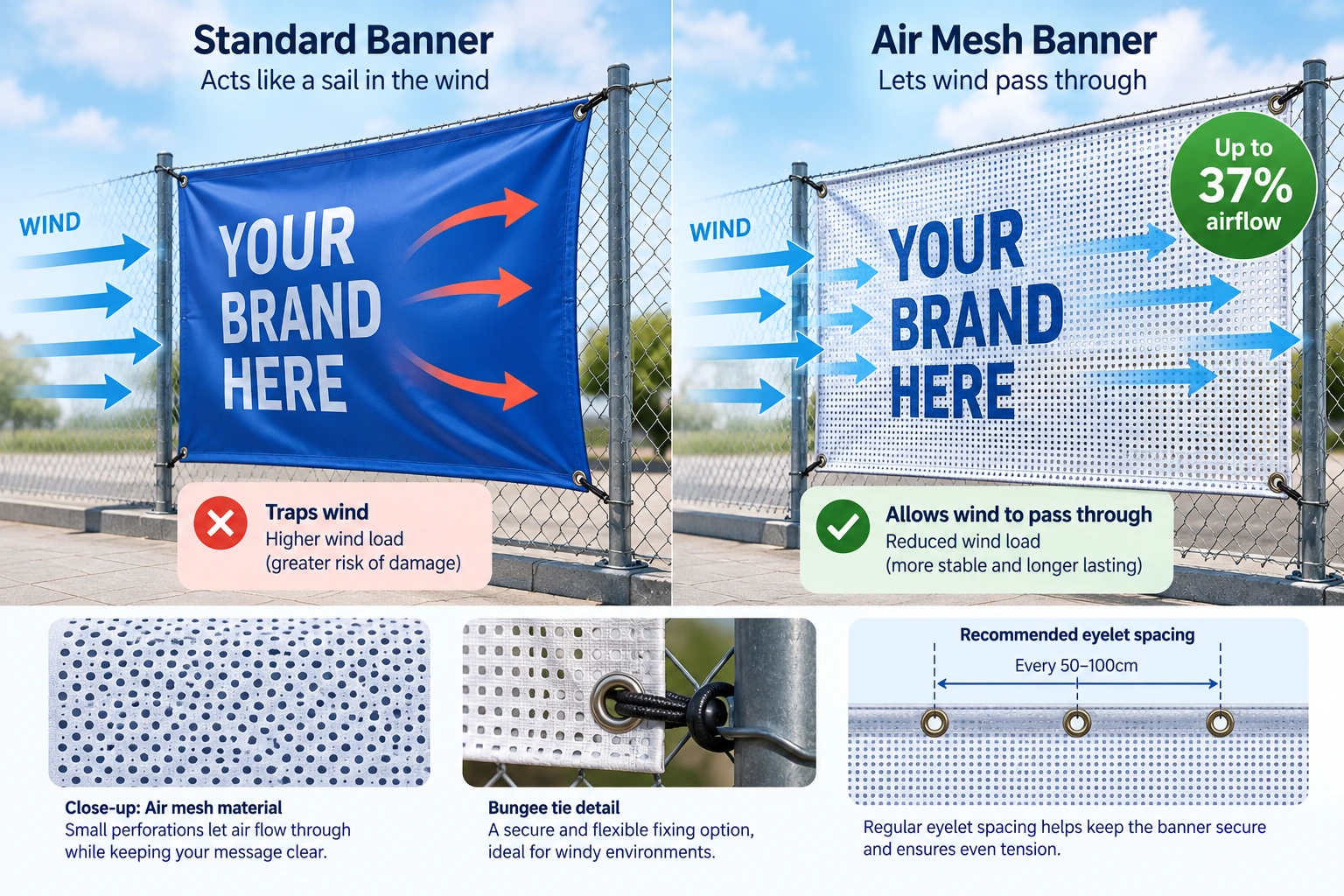
A standard PVC or fabric banner is, by design, a solid, continuous sheet. That is precisely what gives it strong, saturated colour and a clean, professional finish — but it also means the entire surface area catches the wind at once. Every gust puts load through the eyelets, the hems and whatever the banner is tied or bolted to. Over time, or in a single severe gust, that load can tear eyelets out, rip seams, or pull fixing points away from a fence or frame altogether.
This is sometimes called the “sail effect”: the banner behaves less like signage and more like a sail catching wind, with all the force that implies. It is not a flaw in a well-made standard banner — 440gsm and 500gsm PVC are both genuinely durable materials — it is simply a mismatch between a solid surface and a genuinely exposed location.
The damage this causes tends to follow a pattern. Eyelets are usually the first failure point, since they concentrate the entire wind load onto a small ring of reinforced material at a handful of points around the edge. Once one eyelet tears, the load redistributes across the remaining ones, and the failure tends to cascade quickly rather than happening one hole at a time. Hems fail differently — rather than tearing outright, repeated flexing in the wind can work stitching loose over weeks, so a banner might survive a single storm only to fail during ordinary, unremarkable wind a month later, simply from cumulative fatigue.
What Is an Air Mesh Banner?
An air mesh banner uses the same full-colour, UV-resistant printing as a standard banner, but on a perforated material rather than a solid one. Thousands of tiny holes run through the fabric or PVC mesh, allowing a meaningful percentage of wind — typically in the region of 25–37% depending on the material — to pass straight through the banner instead of pressing against it.
The practical effect is a banner that stays noticeably calmer in gusty conditions, with far less strain reaching the eyelets and hems. From typical viewing distances the graphic still reads clearly and boldly; up close, there is some visible texture and a small amount of light show-through, which is the trade-off for the reduction in wind load.
Air mesh is not a compromise version of a “proper” banner — it is a different tool engineered for a different problem. Print quality, colour vibrancy and durability of the ink itself are unaffected by the perforations; the only real trade-off is the small amount of visual texture and light show-through described above, set against a genuine, measurable reduction in the forces acting on the banner in wind. For most exposed sites, that trade is straightforwardly worth making.
Air Mesh vs Standard Banner: Side-by-Side Comparison
Here is how the two material types compare directly:
| Factor | Standard (Solid) Banner | Air Mesh Banner |
| Wind permeability | None — solid surface catches full wind load | High — perforated weave lets 25–37% of wind pass straight through |
| Typical weight | 440gsm (standard) or 500gsm (premium) PVC | 150gsm fabric or 290gsm PVC mesh |
| Best suited to | Shopfronts, indoor displays, short-term outdoor promotions, sheltered walls | Fencing, scaffolding, building wraps, coastal or elevated sites, crowd barriers |
| Print finish | Smooth, high-gloss, maximum colour impact | Slightly softer finish; still full-colour and UV-fade resistant |
| Longevity outdoors | Good for short-to-medium term; strain builds in gusty conditions | Built for sustained outdoor exposure with reduced strain on fixings |
| Relative cost | Lower entry price (from £20) | Slightly higher (from £25) for the added wind engineering |
The short version: if the site is sheltered, indoors, or the banner is only up for a day or two in ordinary conditions, a standard banner is simpler and slightly cheaper. If the site is exposed, elevated, coastal, or the banner needs to stay up for weeks rather than days, air mesh is the safer choice — and often the cheaper choice overall once you account for the cost of a replacement banner.
PVC Air Mesh vs Fabric Air Mesh: Which Mesh Is Right for You?
Not all air mesh is the same. Sailflags offers two mesh options, and the right one depends on how and where the banner will be used:
| Fabric Air Mesh | PVC Air Mesh | |
| Material | 150gsm recycled polyester, warp-knitted | 290gsm perforated PVC mesh |
| Feel & finish | Soft, textile handle; premium appearance | Smooth, semi-gloss; tougher hand-feel |
| Best for | Events, customer-facing branding, shorter-term use | Construction sites, long-term exposure, heavy handling |
| Eco profile | Made from recycled polyester; washable | Wipe-clean; durability reduces replacement frequency |
As a rule of thumb: choose PVC air mesh for construction sites, long-term fencing and anywhere the banner will take a knock; choose fabric air mesh for events, exhibitions and customer-facing branding where a softer, more premium finish matters and the eco-conscious recycled-polyester construction is a bonus.
When a Standard Banner Is Still the Right Call
Mesh is not automatically the better choice — it is the right choice for a specific problem. A standard PVC or fabric banner remains the better option when:
- The banner will be displayed indoors, or somewhere genuinely sheltered from wind
- It is a short, one-off use — a single day’s event in ordinary weather, for example
- Maximum colour saturation and a completely solid, opaque finish matter more than wind performance
- Budget is the primary driver and the site risk is genuinely low
When to Choose Air Mesh
Reach for air mesh whenever the site itself creates risk, regardless of how long the banner will be up:
- Heras fencing, crowd barriers or hoarding around a building site or event
- Scaffolding and building wraps, where height amplifies wind load
- Coastal, hilltop or otherwise exposed locations
- Any multi-week or permanent outdoor installation, where cumulative wind exposure adds up even in moderate conditions
- Large-format signage, where surface area — and therefore wind load — is greatest
Fixing and Finishing Banners for Exposed Sites
Material choice is only half the story — how a banner is finished and fixed matters just as much on an exposed site:
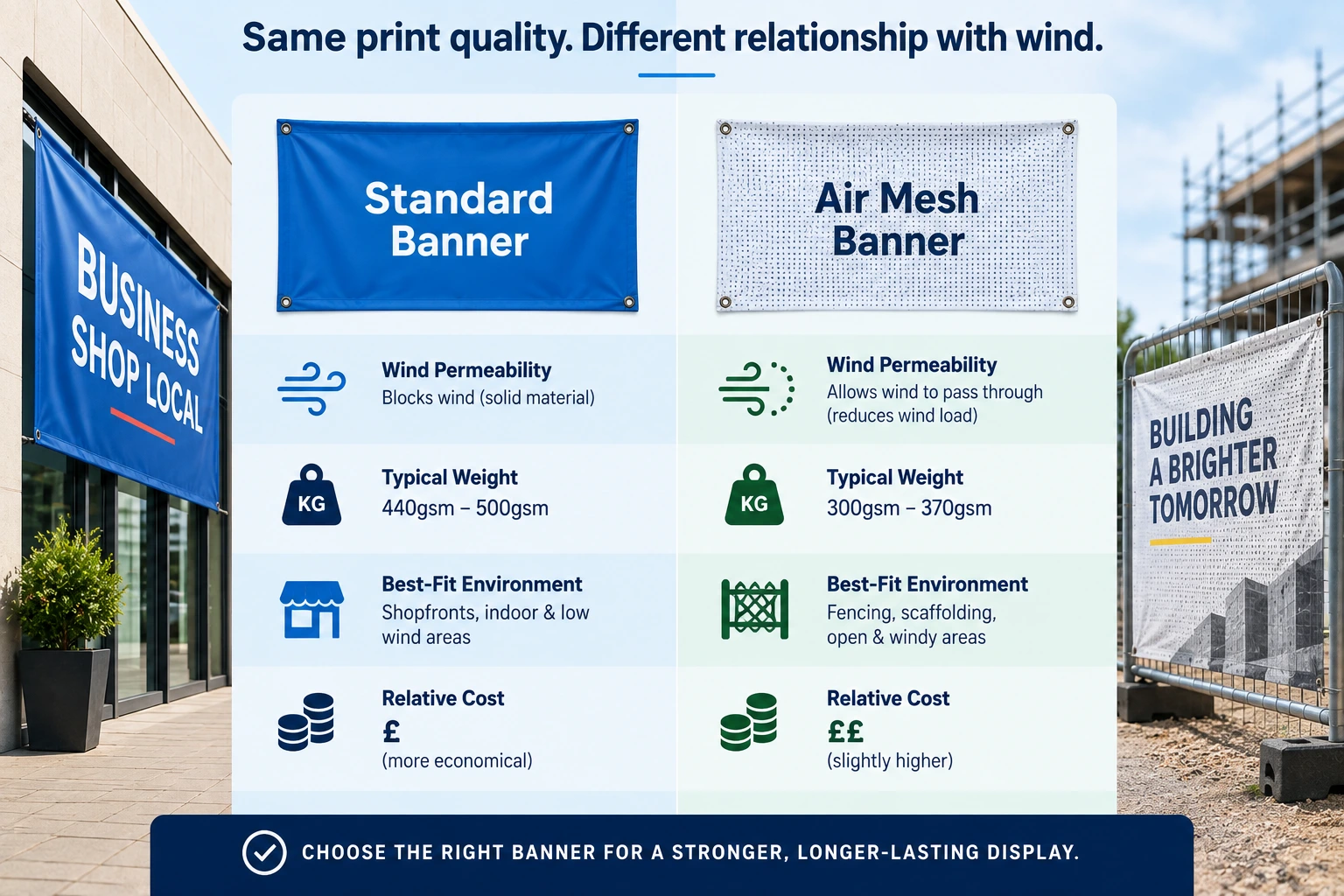
- Eyelets and hems: reinforced hems with evenly spaced eyelets spread load across multiple fixing points rather than concentrating it at the corners
- Bungee ties over rigid rope: bungees allow a banner to flex and “dance” in gusts rather than tearing, and they are quicker to fit and remove
- Fixing spacing: on fencing or barriers, tighter eyelet spacing reduces the amount of unsupported material between fixing points, which is where tearing tends to start
- Sizing to the frame: a banner cut slightly undersized for its frame, rather than stretched taut, gives wind somewhere to go without putting maximum strain on every fixing
These finishing choices matter almost as much as the material itself. A standard banner finished with generously spaced eyelets and secured with bungees on a sheltered wall can outlast a mesh banner that has been badly over-tensioned on an exposed fence with too few fixing points. Material and finish work together — neither one compensates fully for getting the other wrong.
A Note on Wind Limits and Safe Display
Even wind-permeable materials have limits. As a general guide, temporary signage of any kind — mesh included — is not recommended for display in sustained winds beyond around 35mph, and any banner should be taken down or additionally secured ahead of a forecast severe weather warning rather than left to ride it out. This matters more in the UK than it might elsewhere: coastal and upland areas regularly see gusts well beyond that figure, particularly through autumn and winter, so a banner destined for an exposed site is worth planning for the worst realistic conditions it will face, not just the average.
Frequently Asked Questions
Will people be able to see through an air mesh banner?
There is some light show-through and a small amount of visible texture up close, but from normal viewing distance the design reads clearly and with strong colour. Most people only notice the mesh structure if it is pointed out to them.
Is air mesh more expensive than a standard banner?
Slightly, at the point of purchase — but it is often cheaper overall on an exposed site, since it avoids the cost and disruption of replacing a torn standard banner.
Can air mesh banners be used indoors?
Yes, though the wind-resistant properties are wasted indoors. Fabric air mesh’s softer finish still works well for indoor branding if that particular look is wanted.
Do air mesh banners meet fire safety standards?
Sailflags’ air mesh materials are manufactured to recognised fire safety standards, with specific certification available on request — worth confirming for any venue or event with its own compliance requirements.
How do I look after a mesh banner between uses?
Fabric air mesh is washable; PVC air mesh wipes clean with a damp cloth. Let either dry fully before folding away for storage.
What if my site is exposed but I still want the sharpest possible print?
This is the one genuine trade-off worth weighing up: if colour saturation and a completely solid finish are the top priority and the site allows it, a heavier-duty standard option such as 500gsm premium PVC or a ToughTex fabric banner, properly fixed with bungees and closely spaced eyelets, can still be the right call for shorter-term use. For anything long-term or genuinely high-wind, mesh remains the safer choice.
Conclusion: Choosing the Right Banner for the Site
The choice between a standard banner and air mesh comes down to one question: how exposed is the site? Sheltered, short-term and indoor uses are well served by a standard PVC or fabric banner at a lower cost. Anything involving fencing, scaffolding, coastal exposure or a longer outdoor run is a stronger match for air mesh, which is built specifically to stay stable when a solid banner would be straining at every eyelet.
If you are not sure which material suits your site, Sailflags’ team can talk through the location, mounting method and how long the banner needs to stay up, and recommend the right option — with a free design service included either way. Explore the full Air Mesh Banner range or get a free, no-obligation quote to get started.