
If you have ever compared feather flag specifications, you will have seen a number followed by “gsm” and wondered whether it deserves any weight in your decision. Is a 115gsm flag better than a 110gsm one? Is a bigger number always a stronger flag?
The short answer is that gsm matters far less than it looks. A five-point gap between 110 and 115 is small, it sits close to normal manufacturing variation, and it tells you very little about how long a flag will last. We know this partly from our own range, where the tougher of our two fabrics is actually the lighter one on paper. More on that below.
This guide explains what gsm really measures, what 110gsm and 115gsm mean in practice, and what to look at instead. Sailflags has been making flags in Cornwall since 1999, so this is how we think about fabric when we specify it for customers.
| The short answer: gsm means grams per square metre. It describes how dense the cloth is. It does not describe how strong it is. The gap between 110 and 115gsm is roughly 4%. Per square metre of fabric, that is roughly the weight of one sheet of A4 office paper. Heavier is not automatically tougher. Our standard feather flag fabric is 115gsm. Our heavy-duty ToughTex is listed at 110gsm on its data sheet, yet it is the one built to last longer. What matters more: how the fabric is made, how the flag is printed and stitched, how it is flown, and the pole and base it sits on. |
What does gsm actually measure?
GSM stands for grams per square metre. Take a piece of fabric measuring one metre by one metre, weigh it, and the number of grams is its gsm. A 115gsm fabric weighs 115 grams per square metre. That is all the figure says.
It is a measure of density, which makes it a handy shorthand for how substantial a cloth feels. For comparison, standard office paper is usually 80gsm. A flag fabric at 115gsm is therefore about 1.4 times as dense as a sheet of paper, but it is made of woven or knitted yarn, not pressed pulp, so it behaves nothing like paper.
The important limit is this: gsm tells you how much material is in the cloth, not how well that material is put together. Two fabrics can share the same gsm and perform quite differently, because one uses a finer yarn in a tighter structure and the other uses a coarser yarn in a looser one. It is a bit like judging a rope by its weight per metre. It is a useful number, but it does not tell you how it is braided.
Is 110gsm vs 115gsm a real difference?
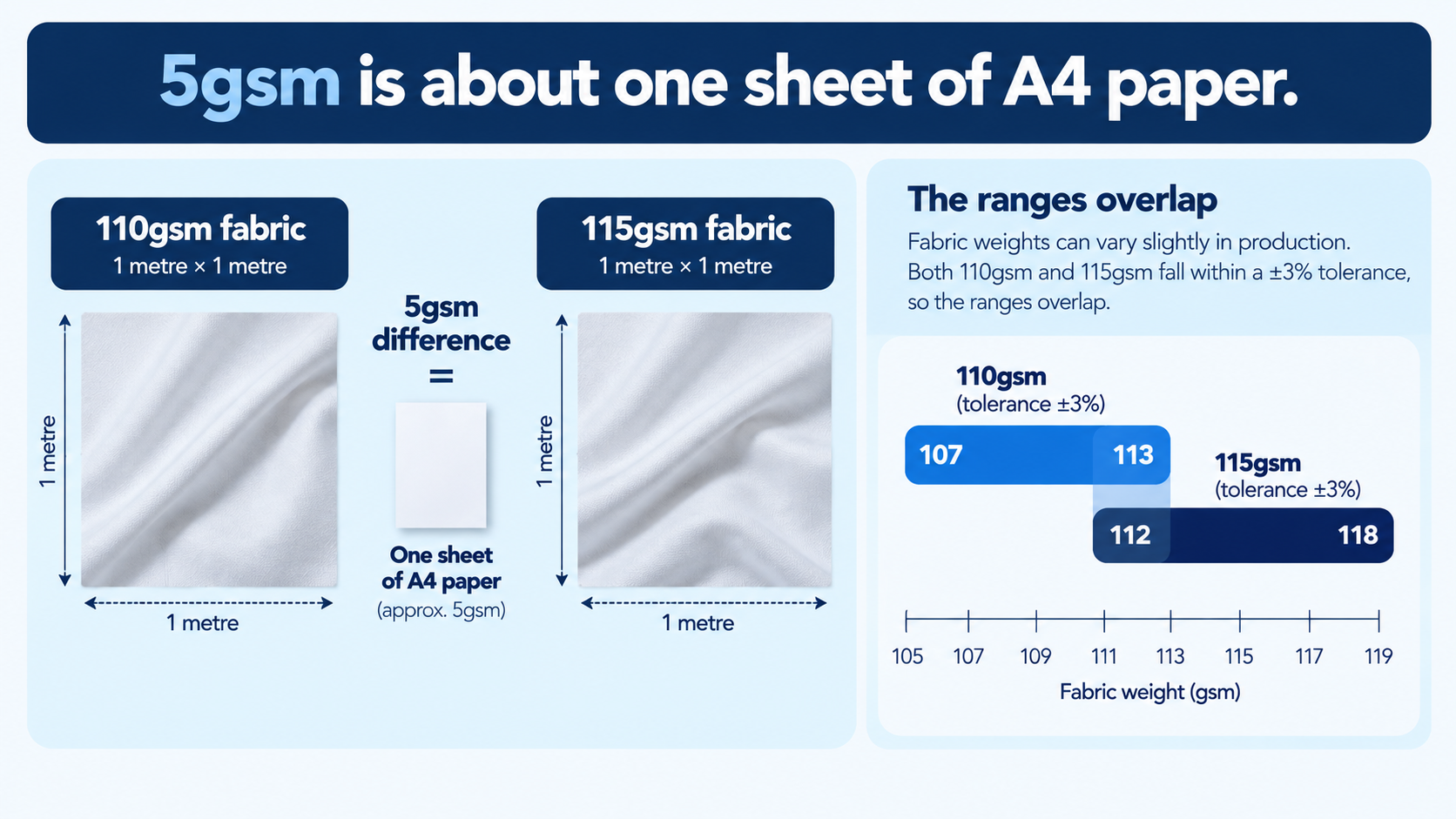
Technically yes, in the way that a 110 gram bar of chocolate is technically different from a 115 gram one. In use, you would struggle to notice it.
Here is the arithmetic. The gap is 5gsm, which is a little under 4.5% of 115. On one square metre of fabric, that is five grams. A sheet of A4 office paper at 80gsm weighs about five grams, so the difference between the two fabrics is roughly one sheet of paper per square metre of cloth. Spread across a feather flag, you cannot feel it in the hand and the flag cannot feel it on the pole.
There is also the matter of tolerance. Fabric is never made to the exact gram, and manufacturers quote an allowed variation. The ToughTex data sheet, for instance, gives its 110gsm weight with a tolerance of ±3%, which means a roll can legitimately land anywhere from about 107 to 113gsm. If a 115gsm fabric carried the same ±3%, it would run from about 112 to 118gsm. The two ranges overlap, so a nominal 110 and a nominal 115 could, in principle, weigh the same on a given day.
No tolerance is quoted here for our standard 115gsm fabric, so treat that overlap as an illustration of how small the gap is rather than a guarantee. The point stands either way: when two fabrics are this close in weight, the number is not the thing to decide on.
| A fair warning about very low numbers. None of this means gsm never matters. Much lighter cloth really is a different product. Our guide to feather flags for windy conditions notes that fabric under about 90gsm tends to tear more easily at the stress points around the pole pocket. A gap of 25gsm or more is worth paying attention to. A gap of 5gsm is not. |
The surprise in our own range
This is where it gets interesting, and where the “bigger number is better” rule falls over completely.
Our standard printed feather flags use 115gsm knitted polyester made from 100% recycled post-consumer PET. Our heavy-duty option, ToughTex, is a different fabric entirely. It is our exclusive material for harsher sites, and we design it to last up to twice as long as regular flag materials. Yet its technical data sheet lists its weight as 110gsm.
So the fabric built for tougher conditions is five gsm lighter than the standard one. If gsm measured toughness, that would make no sense. It makes perfect sense once you remember that gsm only measures density. What makes ToughTex tougher is the way it is made, not how much it weighs.
| Standard feather flag fabric | ToughTex heavy-duty fabric | |
|---|---|---|
| Weight | 115gsm | 110gsm (±3% tolerance on the data sheet) |
| Material | 100% recycled post-consumer polyester, knitted | 100% polyester, with a unique weave |
| Built for | Events, shopfronts, exhibitions and general outdoor display | Exposed sites, coastal locations and flags that are up for long periods |
| What the data sheet shows | Weight and material are stated in our guides; the data sheet is for ToughTex | Tear strength, stretch behaviour and a B1 flame-retardancy rating |
The ToughTex data sheet is a good example of what a useful specification looks like. Alongside weight, it lists tear strength (a minimum of 220 N per 5cm lengthways and 680 N per 5cm across the cloth), stretch behaviour in both directions, and flame retardancy to the B1 / EN13501 classification. Those figures say far more about how a flag will cope with real use than the gsm figure does. You can read the full document in the ToughTex technical data sheet, and our ToughTex introduction explains where it fits.
What actually decides how long a feather flag lasts
If weight is not the answer, what is? In our experience, it is a handful of things that interact with each other, and none of them is a single number on a spec sheet.
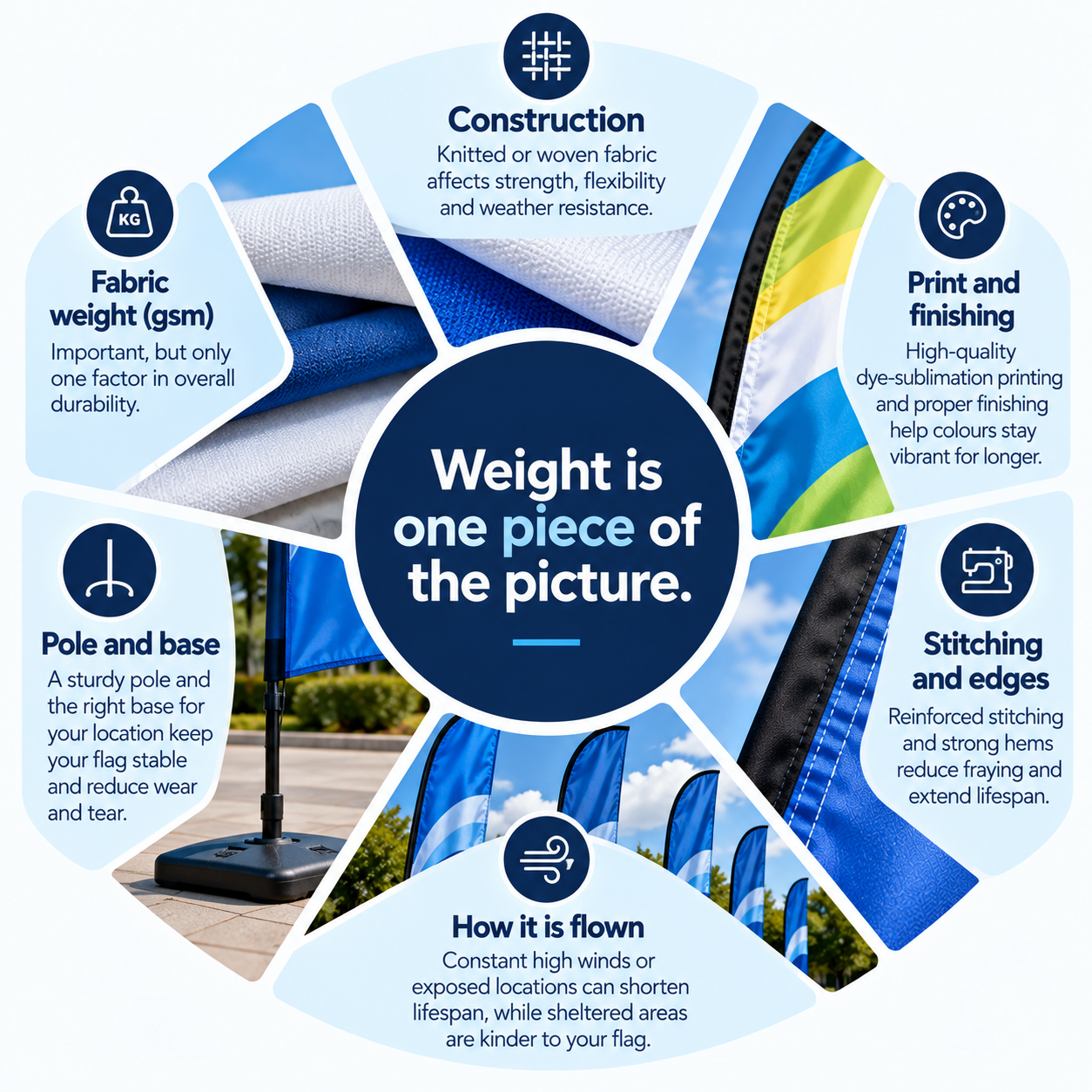
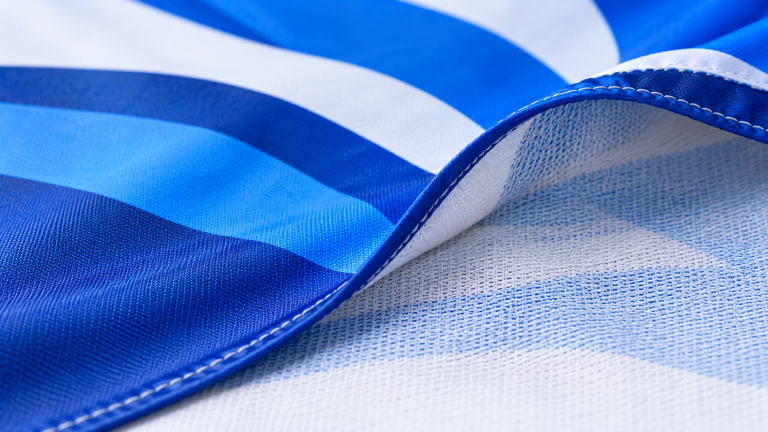
How the fabric is constructed
Knitted or woven, fine yarn or coarse, tight structure or open. This sets how the cloth moves, how it resists tearing and how it takes print. We cover the knitted side of this in our guide to knitted vs woven polyester for feather flags.
Print and finishing
We print with dye-sublimation, where the ink bonds into the polyester fibres rather than sitting on top as a coating. That is why the colour does not crack or peel, and it is also why the print does not add noticeable weight to the cloth.
Stitching and edges
Flags usually fail at the edges, the seams or the pole pocket before the middle of the cloth gives up. A well-finished hem does more for lifespan than a few extra grams. Our flag care page notes that repairs to flag material and stitching are free of charge, which is worth knowing before you write a flag off.
How the flag is flown
A flag left up around the clock ages faster than one that comes in at the end of the day. For most people this habit makes a bigger difference to lifespan than anything in the specification. Rest the flag on a flat surface, let it dry fully before storing it and take it down in rough weather.
The pole and base underneath
A feather flag is a system. The flag, pole and base share the load, and a poor choice in one puts pressure on the others. Our guide to feather flag poles, bases and hardware explains how to match them to the ground and the flag size.
Why heavier is not always better
It is tempting to think more fabric means more protection. In practice, extra weight has costs.
- Less movement. A feather flag has to flutter to catch the eye. Heavier cloth needs more wind to lift, so on a calm day it hangs rather than flies.
- More load at the top of the pole. Feather flag poles are designed to flex. Extra weight at the tip increases leverage on the base, particularly on taller flags.
- Higher cost. More material costs more to make, and you may be paying for weight you do not need.
Double-sided flags make the point neatly. They are built from two printed panels and a blockout liner, and our windy-conditions guide puts them at roughly 40–60% heavier than a single-sided flag of the same size. That is a far bigger jump than the gap between 110 and 115gsm, and it is why we suggest stepping up the base on a double-sided flag. If you are weighing the two, our guide to single-sided vs double-sided feather flags covers it in full.
How to read a gsm figure on any spec sheet
Next time you see a gsm number, run through these five questions before you let it influence your decision.
- Is it the same type of fabric? Comparing a knitted flag fabric with a woven one by gsm alone is like comparing a jumper with a tablecloth. Compare like with like.
- Is there a tolerance? A figure with no tolerance is a nominal figure. A difference of a few gsm sits inside normal variation.
- Is it one layer or several? A double-sided flag has more fabric in it than a single-sided one. Make sure you are comparing the same construction.
- Is there anything else on the spec? Tear strength, stretch and certification all tell you more than weight. If the only thing a supplier quotes is gsm, ask what else they can share.
- Is it recycled and certified? Weight says nothing about origin. Our fabrics are made from 100% recycled post-consumer PET, with up to 60% of that sourced through the SEAQUAL® Initiative, and our eco credentials page sets out the certification behind it.
So which should you choose?
For most people, the honest answer is that 110 or 115gsm should not be what you choose between. Choose by where the flag will fly and how often it will be up.
| Your situation | What to ask for | Why |
|---|---|---|
| Events, markets, shopfront flags taken in each day | Standard 115gsm knitted polyester | Moves well, prints vividly and stays light on the pole |
| Exhibitions and indoor displays | Standard 115gsm knitted polyester | No weather to resist, so there is nothing to gain from heavier cloth |
| Coastal, forecourt or exposed sites, flag up most of the time | ToughTex heavy-duty fabric | Built for harsher use, regardless of its 110gsm weight |
| A flag with text or logos that must read from both sides | Double-sided, then step up the base | The extra panel and liner add far more weight than any gsm difference |
Size matters too, so have a look at our feather flag sizes guide before you settle on a height. If a part wears out in time, our replacement parts guide explains what to buy.
Frequently asked questions
What does gsm stand for on a flag?
Grams per square metre. It is the weight of one square metre of the fabric, and it is a measure of how dense the cloth is.
Is 115gsm good for feather flags?
Yes. It is the weight we use for our standard knitted polyester feather flags, and it suits the great majority of event, shopfront and exhibition use. For sites where a flag is outside most of the time, our heavy-duty ToughTex fabric is the better fit.
Is 110gsm worse than 115gsm?
Not on weight alone. The gap is small and sits close to normal manufacturing variation. What the fabric is made of and how it is constructed matter far more. Our ToughTex fabric is listed at 110gsm and is the more durable of our two options.
Is a higher gsm always stronger?
No. Gsm measures how much material is in a square metre of cloth, not how well it is put together. A tighter, better-constructed fabric can outperform a heavier but looser one.
What gsm are Sailflags feather flags?
Our standard feather flags are 115gsm knitted polyester made from 100% recycled post-consumer PET. ToughTex, our heavy-duty fabric, is listed at 110gsm on its technical data sheet.
Does gsm affect print quality?
Only indirectly. Print quality depends mainly on the fabric’s surface and structure and on the printing method. We print with dye-sublimation, which bonds the ink into the fibres, and we send a free design proof with every order so you can check the artwork before anything is printed.
Does gsm change which base I need?
Not meaningfully at this level. What changes the load on the base is the flag size, whether it is double-sided and how exposed the site is. Match the base to the surface and step up a tier for tall, double-sided or exposed flags.
The bottom line
Fabric weight is worth understanding, but it is not worth agonising over. The difference between 110gsm and 115gsm is small, close to normal variation and a poor predictor of how long a flag will last. Look at how the fabric is made, how the flag is finished, where it will fly and what it is standing on.
If you would like help choosing, tell us where the flag will be used and how often it will be up, and we will recommend the right fabric. Sailflags is an employee-owned business, rated 4.9 on Trustpilot from over 1,200 reviews, and the team can talk fabric all day. You can get a free quote, start designing in our online flag creator, or look at our full range of custom feather flags.