

Searching for ‘cheap feather flags’ in the UK returns a wide range of prices — from under £30 for a complete kit to over £150 for a comparable size from a different supplier. The range is wide enough to make the question of what you’re actually paying for genuinely confusing.
This guide is not a product pitch. It is a plain-English explanation of what drives feather flag pricing, what quality markers to look for, where suppliers cut corners on lower-priced products, and how to identify the best value for money — not necessarily the lowest price. The goal is to help you buy once and buy right, because the flag that costs £35 and lasts one season costs significantly more per week of use than the flag that costs £79 and lasts three years.
1. What Actually Determines Feather Flag Cost?
Feather flag pricing is driven by six factors. Understanding each one makes it straightforward to evaluate why any given flag costs what it does.
Fabric Weight and Type
Flag fabric is measured in grams per square metre (GSM). For outdoor feather flags, the industry standard is 115gsm knitted polyester — a weight that balances print vibrancy, wind movement, and outdoor durability. It is light enough to respond to a gentle breeze but dense enough to hold colour and resist fraying over repeated outdoor use.
Flags sold at very low price points often use lighter fabric — 80gsm or below — which shows more translucency, tears more readily at stress points, and degrades faster under UV exposure. Heavier fabrics exist too: 160gsm and above provide greater durability for permanently installed flags, but are significantly heavier and move less freely in wind, which reduces the visual impact that makes feather flags effective.
Sailflags uses 115gsm 100% recycled polyester across its standard feather flag range — a fabric weight specifically chosen for the balance between vibrancy, outdoor performance, and responsible sourcing.
Printing Method
This is the single most important quality differentiator in the flag market. There are two methods used for fabric flag printing:
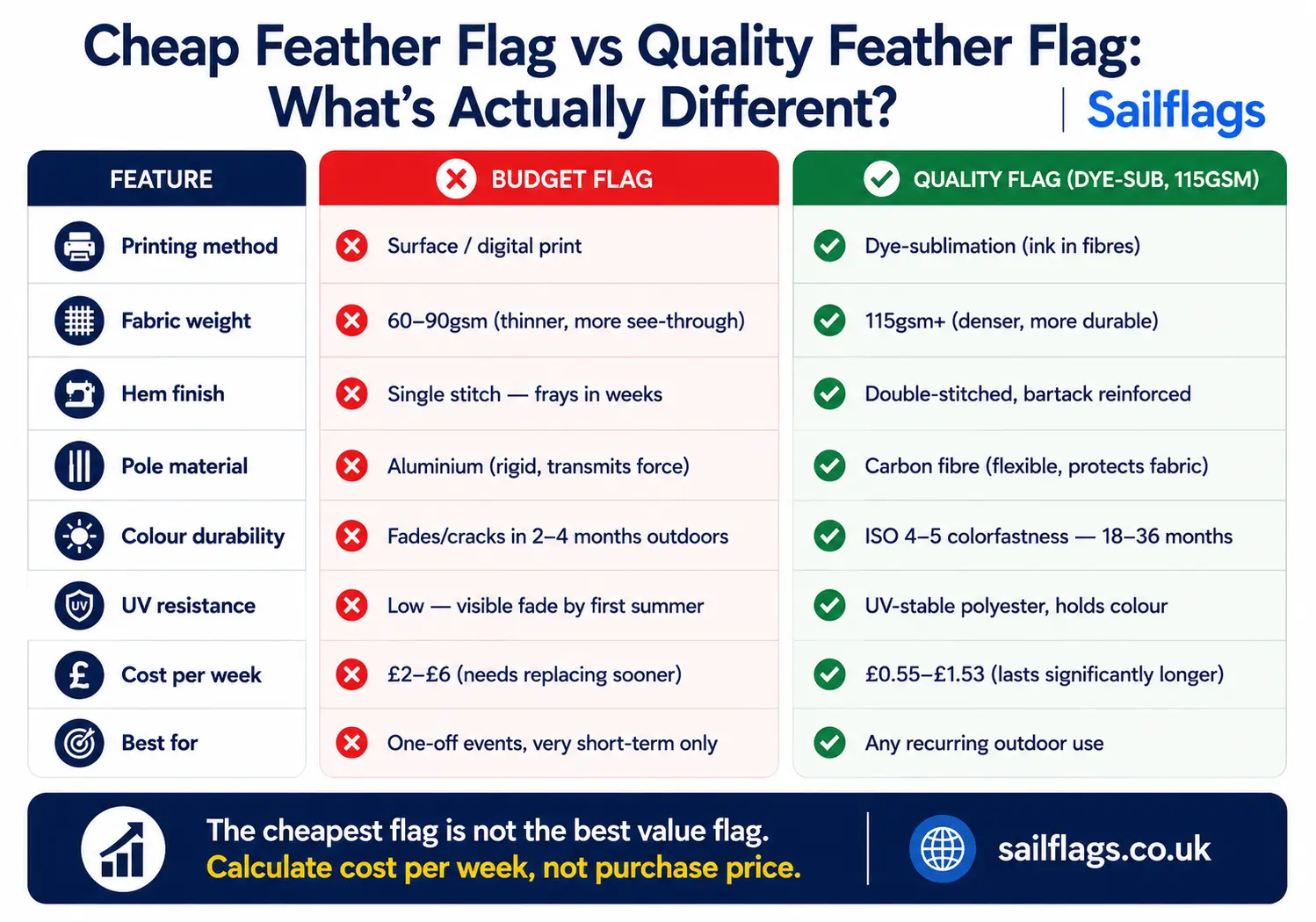
- Dye-sublimation (heat-transfer): the correct method for flag printing. Sublimation ink is printed onto transfer paper, then heat-pressed onto the polyester at approximately 200°C. At that temperature, the ink converts from solid to gas and bonds permanently with the fabric fibres at a molecular level. The colour is embedded into the material — it cannot crack, peel, or wash out, because it has become part of the fabric itself. Colour accuracy is high, gradients reproduce cleanly, and the result is rated to ISO 105-B02 colourfastness standards of 4–5 (the maximum for fade resistance).
- Digital or screen surface printing: ink is applied onto the surface of the fabric rather than embedded into it. This is faster and cheaper per unit but produces a result that sits on top of the fabric fibres. In outdoor conditions — UV exposure, rain, repeated winding and unwinding — surface-printed flags fade, crack, and peel significantly faster than dye-sublimation alternatives. For a flag used once at a single indoor event, this may not matter. For a flag used weekly outdoors for two years, it is the difference between a product that keeps looking good and one that looks degraded within a season.
| How to check: ask the supplier Ask any supplier directly: ‘Is this dye-sublimation printed?’ A reputable UK flag manufacturer will confirm this immediately. If the answer is vague (‘high-quality digital printing’ or ‘full-colour print’) without specifically naming dye-sublimation, ask for clarification. Surface-printed flags are rarely described as such in marketing material. |
Finishing: Sewing, Hemming, and Pole Pockets
A well-made feather flag is sewn, not just printed and cut. The finishing quality determines how long the flag holds together under stress:
- Double-stitched hems: the edges of the flag are folded and sewn twice, creating a reinforced seam that resists fraying at the edges where the fabric is under constant movement.
- Bartack reinforcement: stress points — particularly the corners and the junction between the pole pocket and the flag body — should have bartack stitching (a dense cross-stitch pattern) that prevents tearing propagating from high-stress areas.
- Pole pocket construction: the sleeve through which the pole runs should be sewn from a heavier fabric or a doubled layer of the flag fabric, with reinforced stitching at the top and bottom. A pole pocket that tears is the most common reason flags need early replacement.
On lower-priced flags, finishing is where costs are most commonly cut. A flag with excellent dye-sublimation printing but poor hemming will still fail at the seams within a season.
Pole Material
The pole system accounts for a significant portion of the complete kit cost. The three materials used are aluminium, fibreglass, and carbon fibre — each with different performance characteristics:
- Aluminium: lightweight and inexpensive, but rigid. In strong wind, an aluminium pole transmits force directly to the flag fabric and base rather than flexing to absorb it.
- Fibreglass: flexible and corrosion-resistant. The standard choice for most outdoor flag applications — flexes controllably in wind, reducing stress on the flag fabric.
- Carbon fibre: the lightest and most flexible option. Sailflags uses carbon fibre poles across its range — they are significantly stronger than fibreglass alternatives, resist UV degradation that causes fibreglass to yellow and become brittle, and provide the optimal flex characteristics for flag longevity in exposed outdoor locations.
Design Service
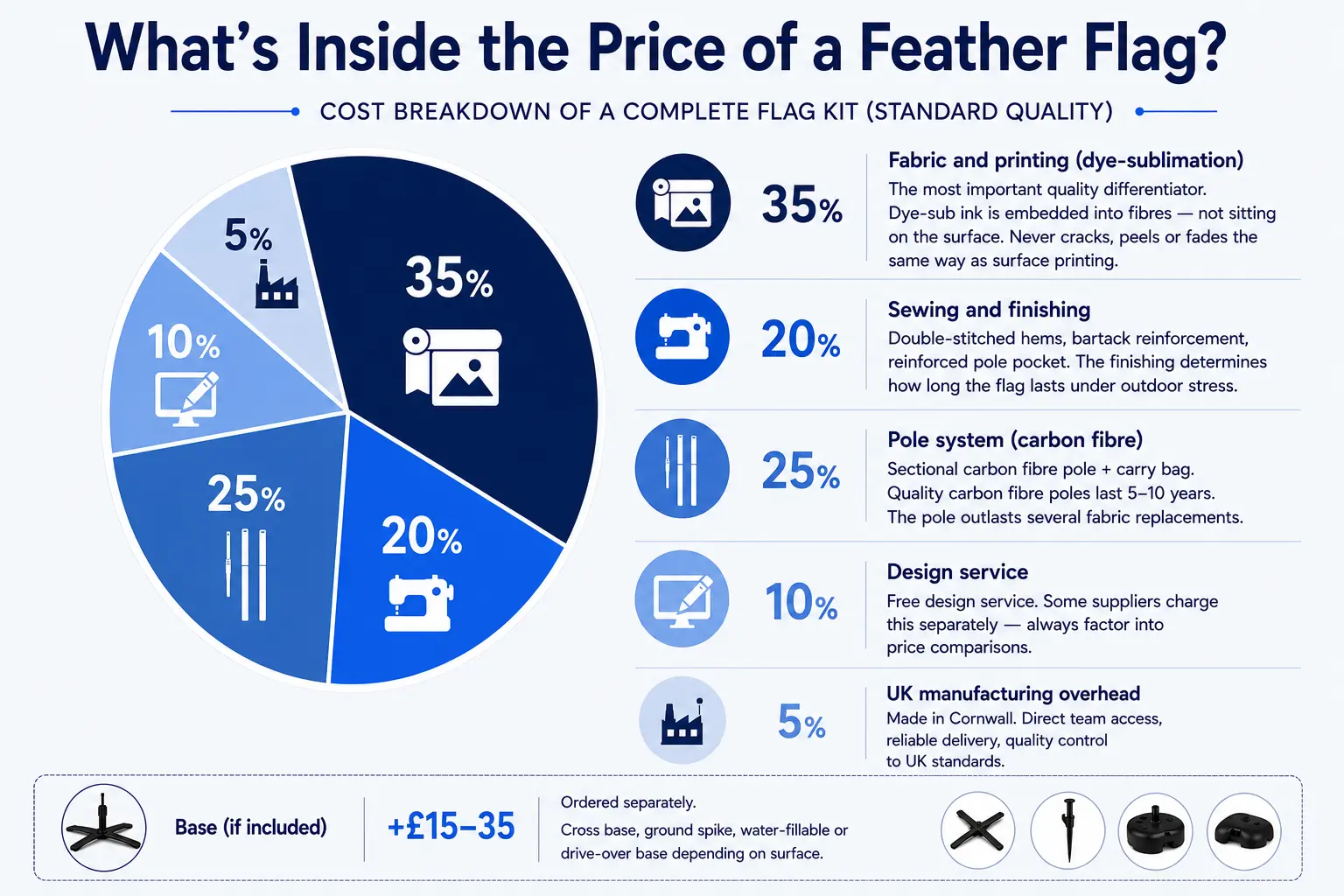
Some suppliers charge separately for design and proofing. Others, including Sailflags, include a free design service with every order — creating a layout from your logo and brief, proofing it, and revising until you approve, at no additional cost. The inclusion or exclusion of design work from the headline price makes a significant difference to the true cost of a first order.
Manufacturing Location
UK-manufactured flags carry higher production costs than overseas equivalents, for obvious reasons. They also offer meaningful practical advantages: faster communication when artwork needs revision, reliable delivery timescales, quality control under UK manufacturing standards, and the ability to escalate issues directly with the production team rather than through a distribution chain. For recurring buyers and trade accounts, the value of a consistent, direct relationship with a UK manufacturer typically outweighs any per-unit price saving from sourcing overseas.
2. What Does a Feather Flag Actually Cost in the UK?
The table below gives indicative price ranges for quality UK-made dye-sublimation feather flags with pole. Prices vary by supplier and may change — treat these as a realistic range rather than fixed figures.
| Size | Complete kit (flag + pole) | With base | Single-sided | Double-sided |
| 1.7m | £49–£65 | £65–£90 | Standard price | +20–40% |
| 2.4m | £65–£85 | £85–£110 | Standard price | +20–40% |
| 3.2m | £79–£110 | £99–£140 | Standard price | +20–40% |
| 4.2m | £95–£130 | £120–£165 | Standard price | +20–40% |
| 5.2m | £119–£155 | £145–£190 | Standard price | +20–40% |
Prices below the lower end of these ranges — particularly for complete kits including a base — should prompt questions about fabric quality, printing method, or finishing standards. A complete outdoor flag kit, including a quality base, is a multi-component manufactured product. Unit economics make it difficult to produce a quality kit for significantly less than the figures above.
| On ‘discount’ flags and coupon pricing Headline prices that are heavily discounted from an inflated RRP are a common marketing tactic. Evaluate the actual price you pay, not the ‘saving’ being claimed. A flag listed at £149 with a 50% discount coupon is simply a £74.50 flag marketed differently from one listed at £74.50 without a coupon. |
3. Where Quality Gets Cut on Cheap Flags — and Why It Matters
Low-GSM Fabric
A flag made from 80gsm or lighter fabric will appear similar in product photos to one made from 115gsm. In use, the differences become apparent within weeks:
- High translucency: lightweight fabric often appears “see-through,” reducing image vibrancy and clarity, particularly in direct sunlight.
- Rapid tearing: lower tear strength makes the flag prone to ripping, especially at stress points like the corners and pole pocket.
- Poor UV resistance: thinner materials degrade quickly under constant UV exposure, leading to brittle fabric and washed-out colours.
Surface Printing vs Dye-Sublimation
Surface-printed flags look similar to dye-sublimation flags when new. The difference becomes visible within one to three months of regular outdoor use:
- Cracking and peeling: surface ink sits on top of fibres and inevitably cracks and flakes off as the flag flexes in the wind.
- Rapid fading: surface-printed designs fade significantly faster because the ink is not bonded to the fibres, losing impact after just a few months.
- Degraded appearance: within a single season, the surface-printed flag looks worn and dull compared to the lasting vibrancy of dye-sublimation.
For a one-day indoor event, a surface-printed flag may be entirely acceptable. For outdoor use, or any use where the flag will be reused over months, dye-sublimation is not a premium option — it is the only option that makes economic sense over time.
Poor Sewing Finishing
The most common point of failure on cheaper flags is the sewing:
- Unprotected edges: single-stitched hems lack the reinforcement needed to prevent fraying as the flag whips in the wind.
- Weak stress points: without bartack reinforcement, the corners and pole pocket junctions rip open quickly under tension.
- Pole pocket failure: poorly constructed sleeves rip easily during pole insertion or removal, often rendering the flag unusable.
| The test to apply before buying Ask the supplier: ‘What GSM fabric do you use? Is the printing dye-sublimation? Are the hems double-stitched?’ A supplier who manufactures quality flags will answer all three questions immediately and specifically. Vague answers (‘high quality materials’, ‘professional printing’) are a signal to probe further. |
4. The Real Cost of Ownership: Cheap Flag vs Quality Flag
The correct way to evaluate feather flag pricing is not the purchase price but the cost per week of effective use — the price divided by the number of weeks the flag performs to a standard that represents your brand positively.
| Budget flag (surface print, 80gsm) | Quality flag (dye-sub, 115gsm) | Quality flag (ToughTex) | |
| Purchase price | £35–£50 | £79–£110 | £110–£150 |
| Usable lifespan | 2–4 months | 18–36 months | 36–60 months |
| Weeks of use | 8–16 weeks | 72–144 weeks | 144–240 weeks |
| Cost per week | £2.19–£6.25 | £0.55–£1.53 | £0.46–£1.04 |
| Replacements in 3yr | 6–9 flags | 1–2 flags | 1 flag |
| 3yr total spend | £210–£450 | £79–£220 | £110–£150 |
The pattern is consistent: a budget flag used outdoors regularly is the most expensive flag over any meaningful period of time. The only scenario where a budget flag represents good value is a single short-duration use — a one-day exhibition, a single outdoor event — where the flag will not be reused.
For any recurring outdoor use — a shopfront, a weekly market stall, a regular event presence — the quality flag costs less over the period where it matters.
| What ToughTex adds to the equation Sailflags’ ToughTex heavy-duty fabric is engineered for long-term outdoor use in exposed or challenging conditions — coastal sites, motorway-adjacent forecourts, permanently installed outdoor displays. ToughTex lasts up to twice as long as standard 115gsm fabric in high-exposure environments. The premium over standard fabric is modest; the lifespan extension is significant. See: sailflags.co.uk/introducing-toughtex-heavy-duty-flags-banners/ |
5. How to Get the Best Value — Smart Buying Strategies
Match the Flag to the Use Case
Overpaying for more flag than you need is as easy as underpaying for less. Use the following as a starting guide:
- Single indoor event, not reused: a mid-range quality flag is sufficient. The priority is correct sizing, a design that reads well in the space, and the right base for the floor surface.
- Weekly outdoor display, seasonal: standard dye-sublimation on 115gsm is the right choice. Budget for a quality base that will outlast several fabric replacements.
- Permanent or semi-permanent outdoor: ToughTex or a heavier fabric variant. The higher upfront cost is repaid within the first year.
- Multiple locations or trade use: a trade account provides volume pricing that reduces per-unit cost significantly across recurring orders.
Single-Sided Unless You Genuinely Need Double
As covered in the single-sided vs double-sided guide, double-sided flags carry a 20–40% price premium. For flags that face one direction — a shopfront flag, a roadside flag, a flag against a fence — that premium adds no value. Only order double-sided when your display position genuinely requires both faces to be correctly printed. Doing so unnecessarily is the simplest way to overspend on a flag order.
Order to a Realistic Turnaround, Not an Urgent One
Express and priority production carry a price premium. If your event or campaign date is known in advance, ordering on a standard production schedule costs meaningfully less than the same flag on a 24-hour turnaround. Plan ahead and use standard delivery where the timeline allows. Reserve express options for genuinely urgent orders where no other option exists.
Reuse the Pole and Base; Replace Only the Fabric
A quality carbon fibre pole will last five to ten years with normal care. A quality base will last at least as long. The fabric — which receives most of the wind, UV, and handling stress — has a shorter lifespan. When a flag fabric reaches the end of its useful life, replacing only the fabric rather than the complete kit saves significantly:
- See: feather flag accessories and replacement fabrics for the full range.
Use the Free Design Service
Design and proofing costs add to the real cost of a flag order if charged separately. Sailflags includes a free design service — layout creation, proofing, and revisions — at no additional charge with every order. This is worth factoring into any like-for-like price comparison with suppliers who charge for design separately.
6. What to Look For When Assessing Any Flag Supplier
The following checklist applies to any UK flag supplier you are evaluating, including Sailflags. Apply it consistently rather than taking marketing claims at face value.
| Quality indicator | What to look for | Red flag |
| Printing method | Dye-sublimation confirmed | Vague ‘digital print’ language |
| Fabric specification | 115gsm+ polyester stated | No fabric spec mentioned |
| Finishing | Double-stitched hems described | No finishing detail |
| Pole material | Fibreglass or carbon fibre stated | No pole material stated |
| Design service | Free proofing included | Design charged separately |
| Manufacturing | UK-made or clearly stated origin | Origin not stated |
| Warranty/guarantee | Written quality guarantee | No guarantee information |
| Reviews | Verified independent reviews | Reviews on own site only |
| Contact/support | Phone number and direct team | Contact form only |
Sailflags publishes independent reviews at sailflags.co.uk/about-us/our-reviews/ and the full product specification — including fabric weight, printing method, and pole material — is detailed on every product page. The Cornwall manufacturing team is reachable directly by phone on 01736 719111.
7. Frequently Asked Questions
How much does a feather flag cost in the UK?
A quality single-sided feather flag kit (flag + pole, no base) from a UK dye-sublimation manufacturer starts at approximately £49 for a 1.7m flag and £79–£110 for the most popular 3.2m size. Complete kits including a ground spike or cross base typically add £15–£35 to these figures. Significantly lower prices are possible but usually indicate lower fabric weight, surface printing, or overseas manufacturing with extended lead times.
Are cheap feather flags worth buying?
For a single short-duration use — one event, one day — a lower-cost flag may serve the purpose adequately. For any recurring outdoor use, the answer is almost always no: a cheap flag used regularly outdoors costs more per week of effective use than a quality flag, because it needs replacing far sooner. The calculation in Section 4 above demonstrates this clearly.
What is the cheapest way to get a feather flag?
The most cost-effective route to a quality flag is to order on a standard production schedule (avoid express premiums), order single-sided rather than double-sided unless the display position requires both faces, use the free design service rather than commissioning separate design work, and keep the pole and base for fabric replacements rather than ordering complete kits each time. For repeat buyers, a trade account provides volume pricing that reduces per-unit cost further.
How much do feather flags cost for custom designs?
At Sailflags, custom-printed feather flags are priced the same as standard flags — custom design is included in the price via the free design service, not charged as an additional item. There is no price difference between a flag printed with an existing design and one created from scratch by the design team. There is also no minimum order quantity, so single custom flags are available at the standard unit price.
Are feather flags near me cheaper than ordering online?
Local flag suppliers may exist in some areas, but the UK feather flag market is predominantly served by manufacturers who operate nationally through direct-to-door dispatch. Buying from a UK-based online manufacturer typically costs the same or less than a local supplier, because the online manufacturer operates at production scale rather than as a local reseller. Delivery to anywhere in mainland UK from Sailflags’ Cornwall factory is typically 1–5 working days depending on the service selected.
Do feather flag prices include VAT?
Always confirm whether a quoted price includes or excludes VAT. UK VAT-registered businesses charge 20% VAT on flag products. A price of £79 ex-VAT becomes £94.80 including VAT. Sailflags prices on the website are displayed including VAT for consumer buyers. VAT-registered business buyers can reclaim the input VAT through their standard VAT return.
Is there a discount for ordering multiple flags?
Yes. Volume discounts apply on orders for multiple flags at Sailflags — the per-unit price decreases as quantity increases. For agencies, resellers, and businesses equipping multiple sites, the Sailflags trade account provides structured volume pricing across the full product range, plus white-label dispatch and priority production.
The Right Flag at the Right Price
The cheapest feather flag is not the best value feather flag. The best value flag is the one that costs the least per week of effective outdoor use — and across any period of regular use, that flag is consistently one made from quality dye-sublimation printed fabric on a reinforced, well-finished construction.
The questions to ask any supplier are simple: what GSM fabric, what printing method, what sewing finish, what pole material. Suppliers who make quality flags will answer all four immediately. Those who deflect or respond with vague language about ‘premium quality’ without specifics are telling you something useful.
At Sailflags, every feather flag is dye-sublimation printed onto 115gsm 100% recycled polyester, double-stitched and hemmed by hand in our Cornwall factory, and supplied on a carbon fibre pole system. The free design service is included with every order. Prices start from £49 for a complete flag and pole, with no minimum order quantity.