
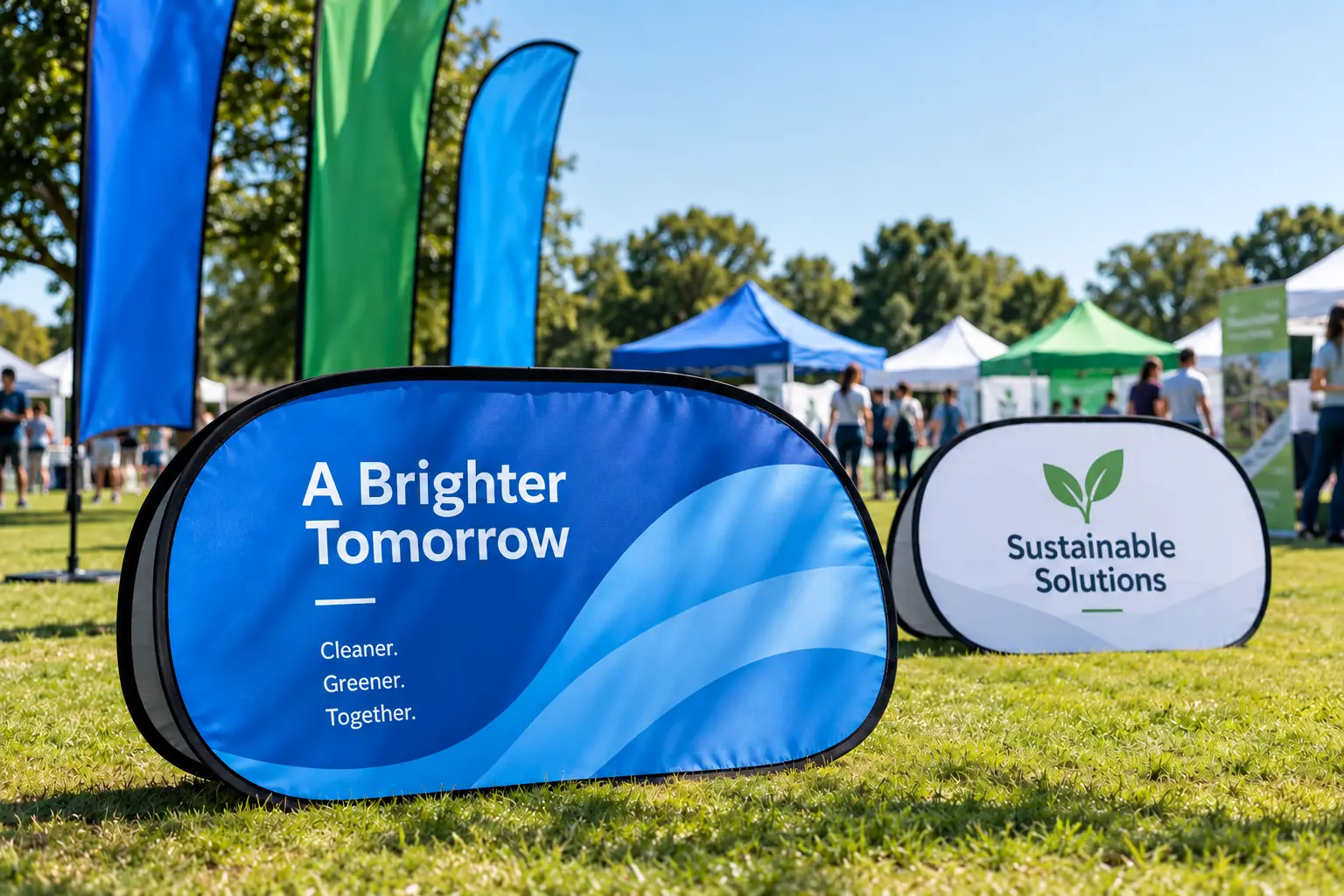
“Can you send over a pop-up banner?” is one of the most common requests that turns out to mean something else entirely once you start asking questions. Roller banners and pop-up banners get used interchangeably in conversation, but they are genuinely different products, built for different environments. Get the choice wrong and you end up with an indoor display that won’t survive a windy sports pitch, or an outdoor-ready display that looks oversized and unnecessary in a small exhibition stand. This guide breaks down what each one actually is, how they compare, and how to choose based on where and how often the display will be used.
Roller Banners Explained
A roller banner (also called a pull-up or pop-up stand, confusingly) is a self-contained display where the printed graphic retracts into a weighted base cassette, with a support pole holding it upright at full height. Pull the graphic up, click the pole into place, and it’s ready — the whole process takes under a minute with no tools.
Sailflags offers two material options:
- Fabric (220gsm, recycled polyester): a soft, low-reflection finish, ideal for well-lit indoor spaces where glare needs to be minimised. Available at 800mm wide, single-sided only, and this is the best-selling option for most exhibitions.
- PVC (440gsm): a smooth, more rigid surface with excellent opacity and structure, available at 850mm or 1000mm wide. PVC is the only material offered as a double-sided roller banner, since the added rigidity is needed to support two graphics within the roller system.
Both materials come as a complete kit — banner graphic, cassette, pole and padded carry case — and both stand 2 metres high. Roller banners are built primarily for indoor use: reception areas, retail counters, exhibition stands and showrooms, where there’s a flat, sheltered floor and no wind to contend with.
Weight and portability matter more than people expect when choosing between the two fabric options. A single 800mm fabric roller banner and its case weighs only a few kilograms, which means one person can comfortably carry several units between a car and a venue in one trip — a real consideration for a small team running a multi-day exhibition circuit. PVC roller banners are noticeably heavier and stiffer, which is part of why they hold their shape well for double-sided printing, but it also means they’re better suited to a single set-up-and-leave placement rather than repeated daily transport.
Pop-Up (Pop Out) Banners Explained
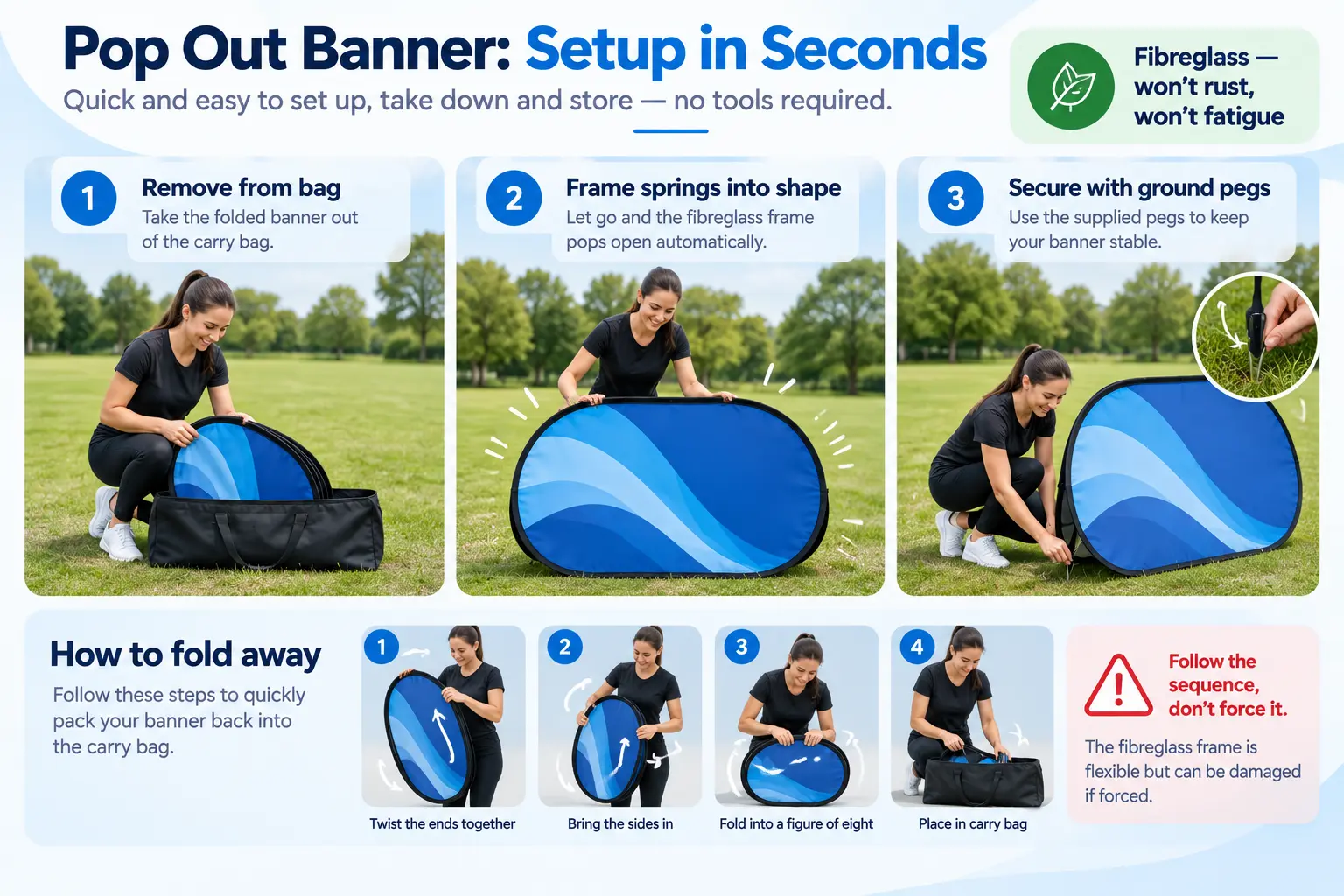
A Pop Out Banner is a different kind of product entirely, built around a strong, flexible fibreglass frame that springs into shape in seconds rather than pulling up from a base. Two separately printed fabric faces give visibility from both directions, and the whole thing folds down compactly into a padded carry bag using a simple twisting technique — similar in spirit to a pop-up camping tent.
Fibreglass rather than steel is the key material choice here: it won’t rust or leave rust stains on the fabric, and it avoids the metal-fatigue problems that come with repeatedly folding a steel frame over a season of events. That makes it well suited to a display that gets packed up and set up dozens of times a year, often outdoors.
- Available in 2m x 1m or 2.6m x 1m, both printed on 220gsm polyester fabric
- Always double-sided — there is no single-sided option
- Supplied with ground pegs for securing on suitable soft ground
- Popular for sports pitches and club sponsorship, running and cycling events, festivals, and outdoor promotions
Pop Out Banners work indoors too, but their real advantage is outdoor use: the frame is designed to handle repeated setup and pack-down on grass, gravel or a pitch-side verge, which a roller banner’s cassette base was never built for. Sports clubs in particular tend to buy these in pairs or sets, positioning one either side of a pitch entrance or dugout so sponsor branding reads clearly from both the stands and the touchline — something a single-sided roller banner simply can’t do outdoors.
Roller vs Pop-Up: Side-by-Side Comparison
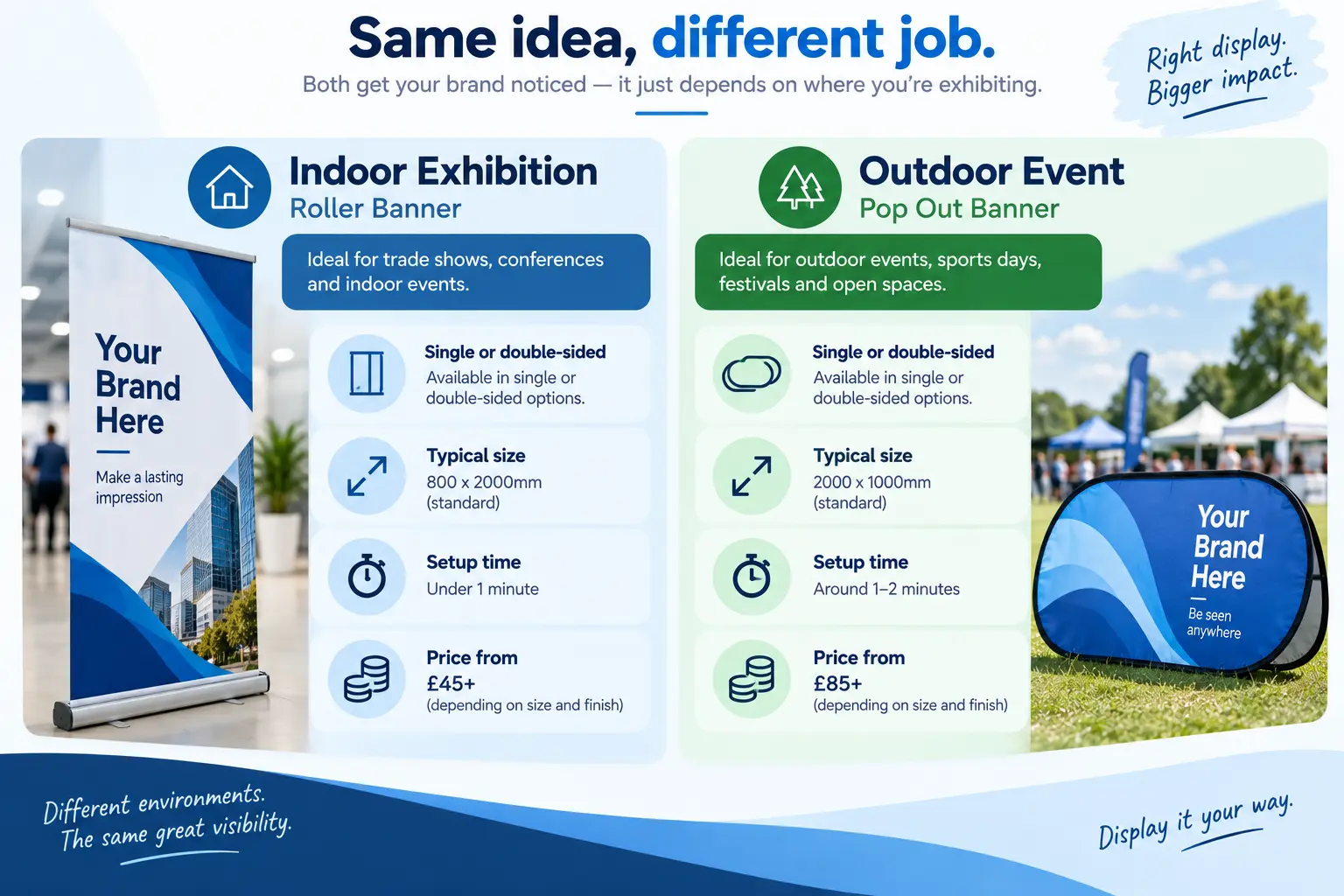
| Factor | Roller Banner | Pop Out Banner |
| Frame / mechanism | Spring-loaded roller cassette with support pole | Flexible fibreglass frame, springs into shape |
| Typical environment | Indoor — exhibitions, retail, reception areas | Outdoor — sports pitches, festivals, promotions (also fine indoors) |
| Print faces | Single-sided as standard; double-sided on PVC only | Always double-sided |
| Material options | Fabric (220gsm) or PVC (440gsm) | 220gsm polyester only |
| Sizes | 800mm wide (fabric); 850mm or 1000mm wide (PVC); 2m high | 2m x 1m or 2.6m x 1m |
| Setup time | Under a minute, tool-free | Seconds, tool-free |
| Ground fixing | Freestanding on its own base, indoors only | Ground pegs included for outdoor use on soft ground |
| Graphic changes | Not designed for easy graphic swaps | Not designed for easy graphic swaps |
| Typical price | From £89 | From £159 |
Choosing by Event Type
Rather than starting from the product name, it usually helps to start from the event:
- Trade show, exhibition stand or retail counter: Roller Banner — fabric for a premium indoor finish, PVC if double-sided visibility is needed
- Sports club sponsorship or pitch-side branding: Pop Out Banner — built for grass, wind, and repeated outdoor setup
- Running event, festival stall or outdoor promotion: Pop Out Banner, for the same reasons — and the ground pegs matter here
- Reception area or permanent indoor signage: Roller Banner, since it won’t be moved or packed away often
- Mixed use — sometimes indoors, sometimes at an outdoor stall: Pop Out Banner is the more flexible single purchase, since it handles both environments, whereas a roller banner is genuinely an indoor product
A useful rule of thumb: if the display will ever touch grass, gravel or a breeze, start with a Pop Out Banner. If it will only ever sit on a flat indoor floor, a Roller Banner gives a slightly more polished, premium finish for less.
It’s also worth thinking about who will be setting the display up on the day. Roller banners are marginally more foolproof for someone unfamiliar with the product — there’s really only one motion, pulling the graphic upward until the pole clicks in. Pop Out Banners take a little more spatial awareness the first time, since the frame genuinely springs outward on its own, but most users find it becomes second nature after one or two setups, and the speed advantage is significant once the technique clicks.
What If I Need to Change the Graphic Regularly?
Neither a roller banner nor a Pop Out Banner is designed for easy graphic swaps — both are supplied as a complete, printed unit. If the message or branding is likely to change every few months (seasonal offers, rotating sponsors, a display used across several campaigns), it is worth looking at a display with a replaceable graphic instead. The L Banner uses a snap-rail system specifically built for interchangeable graphics, so only the printed panel needs replacing rather than the whole stand — and because the base doesn’t need replacing each time, it works out more cost-effective over several campaigns. For indoor use specifically, Fabric Banner Stands offer the same reusable-frame, replaceable-cover approach with a wider range of widths — covered in full in our separate guide to fabric banners and banner stands.
The maths on this is worth spelling out for anyone running several campaigns a year: buying a new roller banner or Pop Out Banner every time the message changes adds up quickly, whereas a snap-rail or sleeve-based stand is bought once and only the graphic panel is reprinted going forward. For a one-off event or a message that won’t change, though, a roller banner or Pop Out Banner remains the simpler, lower-cost choice — there’s no need to pay for interchangeability that will never be used.
Setup, Folding and Looking After Your Display
Both products are designed for quick, tool-free setup, but they reward a bit of care in how they’re handled:
- Roller banners: pull the graphic up smoothly rather than yanking it, and always retract it fully into the cassette before transport — leaving it half-extended strains the spring mechanism over time
- Pop Out Banners: remove all ground pegs before folding, and follow the twisting fold sequence shown in the supplied instructions rather than forcing the frame — fibreglass is flexible but will resist being folded the wrong way
- Both: let the fabric or PVC dry fully before packing away if it’s been used outdoors or gotten damp, to avoid mould or odours developing in the carry bag
- Both: avoid using a roller banner outdoors in anything beyond calm, dry conditions — it isn’t built for wind, unlike the Pop Out Banner’s pegged, fibreglass construction
Treated properly, both displays are built for repeated use across many events rather than a single outing, which is where their slightly higher upfront cost compared to a one-off printed banner pays for itself. A well-cared-for roller banner or Pop Out Banner will typically outlast several seasons of regular use, provided the basic handling steps above are followed — most damage to either product comes from rushed pack-down rather than the print or frame wearing out on its own.
Storage between events matters too. Keep the padded carry case or bag somewhere dry and out of direct sunlight rather than left in a car boot for weeks at a time — prolonged heat can soften adhesives in a roller banner’s cassette mechanism, and UV exposure will fade any printed graphic faster than normal use ever would. For clubs and organisations that store several banners together, a simple labelling system on each case saves considerable time when a specific sponsor board or display needs to be found quickly before an event.
Frequently Asked Questions
Can a roller banner be used outdoors?
Only in calm, short-term conditions — PVC roller banners can tolerate brief outdoor use, but neither material is designed for wind or prolonged exposure. For anything genuinely outdoor, a Pop Out Banner is the better-suited product.
Can I get a double-sided Pop Out Banner?
Every Pop Out Banner is double-sided as standard — there’s no single-sided option, since the two-face design is core to how the product works.
Which is easier to set up, a roller banner or a Pop Out Banner?
Both are tool-free and take well under a minute. A roller banner is arguably the more familiar motion — pull up, click the pole in — while a Pop Out Banner springs into shape on its own once released from the bag, which some people find takes a moment to get used to.
What size roller banner should I choose?
The 800mm-wide fabric roller banner is Sailflags’ best seller, balancing visibility, sustainability and portability. Wider PVC options (1000mm) suit exhibitions or larger stands where more visual impact is needed.
Do Pop Out Banners come in more than one size?
Yes — 2m x 1m and the larger 2.6m x 1m, both on the same fibreglass frame system, so the choice comes down to how much visual impact the space allows for.
Is there a version with interchangeable graphics?
Not in the roller banner or Pop Out Banner ranges — for regularly changing graphics, the L Banner or a Fabric Banner Stand are the better fit, since both use a replaceable-cover system on a reusable frame.
How long does either display last with regular use?
Both are built for repeated use across multiple events rather than a single outing. With the basic care steps above — full drying before packing, retracting or folding correctly, and avoiding harsh weather outside their intended use — either display should comfortably serve several seasons of regular events.
Matching the Display to the Event
The short version: roller banners are the polished, indoor choice for exhibitions, retail and reception areas; Pop Out Banners are the rugged, outdoor-ready choice for sports, festivals and events where the display needs to handle grass, wind and repeated pack-down. Neither is objectively “better” — they’re built for different jobs, and picking based on where the display will actually spend its time is the fastest way to the right answer.
Not sure which fits your event? Sailflags’ team can talk through sizing, material and how often the display will be packed up and moved — with a free design service included either way. Explore the full Roller Banner range, the Pop Out Banner range, or get a free, no-obligation quote to get started.