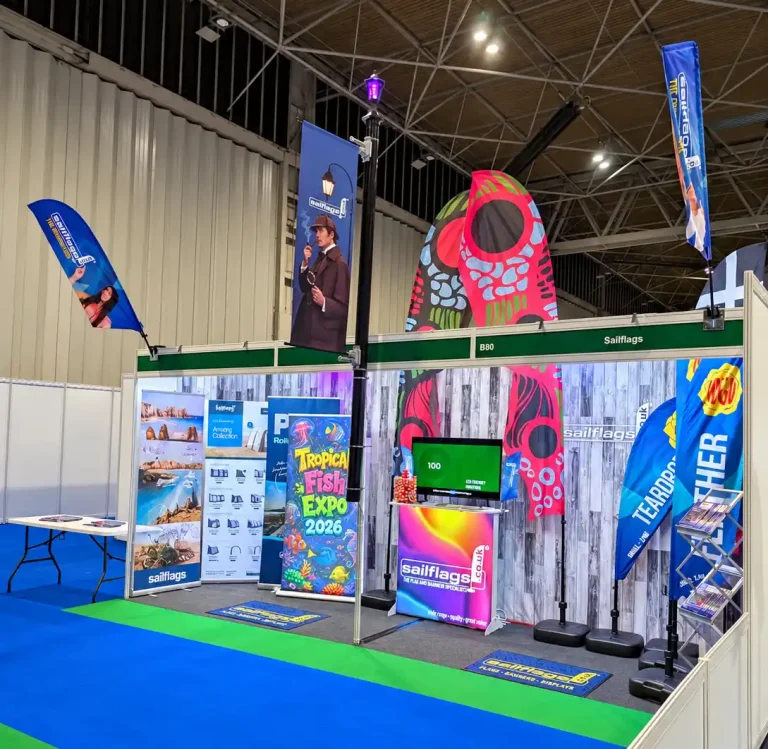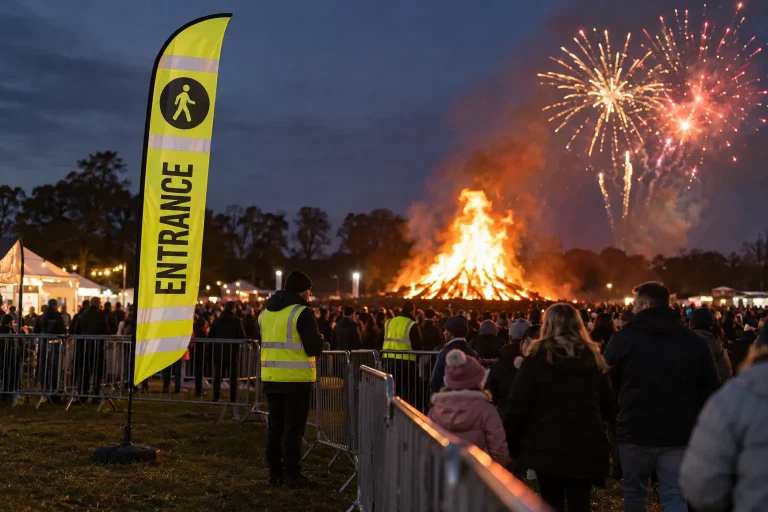


Festivals, markets, exhibitions and trade shows all put teardrop flags to the same basic test: can people find you in a crowd, across a field, or down a busy aisle? This guide focuses specifically on that use case — what changes when your flag isn’t sitting outside a shop but working a temporary pitch for a day, a weekend, or a full show season.
If you haven’t already settled on a size, finish, or how to order, our buyer’s guide and sizes guide cover those decisions in more depth — this post assumes you’re past that stage and focused specifically on getting the most out of a flag at events.
Why Teardrop Flags Work So Well at Events & Trade Shows
Temporary events put different demands on signage than a permanent shopfront does. You need something that goes up fast, comes down just as fast, survives being transported and re-erected repeatedly, and still gets noticed against a backdrop of other stalls, stands, and general event noise. Teardrop flags tick all of those boxes: no tools needed to assemble, a compact carry footprint, and a shape that’s genuinely more wind-stable than a flat banner — a real advantage outdoors, where you don’t control the weather.
They also solve a specific event problem that’s easy to underestimate: being findable. A tall, distinctive flag gives people something to walk toward from across a field or hall, which matters more than most exhibitors expect until they’ve stood at their own stand watching visitors walk past because they couldn’t see it from the entrance.
There’s a return-on-investment angle here too, particularly for anyone doing a full season of events rather than a one-off. Unlike printed banners or one-use signage, a well-made teardrop flag is reusable across dozens of events over multiple seasons, which makes the per-use cost considerably lower than it might first appear against a single event’s budget.

Festival & Market Stalls: What to Consider
For festivals, food markets, and pop-up stalls, portability usually matters as much as visibility. You’re often setting up and packing down in the same day, sometimes across multiple pitches if you’re trading at more than one event in a season. A mid-size flag — 2.7m is the usual sweet spot — balances being seen across a busy field with still being manageable for one person to carry, plant, and remove without help.
Ground conditions vary a lot at this kind of event — grass, packed earth, occasionally tarmac car-park pitches — so it’s worth checking what base suits your specific site rather than assuming. A ground spike base is usually the simplest and most wind-resistant option on grass or soil, while hard standing needs a weighted base instead.
Trade Show & Exhibition Stands: Making Your Flag a Landmark
Indoors or on a showground, a flag’s job at a trade show is slightly different: less about pure distance visibility and more about giving visitors a fixed point to navigate toward once they’re already in the hall or on the ground. A single flag positioned at a corner of your stand, visible down the main aisle, tends to work better than one buried in the middle of your display where other exhibitors’ stock or signage can block the sightline.
If your stand runs across a multi-day show, it’s worth thinking about durability as well as look — a flag that’s assembled and struck once and then left standing for the duration of the show sees less wear than one being packed up nightly, but either way, a flag that’s been sat folded in a bag between show days should be given a chance to relax back into shape before you plant it each morning.
Multi-Flag Setups: Marking Out a Larger Pitch
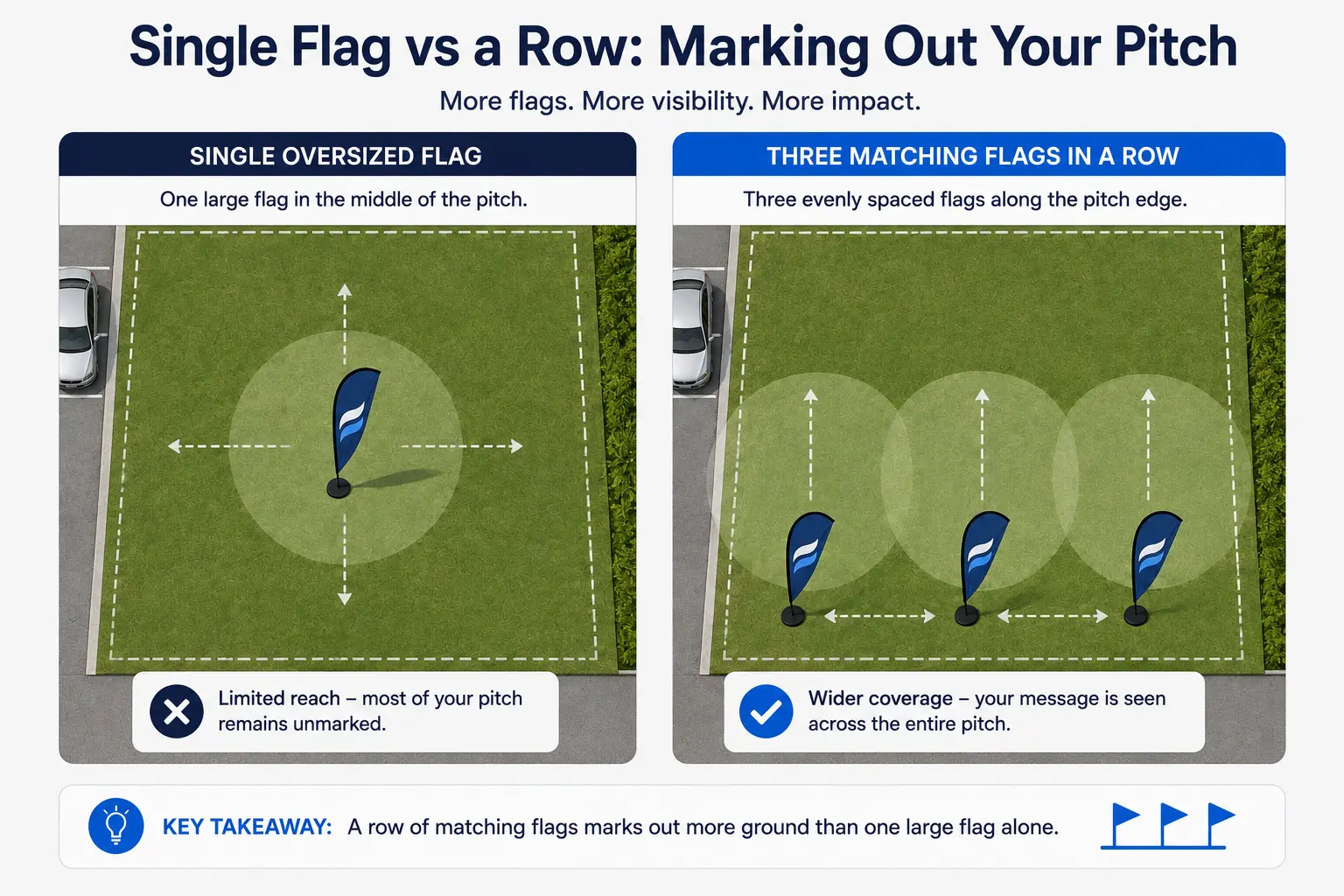
If your stall or stand covers more ground than a single flag can define — a larger festival pitch, a car park activation, or a stand with more than one entrance — a small row of matching flags does more work than one oversized flag in the middle. Spaced evenly along the edge of your pitch, a row of flags marks out the whole area and draws the eye along it, which is particularly useful anywhere visitors might approach from either end rather than a single fixed direction.
Consistency matters more than size here: three matching 2.7m flags spaced along a frontage will usually read as more professional and more visible over a wider area than one 3.6m flag on its own, for a similar total cost.
This approach also has a practical upside for larger operations: if one flag in a row needs to come down temporarily — a gust of wind, a quick repair, a base that’s shifted — the rest of the display still holds the space, rather than the whole pitch losing its signage at once.
Weather & Ground Conditions at Outdoor Events
Outdoor events don’t come with a guarantee of good weather, and UK conditions can change quickly across a single day, let alone a multi-day show. It’s worth checking the Met Office’s UK wind map ahead of an outdoor event, particularly if it’s somewhere exposed like a coastal showground or an open field, so you can plan for a heavier base or a smaller flag if strong winds are forecast.
If conditions do turn genuinely bad — the kind of wind that has event organisers making tannoy announcements — bringing your flag down temporarily is always the safer call than leaving it staked out and hoping. A flag is replaceable far more easily than the goodwill of whoever’s stood next to it if it comes down in a gust.
Portability: Getting Your Flag To and From the Event
If you’re regularly moving between events, a backpack kit — flag, pole, and base built into one rucksack-style carry system — is worth considering over separately packed components. It’s a small thing, but not having to juggle a flag bag, a pole case, and a base separately across a muddy festival field or a multi-storey exhibition car park adds up over a season of regular use.
Whatever you’re carrying, a quick pre-event check of your kit — pole sections, base fittings, any wear on the pole sleeve — takes a couple of minutes and avoids discovering a problem for the first time when you’re trying to set up in a rush before doors open.
Indoor Exhibition Considerations
Indoor venues bring their own constraint that outdoor sites don’t: height restrictions. Many shell-scheme stands and exhibition halls cap stand height, so it’s always worth checking with the show organiser before committing to a taller flag for an indoor event — a 2.7m flag is usually a safe indoor default. See our sizes guide for more detail on matching flag height to venue type.
It’s also worth checking whether the venue has any restrictions on base type — some indoor halls don’t allow water-weighted bases on certain flooring, or ask for a specific base style to protect the venue floor. This is a quick question to ask the organiser alongside the height check, rather than something to discover on the morning of the show.
Branding Tips for Event Flags
At a busy event, your flag is often competing for attention with dozens of other stands and stalls, so simplicity tends to win. A bold logo and minimal text, readable from a genuine event-floor distance, will outperform a design packed with detail that only reads clearly up close — by the time someone’s close enough to read fine print, they’ve usually already decided whether to walk over.
If you attend the same event annually or trade the same market regularly, it’s worth keeping your design consistent year to year rather than refreshing it every season — familiarity is part of what makes returning visitors recognise your stand from across the field.
It’s also worth thinking about what your flag needs to communicate versus what your stand or stall itself already does. A flag’s job is usually to get someone walking in your direction from a distance — the finer detail of your offer, pricing, or full product range is better placed on the stand itself, where people are close enough to actually read it. Trying to cram both jobs onto one flag tends to do neither well.
Real-World Examples by Event Type
- Weekend food festival: a single 2.7m double-sided flag with a ground spike base — light enough to carry across a field and stable enough for a day of variable wind.
- Multi-pitch market trader: a backpack kit for fast setup and teardown across several trading days at different sites in a season.
- Corner exhibition stand: a single 2.7m flag placed at the aisle-facing corner, checked against the venue’s shell-scheme height limit in advance.
- Large car park activation or roadshow: a row of three matching flags spaced along the site frontage rather than one oversized flag in the centre.
- Agricultural or county show: a 3.6m flag on a heavy-duty ground-anchored base, sited with wind exposure and multi-day weather in mind.
Planning Ahead: Timing Your Order for Event Season
Event and show season tends to cluster — spring and summer for festivals and outdoor markets, a busy autumn calendar for trade shows — which means production can be busier around those periods too, as covered in our guide to ordering custom teardrop flags. If you know your event dates for the season ahead, ordering with some lead time rather than the week before your first show gives you room for proofing and any last-minute artwork changes without the pressure of a fixed deadline bearing down.
This matters even more if you’re ordering multiple flags for a full season of events rather than a one-off — batching that order together, rather than placing it show by show, is usually both more cost-effective and easier to keep visually consistent across every site you trade at.
Common Mistakes at Events & Shows
- Choosing a flag size based on a shopfront setting rather than the actual distance across a field or hall
- Turning up without checking whether your indoor venue has height restrictions
- Using a single-sided flag on a pitch with visibility from multiple directions
- Packing a flag away wet after a rained-on event, without letting it dry before the next use
- Not checking wind forecasts before a genuinely exposed outdoor site
Frequently Asked Questions
What’s the best teardrop flag size for a festival stall?
2.7m suits most stalls — tall enough to be seen across a field, light enough for one person to manage. See our sizes guide for the full breakdown.
Can I use the same flag for both outdoor events and my shopfront?
Yes — a single flag with a portable base works for both, though a dedicated backpack kit makes moving between event sites easier if you’re doing it regularly.
Do exhibition halls always restrict flag height?
Not always, but many do — always check with the show organiser before ordering a taller flag for an indoor stand.
Should I choose single- or double-sided for an event flag?
Double-sided is usually the better choice for event use, since stalls and stands are typically viewed from multiple directions. See our single vs double-sided guide for the full comparison.
How far ahead should I order for a specific show date?
As early as your event calendar allows, particularly if you’re ordering for peak season — artwork readiness and proofing time matter more than the order itself, so the earlier you start that process, the more buffer you have.
Can I get matching flags for a multi-pitch or multi-stand setup?
Yes — batching a multi-flag order together keeps designs consistent and is usually more cost-effective than ordering each one separately.
Ready to Order for Your Next Event?
Browse the full range of teardrop flags or get a custom quote and we’ll help you put together the right flag, base, and carry setup for your event schedule.