

The two most popular promotional flag shapes in the UK are the feather flag and the teardrop flag. They look different, behave differently in wind, perform differently indoors and outdoors, and suit different display environments. Choosing the wrong one does not usually result in a bad flag — it results in a flag that works less well than the alternative would have.
This guide explains the difference between feather flags and teardrop flags across every decision variable — shape, wind performance, indoor and outdoor suitability, print area, sizes, and cost — and gives a clear verdict for 10 common business scenarios. If you know your situation, you should be able to find your flag type in under three minutes.
1. What Is a Feather Flag?
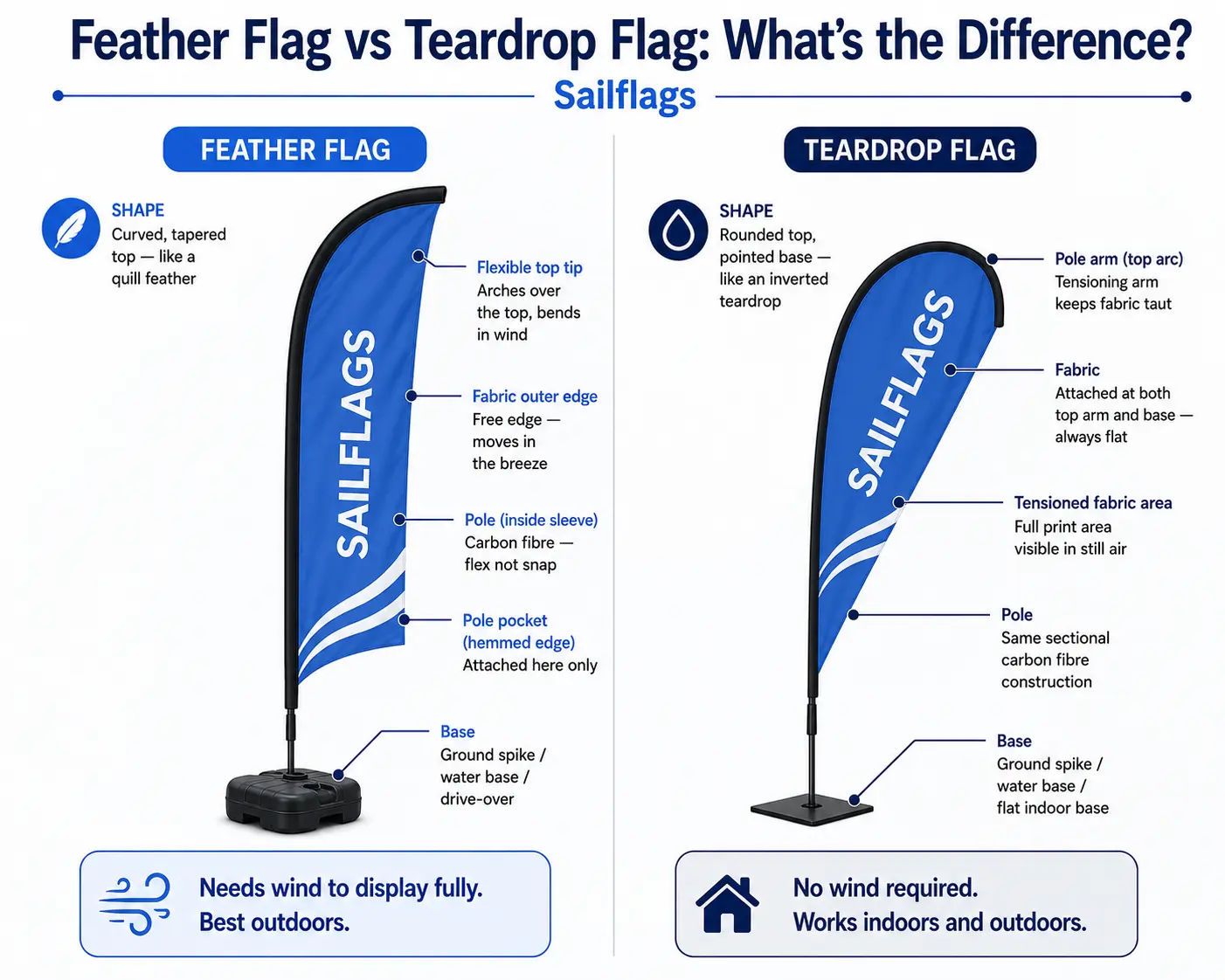
A feather flag gets its name from its shape: a tall, curved flag profile that tapers at the top into a distinctive pointed arch, like the tip of a quill. The fabric is attached at the outer curved edge and at the base, with the curved pole creating the shape. The design relies on wind movement to hold its shape — in still air, the flag hangs loose against the pole; in any breeze, it extends outward and displays the design clearly.
This movement is intentional. A feather flag in a gentle breeze creates continuous visual motion — the most effective mechanism for attracting the human eye outdoors. It also functions as an immediate wind indicator, constantly communicating that something is happening at this location.
Feather flags are available from 1.7m to 5.2m and are suited to both indoor and outdoor use (with the appropriate base). They are the most versatile flag type for general promotional use across the widest range of environments.
2. What Is a Teardrop Flag?
A teardrop flag gets its name from its outline: a wide, rounded top tapering to a narrow point at the base, like an inverted teardrop. Unlike a feather flag, the fabric is attached at both the outer edge and the curved pole arm — creating a tensioned display where the print area is held taut and flat regardless of wind conditions.
This tensioning is the teardrop flag’s defining characteristic. The fabric cannot flap or wrap around the pole because it is under constant tension from the frame structure. In completely still air — an exhibition hall, an indoor showroom, a calm day — a teardrop flag looks identical to how it looks in 20 mph wind. This consistency is what makes it the preferred flag type for indoor and windless environments.
Teardrop flags at Sailflags are available in four standard heights and are used across exhibitions, shopfronts, forecourts, and events where a clean, stationary display is valued over movement and animation.
3. The Key Differences at a Glance
| Property | Feather flag | Teardrop flag |
| Shape | Curved, tapered top — resembles a quill feather | Rounded top, pointed base — like an inverted teardrop |
| Fabric tension | Relaxed — relies on wind to display | Tensioned — frame holds shape in all conditions |
| Wind required? | Yes — needs airflow to display fully | No — displays correctly in still air |
| Wind performance | Designed for wind — flexes and moves | Tolerates moderate wind; curve reduces flapping |
| Best environment | Outdoor — especially where there is wind | Indoor AND outdoor — works in any condition |
| Print area shape | Long and narrow — tall vertical format | Wider proportions — more design flexibility |
| Visual effect | Dynamic, moving — catches attention from distance | Static, clean — professional and consistent |
| Heights available | 1.7m, 2.4m, 3.2m, 4.2m, 5.2m | 1.7m, 2.7m, 2.9m (long), 3.6m |
| Double-sided? | Yes — blockout liner between two panels | Yes — same construction |
| Cost | Standard | Similar — slight premium on some sizes |
| Best for | Outdoor events, forecourts, roadside, markets | Exhibitions, indoor retail, windless outdoor use |
4. Shape and How It Affects Each Flag Type
The Feather Flag’s Curved Shape
The feather flag pole is curved at the top — the flexible tip arches over the flag fabric and holds it in position when wind catches it. In a breeze, the fabric fills out to the left of the pole (or right, depending on wind direction) and creates the flag’s full visible profile. The outer curved edge of the flag is hemmed but not attached to a frame — it moves freely.
This free-edge design is what creates the characteristic movement that makes feather flags so effective outdoors. It is also why they are less suited to indoor environments: in a completely still room, the fabric hangs against the pole and the design cannot be seen clearly from the side.
The long, narrow vertical format of a feather flag is also a design constraint: the print area is typically around 55–65cm wide at the widest point, even for a 3.2m flag. Text must be legible in a tall, narrow column. Logos that are wider than they are tall need careful layout to avoid being reduced to an unreadable size.
The Teardrop Flag’s Tensioned Shape
The teardrop flag uses a curved pole arm that attaches to both the top and the base of the fabric, holding the outer edge under continuous tension. The fabric is essentially suspended between two points of the frame — like a guitar string — and therefore stays taut regardless of whether there is wind or not.
The proportions of a teardrop flag are wider relative to height than a feather flag, giving designers more flexibility for logos, images, and text layouts. A square logo that would be difficult on a narrow feather flag prints comfortably in the wider upper section of a teardrop.
The curved design of the teardrop pole also reduces wind resistance compared to a flat-edged flag — the fabric presents a curved surface to the wind rather than a flat one, which reduces flapping and stress on the fabric and stitching in moderate conditions.
5. Wind Performance Compared
This is the most common comparison question, and it has a clear answer: feather flags perform better than teardrop flags in consistently windy outdoor conditions. But the nuance matters.
Feather flags are designed for wind. The fabric moves with gusts rather than resisting them, the pole flexes controllably, and the open edge of the flag creates no rigid structure for wind to force against. In a 20 mph breeze, a feather flag will be flying cleanly and visibly from 25 metres away.
Teardrop flags are tolerant of moderate wind, not optimised for it. The tensioned construction — while it keeps the fabric taut in still air — creates a more rigid surface that resists rather than flexes with gusts. The curved shape reduces flapping significantly compared to a flat rectangular banner, but in sustained high wind (above Beaufort 5–6), a teardrop flag generates more mechanical stress than a feather flag of the same height.
For the specific question of ‘which is better in wind’, the answer across all exposure levels is the feather flag. For detailed wind performance guidance including the Beaufort scale reference, see the feather flags for windy conditions guide.
| The key wind insight Teardrop flags do not ‘need’ wind — they display correctly without it. Feather flags do need at least a light breeze (Beaufort 2–3) to display correctly. This single difference drives most of the scenario-by-scenario choices: if your environment has consistent wind, feather flags work better. If your environment is windless or only occasionally breezy, teardrop flags work better. |
6. Indoor vs Outdoor: Which Flag Suits Each Environment
| Environment | Feather flag | Teardrop flag |
| Indoor exhibition hall | Not ideal — hangs against pole in still air | Excellent — displays correctly with no airflow |
| Indoor retail / reception | Poor without airflow | Excellent — consistent presentation |
| Sheltered outdoor (covered walkway) | May work if occasional breeze | Excellent — does not need wind |
| Exposed outdoor (forecourt, roadside) | Excellent — designed for this | Good — handles moderate wind well |
| Open field / festival | Excellent — dynamic in wind | Adequate — check wind levels |
| Beach / coastal | Excellent with correct spec | Moderate — careful above Beaufort 5 |
| Trade show stand (indoor) | Not recommended | Recommended |
| Shop front (usually some breeze) | Excellent | Good |
| Car forecourt (open, traffic wind) | Excellent | Good with correct base |
The pattern is consistent: teardrop flags are more versatile across environments because they work indoors. Feather flags are more effective outdoors where there is wind, but are the wrong choice for any truly windless setting.
7. Print Area and Design Considerations
Feather Flag Design
The feather flag’s print area is long and narrow — typically 55–65cm wide at the widest point on a 3.2m flag. This format works naturally for:
- Vertical logos and stacked branding – The tall, narrow shape is perfect for logos, icons and branding arranged from top to bottom.
- Short vertical messages – Simple wording such as Open Today, Sale, Now Open or Coffee remains easy to read from a distance.
- Bold graphics and strong colour blocks – High-contrast designs with large elements make the most of the flag’s elongated shape and maximise visibility.
What works less well on a feather flag: landscape-format logos, complex multi-element designs, and any layout that requires text at a small size to fit horizontally. For help with flag design, the online flag creator shows the print area shape in real time as you design.
Teardrop Flag Design
The teardrop flag’s wider proportions at the top create a broader canvas for the most prominent design elements. The wider section at the top is naturally where the eye goes first — and where a large logo or headline message sits best. Towards the lower point, the design narrows to a fine tip.
Works well on a teardrop flag:
- Large logos and bold branding – The wide upper section gives your logo maximum visibility and impact from a distance.
- Short, punchy messages – Ideal for simple headlines, promotions or directional text that can be read at a glance.
- Clean, uncluttered designs – Best suited to minimal artwork with strong colours and high contrast, ensuring the design remains clear as the flag tapers towards the bottom.
What works less well: very long vertical text columns, since the flag narrows towards the base and any text in the lower third becomes progressively harder to read.
| Artwork tip for both flag types Always download the Sailflags artwork template for your specific flag type and size before designing. The templates include the correct bleed lines, safe zones, and pole-pocket position — different for feather and teardrop. Designing without the template risks losing key content to the pole pocket or the edge hem. Download at sailflags.co.uk/artwork/ |
8. Sizes Available
| Size | Feather flag | Teardrop flag |
| Compact / indoor | 1.7m | 1.7m |
| Small / all-round | 2.4m | 2.7m (2.2m flag fabric) |
| Standard | 3.2m ★ | 2.9m Long |
| Large outdoor | 4.2m | 3.6m ★ |
| Maximum | 5.2m | Not available |
The feather flag range extends to 5.2m — the largest freestanding flag size available from Sailflags. The teardrop range tops out at 3.6m, making feather flags the only option for maximum-visibility applications (motorway-adjacent forecourts, large outdoor events requiring flags visible from 60m+).
For a detailed size-by-size guide including visibility distances and base recommendations, see the feather flag sizes guide.
9. Cost Comparison
The two flag types are broadly similar in cost at equivalent sizes. The teardrop flag’s more complex frame construction (the tensioning arm) adds a modest premium at some sizes over a feather flag of the same nominal height. However, the difference is not significant enough to be a deciding factor — the choice should be driven by suitability for the environment, not cost.
Where the cost comparison matters more is in double-sided printing. Both flag types are available with double-sided printing at a 20–40% premium over single-sided. For teardrop flags used at exhibitions and trade shows where visitors circulate around the display and both sides will be visible, double-sided is frequently worth the investment. For outdoor feather flags that face one direction, single-sided is almost always the right choice. See the complete guide to single-sided vs double-sided flags for the decision framework.
10. Single-Sided and Double-Sided: How It Works for Each Type
Both feather flags and teardrop flags are available in single-sided and double-sided print. The construction is the same in both cases: a blockout liner between two printed panels prevents show-through between the faces.
The practical difference is that double-sided is more commonly the right choice for teardrop flags than for feather flags. The reason: teardrop flags are frequently used indoors at exhibitions and trade shows where visitors approach from multiple directions simultaneously — the consistent, tensioned display that a teardrop flag provides is visible from any angle, making two-sided presentation much more valuable than for an outdoor feather flag that primarily faces one direction.
Feather flags are most often single-sided — facing a road, a fence, or a direction of pedestrian approach. Double-sided feather flags are used at junction positions and in multi-directional pedestrian environments. For feather flags, the weight increase from double-sided construction means the base should be upgraded one tier — a consideration that does not apply as significantly to the lighter teardrop frame.
11. Scenario-by-Scenario Verdicts
Scenario Winner + reasoning
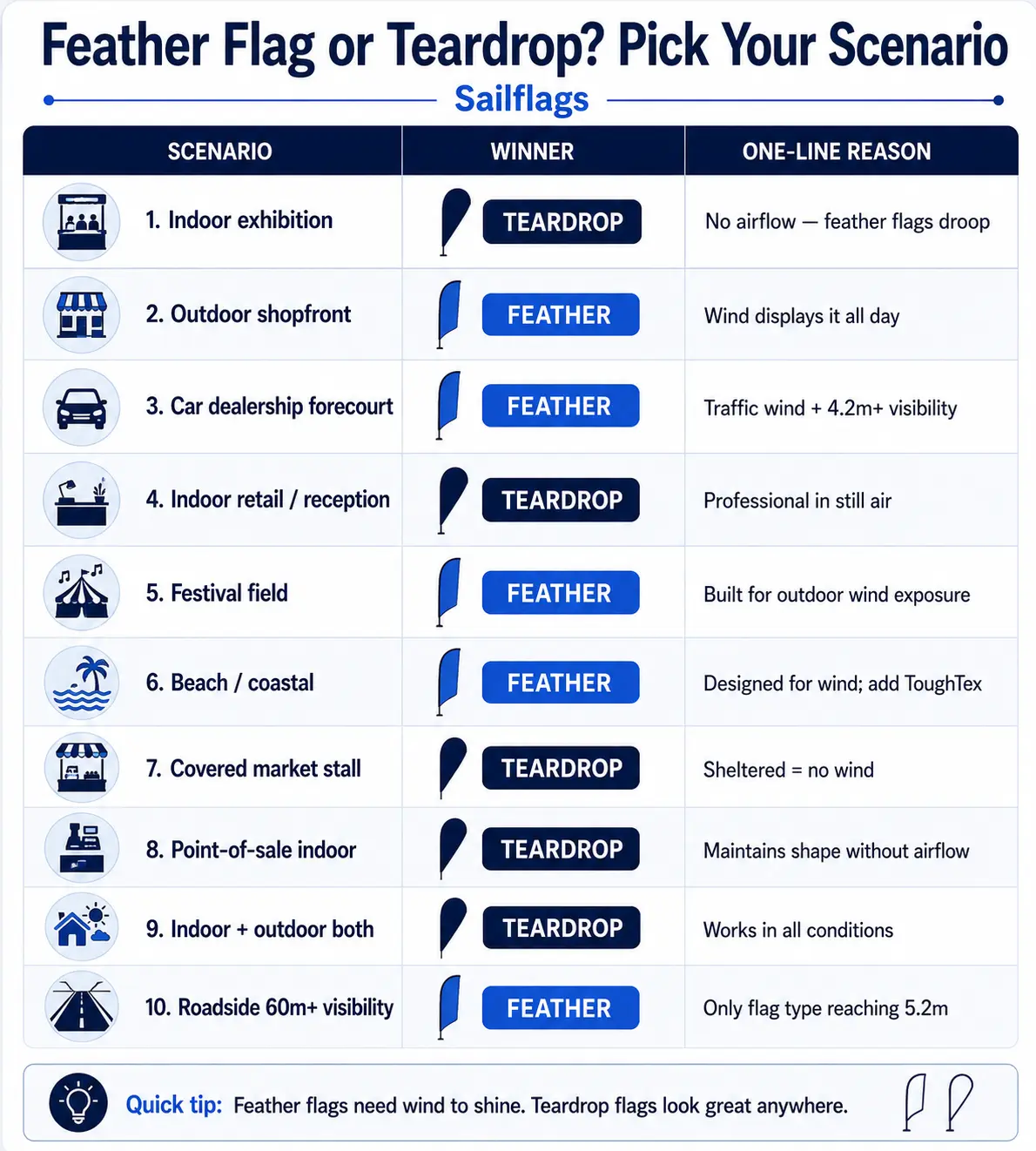
| Indoor exhibition or trade show | Winner: Teardrop flag No wind means a feather flag cannot display. A teardrop flag presents consistently from any viewing angle around the stand. | Custom Teardrop Flags → |
| Outdoor shopfront (daily wind) | Winner: Feather flag Regular outdoor airflow means a feather flag displays perfectly all day. More visual movement and larger size range. | Custom Feather Flags → |
| Car dealership forecourt | Winner: Feather flag Traffic wind provides consistent airflow. 4.2m–5.2m feather flags are visible above vehicle roof height from the road. | Custom Feather Flags → |
| Indoor retail / reception area | Winner: Teardrop flag Still air means feather flags hang limp. Teardrop flags maintain their professional shape regardless of airflow. | Custom Teardrop Flags → |
| Festival or outdoor event field | Winner: Feather flag Open-field wind exposure makes feather flags the more resilient and visually dynamic choice. 4.2m minimum for festival visibility. | Custom Feather Flags → |
| Beach or coastal location | Winner: Feather flag Coastal wind exposure is well-suited to feather flags on correct bases. ToughTex fabric handles salt air significantly better. | Custom Feather Flags (ToughTex) → |
| Covered market stall or arcade | Winner: Teardrop flag Sheltered environments with only intermittent airflow favour the teardrop’s consistent display. 2.7m is the most practical size. | Custom Teardrop Flags → |
| Point-of-sale next to a product | Winner: Teardrop flag Indoor POS positions rarely have airflow. A teardrop flag maintains its shape and professional appearance at the shelf or counter. | Custom Teardrop Flags → |
| Both indoor and outdoor use | Winner: Teardrop flag A teardrop flag taken from an indoor event to an outdoor location works in both. A feather flag only works well outdoors. | Custom Teardrop Flags → |
| Maximum roadside visibility (60m+) | Winner: Feather flag Only the feather flag range goes to 5.2m. Teardrop flags top out at 3.6m, which is insufficient for long-range roadside visibility. | Custom Feather Flags 4.2m–5.2m → |
12. Can I Use Both? Combining Feather and Teardrop Flags
Yes — and for businesses that operate across both indoor and outdoor environments, ordering both types is a practical solution. A common setup for an event company or marketing agency is:
- Feather flags (3.2m or 4.2m): for outdoor events, festival fields, roadside display, and any location with reliable airflow.
- Teardrop flags (2.7m): for trade show stands, indoor activations, showrooms, and any venue where still air makes feather flags impractical.
Both flag types can be produced using the same artwork file — the design is adapted to each flag’s shape. The Sailflags design team can prepare both layouts from a single brief. For businesses ordering both types, a trade account provides volume pricing across the full range.
For exhibition stand builders and display companies supplying both flag types to their clients, the white-label trade dispatch service handles both flag types in a single shipment — both arrive in plain packaging with no Sailflags branding.
13. Frequently Asked Questions
What is the difference between a feather flag and a teardrop flag?
The main difference is how the fabric is held. A feather flag relies on wind to extend its fabric outward from the pole — it moves in a breeze but droops in still air. A teardrop flag uses a tensioned frame that holds the fabric taut in all conditions, including completely still air. This makes feather flags better for outdoor windy environments and teardrop flags better for indoor and windless use.
Are feather flags or teardrop flags better in the wind?
Feather flags. They are specifically designed for wind interaction — the fabric flexes freely with gusts rather than resisting them, reducing stress on the pole and stitching. Teardrop flags tolerate moderate wind well (the curved design reduces flapping compared to flat-edged banners) but they are not the right choice for sustained high-wind outdoor locations. See the high-wind feather flags guide for detailed wind performance guidance.
Which flag is better for exhibitions?
Teardrop flags. Exhibition halls have no airflow — feather flags cannot display correctly in completely still air. A teardrop flag’s tensioned construction keeps the print area taut and fully visible from any direction around the stand, which is exactly what a trade show environment requires.
Can I use a teardrop flag outdoors?
Yes. Teardrop flags are suitable for most outdoor conditions. They handle moderate wind well — the curved shape reduces flapping — and their consistent display is appealing for shopfronts and forecourts where you want a static, professional look. In sustained high winds (above Beaufort 5–6), they are less resilient than feather flags of the same height.
Which flag type is more expensive?
They are broadly comparable in price at similar heights. The teardrop flag’s more complex frame construction (the tensioning arm) adds a modest premium at some sizes, but the difference is not significant enough to be the deciding factor. Choose the flag type that suits your environment, not the one that costs less.
Can feather flag artwork be used on a teardrop flag?
Not directly — the two flag types have different shapes and proportions. The artwork must be adapted to each flag’s specific template. However, the Sailflags design team can adapt your brand assets (logo, colours, messaging) to both flag types from the same brief, so ordering both types does not require two completely separate design processes.
Which flag is better for a shopfront?
A feather flag, for most UK shopfronts. A shopfront on a UK high street almost always has at least a moderate breeze, which means a feather flag displays well throughout the day. The 3.2m Standard is the most common shopfront flag — tall enough to be seen from 25 metres, portable, and stable on a cross base or ground spike. For shopfronts in particularly sheltered locations (enclosed arcades, indoor markets), a teardrop flag is the better choice.
Choose the Flag That Fits Your Environment
The question is not which flag is better — it is which flag is better for your specific situation. Teardrop flags are the more versatile choice across environments because they display correctly both indoors and outdoors. Feather flags are the stronger choice for outdoor, wind-exposed, and maximum-visibility applications — and the only option for heights above 3.6m.
If you primarily display indoors, or need a flag that works identically in an exhibition hall and at an outdoor event: teardrop flag. If you primarily display outdoors, on a road, at a festival, or at a forecourt: feather flag. If you do both: order both, using the same brand assets adapted to each flag’s shape.
At Sailflags, both flag types are produced in-house in Cornwall, using the same dye-sublimation printing, the same 100% recycled polyester fabric, and the same free design service.