

Promotional products occupy an awkward position in the sustainability conversation. They are physical, manufactured goods produced in volume for branding purposes — not an obvious candidate for environmental leadership. But the promotional flag industry has changed considerably in recent years, and a growing number of businesses, event organisers, and procurement teams now ask questions about material sourcing, print method, and certification before they ask about price.
This guide explains what feather flags are actually made from, how the printing process works, what sustainability credentials are independently verifiable (and what is not), and how Sailflags’ specific approach to materials, production, and carbon offsetting compares to the claims made across the promotional products industry. It also includes a practical guide for buyers who want to ask the right questions of any flag supplier.
1. What Are Feather Flags Actually Made From?
Standard polyester vs recycled polyester
The fabric used in feather flags is polyester — specifically knitted polyester, which is woven in a way that creates the weight (measured in GSM, grams per square metre) and flexibility needed for flag use. Standard polyester is made from petroleum-derived plastic fibres — a finite resource with a significant carbon footprint in production.
Recycled polyester is made from the same material — polyethylene terephthalate, or PET — but from post-consumer sources: primarily plastic bottles collected from the waste stream, and in some cases, from marine plastic recovered through ocean clean-up initiatives. Mechanically, the two fabrics are functionally identical for flag production. The difference is entirely in where the raw material comes from.
Converting PET bottles into polyester fibre uses approximately 50–60% less energy than producing virgin polyester from petrochemical feedstocks, and eliminates the plastic from the waste stream or ocean environment where it would otherwise cause harm. A flag made from recycled polyester is not a sustainable product in the absolute sense — it is still plastic — but it is meaningfully more responsible than the same flag made from virgin polyester.
Post-Consumer PET: what it means in practice
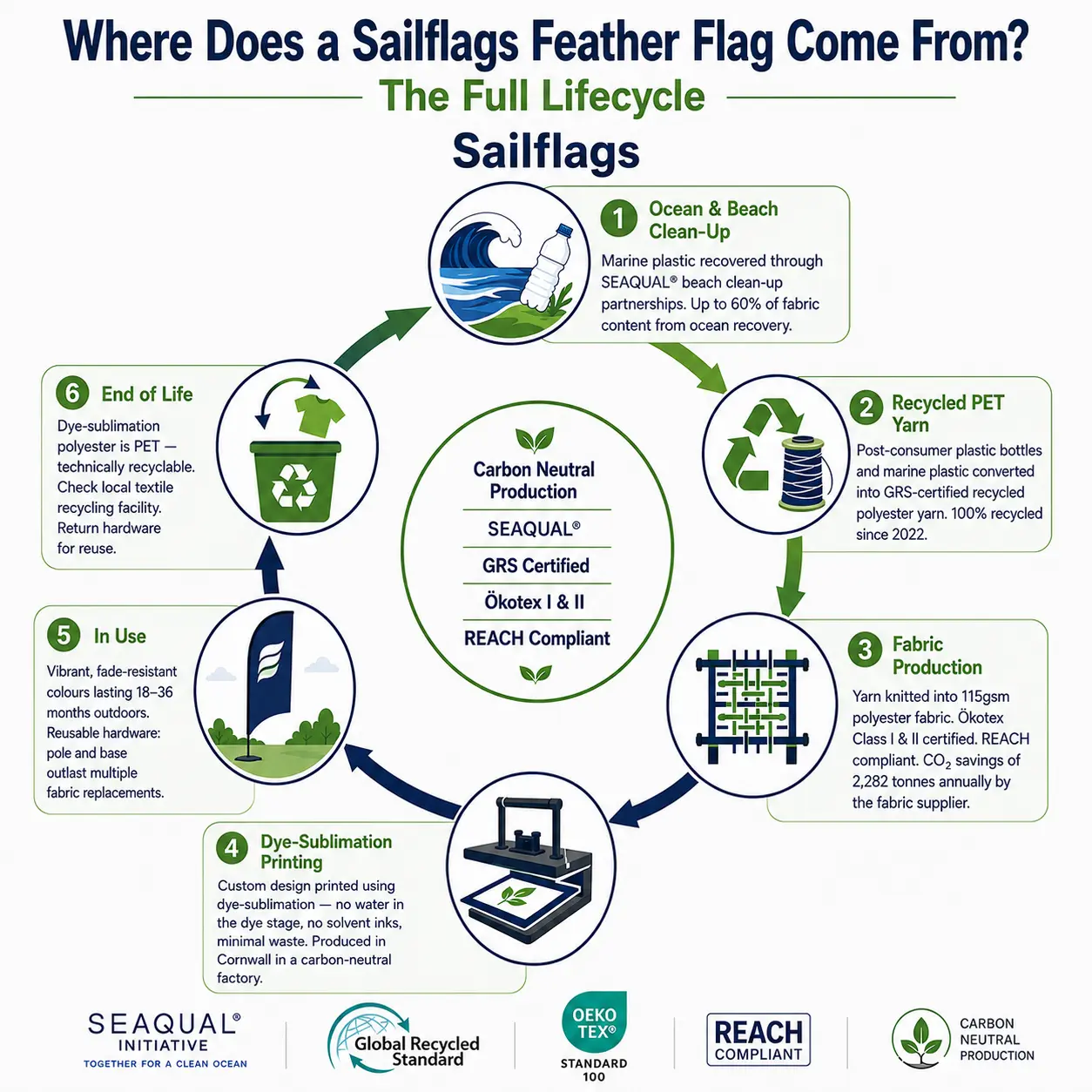
Post-consumer PET refers to plastic that has already been used by a consumer and would otherwise enter the waste stream. The most common source is plastic drinks bottles. The recycling process involves shredding the bottles, melting them into pellets, and extruding them into the fine continuous fibres (called filaments) that are woven into polyester fabric.
Since 2022, all Sailflags flag and banner fabrics are made from 100% recycled post-consumer PET. This is not a marketing claim — it is a material specification verifiable through the Global Recycled Standard certification that Sailflags’ fabric supplier holds. The GRS is an internationally recognised third-party certification that tracks and audits the recycled content of textile products through the entire supply chain.
SEAQUAL® Initiative: marine plastic in your flag
Sailflags’ recycled polyester fabric goes beyond standard recycled PET. Up to 60% of the recycled content is sourced through the SEAQUAL® Initiative — a partnership programme that funds beach clean-ups and ocean plastic recovery operations, with the recovered marine plastic incorporated into the recycled polyester supply chain.
Marine plastic is more challenging to process than standard post-consumer bottle PET because it has been degraded by UV exposure, salt, and mechanical abrasion in the ocean. The SEAQUAL® process cleans, sorts, and processes recovered marine plastic to a standard suitable for textile use — which is significantly harder and more expensive than processing clean bottle PET. The initiative means that buying a Sailflags feather flag directly funds the collection of plastic that would otherwise remain in the ocean environment.
| What SEAQUAL® means for your flag Up to 60% of the recycled PET content in Sailflags fabric is sourced from beach clean-ups and ocean plastic recovery. Each SEAQUAL® yarn is traceable: the initiative provides a unique tracer and a verified chain of custody from ocean to finished fabric. |
2. Dye-Sublimation Printing: The Most Sustainable Print Method for Fabric
The print method matters as much as the fabric material when evaluating the environmental impact of a flag. There are two main approaches to printing on polyester flag fabric: dye-sublimation and surface/digital printing. The difference between them is not just a quality question — it is also an environmental one.
How dye-sublimation printing works
In dye-sublimation printing, the design is printed onto transfer paper using sublimation inks. The paper is pressed against the polyester fabric under heat (approximately 200°C) and pressure. At that temperature, the ink converts from solid to gas and penetrates the polyester fibres, bonding permanently at a molecular level. The colour becomes part of the fabric — not a coating on top of it.
This process has several environmental advantages over surface printing:
- No excess ink waste: the ink is transferred almost entirely into the fabric, leaving minimal residue on the transfer paper.
- No water in the dyeing process: conventional textile dyeing uses large volumes of water and generates dye-laden wastewater. Dye-sublimation uses dry heat transfer — no water is involved in the colouring stage.
- Longer product lifespan: because the colour is embedded in the fibre rather than sitting on the surface, dye-sublimation printed flags do not fade, crack, or peel in the way surface-printed alternatives do. A flag that lasts three years rather than one season means three times fewer replacements, and three times less total material used.
- No VOC solvents: dye-sublimation inks do not require solvent-based carriers, which are a significant source of volatile organic compound (VOC) emissions in some printing processes.
Sailflags prints all flags using dye-sublimation in its Cornwall factory. The process is energy-intensive at the heat-press stage, but the energy use is offset through the carbon neutrality programme described in Section 3.
3. Sailflags’ Sustainability Credentials — Verified
The following credentials are not marketing claims — they are independently certified, publicly verifiable, or evidenced by specific third-party partnerships. Each one is stated precisely as it applies.
| Credential | What it means | Type |
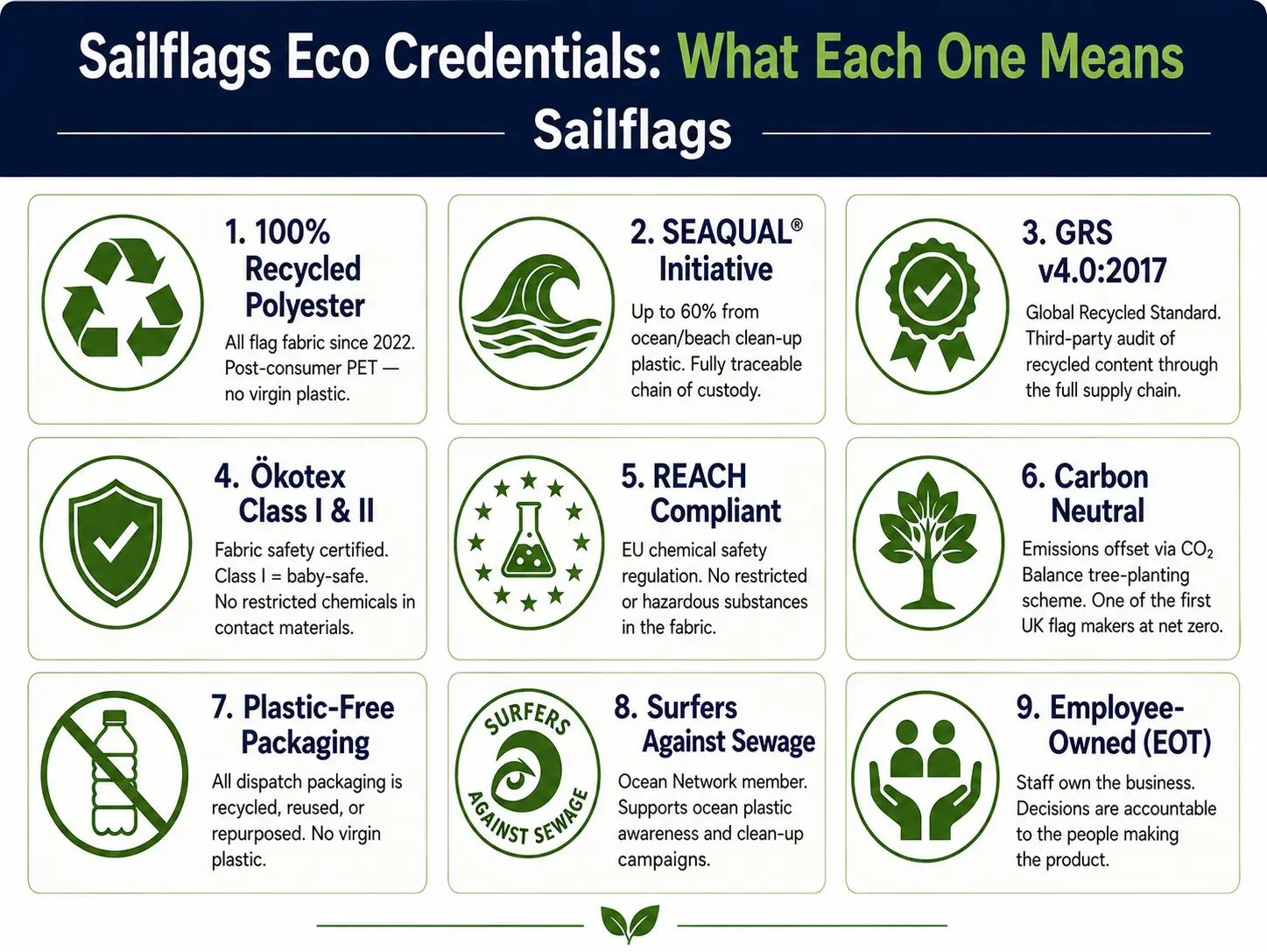
| 100% Recycled Polyester | All flag and banner fabrics since 2022. Post-consumer PET, not virgin plastic. | Material spec |
| SEAQUAL® Initiative | Up to 60% of recycled content from ocean/beach clean-up plastic. Fully traceable. | Partnership |
| Ökotex Class I & II | Fabric safety certification. Class I (baby-safe): no harmful substances. Class II: skin-contact safe. | 3rd-party cert |
| REACH Compliant | EU chemical safety regulation. No restricted substances in the fabric. | Regulatory |
| GRS v4.0:2017 | Global Recycled Standard. Third-party audit of recycled content through the supply chain. | 3rd-party cert |
| Carbon Neutral / Net Zero | Emissions offset via CO2 Balance tree-planting scheme. One of the first UK flag makers at net zero. | Offset scheme |
| Plastic-Free Packaging | Dispatch packaging is recycled, reused, and repurposed. No virgin plastic in packing materials. | Operational |
| Surfers Against Sewage | Ocean Network member. Supports ocean plastic awareness and clean-up campaigns. | Partnership |
| Employee-Owned Trust (EOT) | Staff own the business through an EOT. Accountability for decisions runs through the people making the product. | Business model |
Full details of Sailflags’ sustainability programme are published on the eco credentials page. The certifications listed above are specific, auditable, and not self-declared.
Carbon Neutral Status in Detail
Sailflags offsets its carbon emissions annually through the CO2 Balance offsetting scheme. Under this programme, trees are grown in woodland owned and managed by CO2 Balance — providing absolute control over the future of the woodland rather than relying on third-party forestry management. When the woodland matures, ownership transfers to a charitable trust, ensuring long-term community benefit and continued carbon sequestration.
Sailflags was among the first UK flag manufacturers to achieve net zero status through this programme. Carbon offsetting is not equivalent to reducing emissions — it is a mechanism for compensating for unavoidable emissions while longer-term reduction programmes are developed. It should be understood as a transitional measure, not a final solution. Sailflags publishes this context openly rather than presenting carbon neutral status as a complete sustainability solution.
4. Why Longevity Is Sustainability: The Cost-Per-Use Argument
The most important sustainability factor for a promotional flag is one that is rarely discussed in sustainability marketing: how long does it last? A flag that lasts three years in outdoor use has one-third the material impact of a flag that lasts one year — regardless of what the fabric is made from.
This is the practical argument for dye-sublimation printing on quality recycled polyester over cheaper surface-printed alternatives: the product lifespan difference is significant. A surface-printed flag on 80gsm non-recycled polyester may cost less on day one. After six months of outdoor use, it is fading. After twelve months, it looks degraded. After eighteen months, it needs replacement. Over three years, you have bought two or three replacement flags — each consuming materials and production energy.
The dye-sublimation flag on 115gsm recycled polyester costs more upfront and lasts significantly longer. The total material consumption over three years is lower, not higher.
| Budget surface-print flag | Standard dye-sub flag | Sailflags recycled dye-sub | |
| Fabric | Virgin polyester | Virgin polyester | 100% recycled PET (SEAQUAL) |
| Print method | Surface / digital | Dye-sublimation | Dye-sublimation |
| Typical lifespan | 6–12 months outdoor | 18–36 months outdoor | 18–36 months + (ToughTex: 36–60) |
| Flags in 3 years | 3–6 replacements | 1–2 replacements | 1–2 replacements |
| 3yr material use | 3–6× single flag | 1–2× single flag | 1–2× single flag, recycled content |
| Certifications | None typically | Varies | GRS, Ökotex, REACH, SEAQUAL |
| Carbon offset | Rarely | Varies | Yes — net zero production |
Viewed through a total-lifecycle lens, the cheapest flag is often the least sustainable flag. The higher the turnover rate — the more frequently flags need replacing — the greater the total material consumption across the product’s service life.
5. What Makes a Promotional Flag ‘Eco Friendly’? The Honest Answer
‘Eco friendly’ is used freely in promotional product marketing, often without substantiation. Here is an honest framework for evaluating any claim:
- Recycled material content: is it independently certified (GRS, OEKO-TEX) or self-declared? Self-declaration without third-party audit is unverifiable.
- Print method: dye-sublimation is significantly more sustainable than solvent-based surface printing for fabric products. Ask specifically which method is used.
- Carbon offsetting: carbon neutral claims require an independent verification scheme (CO2 Balance, Verra, Gold Standard). ‘Carbon neutral’ without specifying the scheme and verification process is an unverifiable claim.
- Packaging: plastic-free dispatch packaging is a meaningful operational commitment, not a product characteristic. Worth asking about separately.
- Longevity: the most undersold sustainability metric. A product with a longer service life has a lower per-use environmental impact regardless of what it is made from.
- End of life: can the flag be recycled at the end of its life? Dye-sublimation polyester is technically recyclable (it is still PET), but the combination of dye-sublimated inks and sewn threads makes the recycling process more complex than a standard plastic bottle. This is an area of ongoing development in the promotional textiles industry.
| The question to ask When a supplier claims their flags are ‘eco friendly’ or ‘sustainable’, ask: ‘Can you provide the third-party certification for the recycled content of your fabric?’ A credible supplier will cite a specific standard (GRS, OEKO-TEX) and be able to provide documentation. A vague response or reference only to the supplier’s own claims is not adequate evidence. |
6. What to Ask Any Flag Supplier About Sustainability
For procurement teams and sustainability-conscious buyers, here is a practical checklist of questions to ask any flag manufacturer before ordering:
| Question to ask | What a credible answer looks like |
| Is the fabric made from recycled polyester? | Yes — and can cite the specific recycled content percentage and GRS certification number |
| Is the recycled content certified by a third party? | GRS (Global Recycled Standard) or OEKO-TEX — not just ‘yes, it’s recycled’ |
| What print method do you use? | ‘Dye-sublimation’ specifically — not ‘digital’ or ‘high-quality printing’ without naming the process |
| Are you carbon neutral? | Can name the specific offsetting scheme and verification body (CO2 Balance, Verra, Gold Standard) |
| What is your packaging made from? | Recycled or reused materials — not virgin plastic |
| What certifications does your fabric hold? | Should be able to name: REACH, OEKO-TEX Class, GRS — not just ‘meets all safety standards’ |
| What is the typical lifespan of your flags? | Should give a realistic range by use case — not an inflated number without qualification |
7. Eco-Friendly Flag Use: Tips for Buyers
Beyond choosing a sustainably produced flag, buyers can reduce the overall environmental impact of their flag use through a few practical choices:
Order the right size
Flags that are too large for their environment generate unnecessary wind load, wear faster, and need replacing sooner. Matching the flag size to the intended viewing distance and environment reduces the rate of replacement — which is the most direct way to reduce material consumption.
Choose single-sided unless you genuinely need double
As covered in the single-sided vs double-sided guide, double-sided flags use significantly more material (two fabric panels plus a blockout liner) than single-sided. For flags that display in one direction, single-sided uses fewer resources for equivalent performance.
Bring flags indoors after use
The single most effective way to extend flag life — and therefore reduce replacement frequency — is to bring flags indoors after each use rather than leaving them displayed continuously. UV exposure, temperature cycling, and damp accelerate fabric degradation. A flag stored dry between uses typically lasts two to three times as long as the same flag left outdoors continuously.
Replace fabric, not the complete kit
When the flag fabric reaches end of life, replace only the fabric — the carbon fibre pole and base will outlast several fabric replacements. Ordering only the fabric rather than a complete new kit reduces material consumption significantly. At Sailflags, replacement fabrics are available for all flag sizes independently of the hardware.
Choose ToughTex for permanent outdoor installations
For flags that will be displayed continuously outdoors — a forecourt, a coastal business, a permanent shopfront installation — ToughTex heavy-duty fabric lasts up to twice as long as standard fabric in exposed conditions. The higher upfront cost and the extended lifespan mean fewer replacements — and fewer replacements mean lower total material use over the installation’s life.
8. Frequently Asked Questions
Are feather flags produced by Sailflags eco friendly?
Feather flags produced by Sailflags are made from 100% recycled post-consumer PET polyester, with up to 60% sourced through SEAQUAL® marine plastic recovery. The fabric is certified under the Global Recycled Standard (GRS v4.0:2017), REACH compliant, and Ökotex Class I and II certified. The printing process uses dye-sublimation, which is one of the most sustainable methods for fabric printing. Production is carbon neutral through the CO2 Balance offset scheme. In the context of promotional products, this represents a high standard of environmental practice — though it should be understood as responsible manufacturing rather than a zero-impact product.
What are Sailflags feather flags made from?
Sailflags feather flags are made from 115gsm knitted polyester fabric produced from 100% recycled post-consumer PET. The pole system is carbon fibre. The carry bag is fabric. Dispatch packaging uses recycled, reused, and repurposed materials with no virgin plastic.
Can feather flags be recycled at the end of their life?
Dye-sublimation polyester is technically PET plastic and is therefore recyclable in principle. In practice, the combination of dye-sublimated ink and sewn threads makes conventional textile recycling more complex than recycling a clean plastic bottle. The most practical approach at end of life is to check with your local textile recycling facility — many accept polyester fabric for mechanical recycling into insulation materials or other non-food-contact applications. This is an area of active development in the promotional textiles sector.
Is dye-sublimation printing more eco friendly than digital printing?
For fabric printing specifically, yes. Dye-sublimation does not require water in the colouring process (unlike conventional textile dyeing), does not use solvent-based ink carriers, produces minimal ink waste, and creates a longer-lasting product than surface printing alternatives. The main environmental cost is the energy required to heat the press — which is addressed through Sailflags’ carbon offsetting programme.
What is the SEAQUAL® Initiative?
SEAQUAL® is a programme that funds ocean and beach clean-up operations and incorporates the recovered marine plastic into a certified recycled yarn supply chain. SEAQUAL® yarn is traceable from ocean collection to finished fabric through a chain-of-custody system. Sailflags’ fabric supplier is a SEAQUAL® partner, meaning that the recycled content in Sailflags flags includes marine plastic recovered specifically through clean-up activity. More information is available on the SEAQUAL® website: seaqual.org.
Does buying eco-friendly flags cost more?
Not at Sailflags — the standard flag pricing already includes the recycled polyester fabric as the base material. There is no premium for choosing recycled over virgin polyester because all Sailflags flags have been made from 100% recycled PET since 2022. The cost difference between standard and heavy-duty (ToughTex) fabric is modest and justified by the significantly extended lifespan in exposed outdoor conditions.
Is Sailflags really carbon neutral?
Yes — Sailflags offsets its carbon emissions annually through the CO2 Balance scheme, which involves growing trees in owned and managed woodland. Carbon offsetting compensates for emissions that cannot currently be eliminated entirely; it does not mean zero emissions from manufacturing. Sailflags was one of the first UK flag manufacturers to achieve net zero status through this approach. Full details are published on the Sailflags eco page.
Promotional Flags That Are Responsible to Produce — and Honest About It
The sustainability credentials of a promotional product are only as trustworthy as the evidence behind them. Generic claims — ‘eco friendly’, ‘sustainable’, ‘green’ — without certification, without third-party verification, and without transparency about what they do and do not cover, are not useful information for buyers trying to make responsible choices.
Sailflags’ sustainability programme is specific, auditable, and publicly documented: 100% recycled post-consumer PET including SEAQUAL® marine plastic, REACH compliance, Ökotex Class I and II certification, GRS v4.0:2017, carbon neutral through CO2 Balance, plastic-free packaging, and Surfers Against Sewage Ocean Network membership. None of these are self-declared — all are independently certifiable.
At Sailflags, every custom feather flag is printed using dye-sublimation on 100% recycled polyester and manufactured in Cornwall in an employee-owned business that has been making flags since 1999. To view the full sustainability credentials, visit the Sailflags eco page. To start designing, use the online flag creator or call 01736 719111.