

Teardrop flags are one of the more cost-effective forms of outdoor advertising going, but ‘affordable’ means something different depending on what you’re comparing it to. This guide breaks down exactly what drives the cost of a teardrop flag, where the genuine savings are, and where cutting cost tends to cost you more in the long run.
If you’ve already read our buyer’s guide, this post goes deeper specifically on price — what you’re actually paying for at each stage of the spec, and how to bring cost down deliberately rather than by accident.
What Actually Drives the Cost of a Teardrop Flag
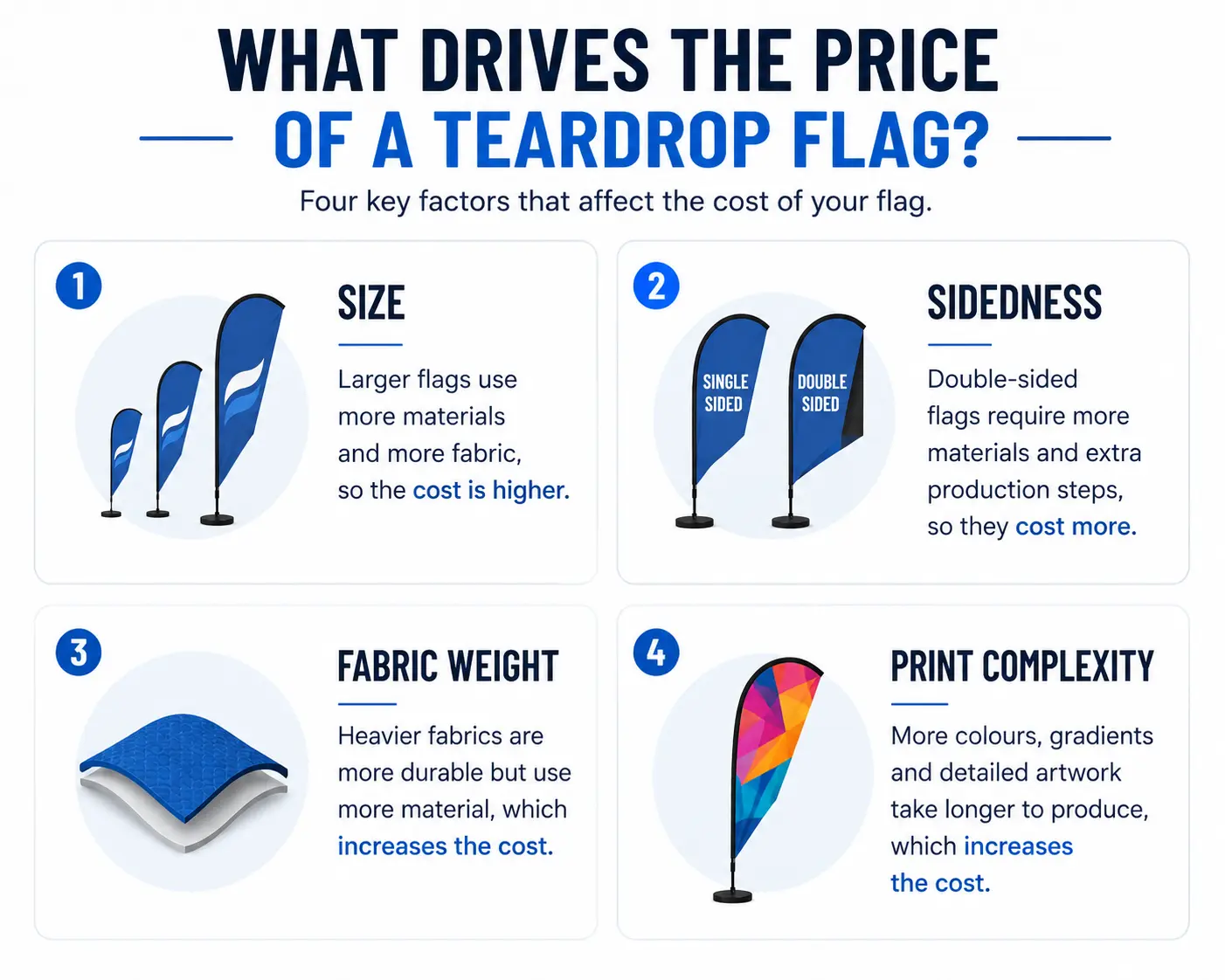
Four things do most of the work in determining price: the size of the flag, whether it’s single- or double-sided, the weight and quality of the fabric, and the complexity of your print. Everything else — the base you choose, whether you order one flag or several — sits on top of those four core factors. Understanding them means you can make deliberate trade-offs rather than guessing at where a lower price is coming from.
Knowing which of these four actually matters for your situation is more useful than trying to cut a little from each — a flag specified sensibly against your real setting, with cost trimmed deliberately in one or two places, almost always beats one where every factor has been pushed to the cheapest option available.
Size & Cost: Bigger Isn’t Always Proportionally More
Larger flags use more fabric and more print area, so they do cost more than smaller ones — but the increase isn’t always a straight line, and a bigger flag isn’t automatically the wrong choice on a budget. If a 3.6m flag is genuinely what your site needs to be seen properly, a smaller flag that people can’t actually see from a distance isn’t a saving — it’s money spent on something that doesn’t do its job. See our sizes guide if you’re not sure which size your site actually calls for before you start optimising for price.
Single vs Double-Sided: The Cost Difference
Double-sided flags cost more than single-sided ones of the same size, because they use more material and construction time. This is a genuine place to save if your flag will only ever be viewed from one direction — but if your site has visibility from multiple angles, going single-sided to save money is a false economy, since half your audience ends up seeing a mirrored, unfinished-looking flag. Our single vs double-sided guide has a simple test for working out which one your setting actually needs.
Worth noting: the cost gap between single- and double-sided is usually smaller than the gap between adjacent sizes, so if you’re weighing up cutting one or the other to save money, it’s worth checking both figures at quote stage rather than assuming which saves more.
Fabric Weight & Print Complexity
A simple one- or two-colour design on standard-weight fabric will always cost less than a full-bleed photographic print on a heavier, wind-rated material. Both are legitimate choices — the right one depends on how long the flag needs to last and how exposed the site is, not on which is objectively ‘better’. A flag that’s up for a single weekend event doesn’t need the same fabric spec as one that’s planted outside a shop year-round, and there’s no reason to pay for durability you don’t actually need.
If you’re not sure which spec makes sense for your situation, it’s worth telling us how the flag will actually be used — indoor or outdoor, one-off or ongoing, sheltered or exposed — rather than guessing at a fabric weight in isolation. That context makes it much easier to recommend a sensible spec rather than defaulting to the heaviest option out of caution.
Our Value Range: A Genuine Budget Option
If cost is the deciding factor, it’s worth knowing we offer a dedicated value teardrop flag in the 1.7m size, available single- or double-sided. This is a genuine lower-cost option rather than a compromised one — it’s built to the same core standard, just at the size and spec that keeps cost down, which makes it a sensible starting point if budget is the primary driver and a compact flag suits your setting.
The value range works particularly well for exactly the kind of close-range settings a 1.7m flag suits anyway — shop doorways, market stall counters, café entrances — so choosing it isn’t usually a trade-off against what you actually need, provided your setting was already a good match for the compact size in the first place.
Cost Per Use: Why Teardrop Flags Are Cheaper Than They Look
It’s easy to compare the upfront price of a teardrop flag against a one-off printed banner or a disposable pop-up sign and conclude the flag is the pricier option. That comparison misses the more useful number: cost per use. A well-made teardrop flag, cared for properly between outings, typically lasts multiple seasons of regular use — which means the same flag might do duty at dozens of events, market days, or simply months outside a shopfront, bringing the real cost-per-use down well below something that’s designed to be used once and discarded.
This is worth bearing in mind if you’re comparing a teardrop flag against genuinely disposable signage on price alone — the upfront number only tells part of the story. If you’re using something regularly, over and over, a slightly higher one-off cost for a flag that lasts years usually works out cheaper than repeatedly replacing something built for a single use. The same logic applies to comparing our standard range against the value range: both are genuinely durable, the difference is in size and spec rather than one being disposable and the other built to last.
Real-World Budget Examples
- Tight budget, single shopfront: a single-sided value 1.7m flag against a wall, with a basic ground spike or lightweight base — the most economical genuinely sensible setup.
- Occasional weekend market trader: a standard 2.7m single-sided flag if the stall backs onto something, double-sided if it doesn’t — this is the point where checking your actual site pays off rather than defaulting to the cheapest option.
- Multi-site retailer on a rollout budget: batching several standard 2.7m flags into one trade-priced order, rather than ordering site by site, to bring the per-flag cost down across the whole rollout.
- Forecourt or large site with a stretched budget: a row of two or three smaller flags rather than jumping straight to the largest single size — often similar total cost with better coverage across a wider frontage.
None of these are the only right answer — they’re simply where cost and practicality tend to meet for each scenario. Your own site may call for a different balance.
Base & Pole: Don’t Cut Cost in the Wrong Place
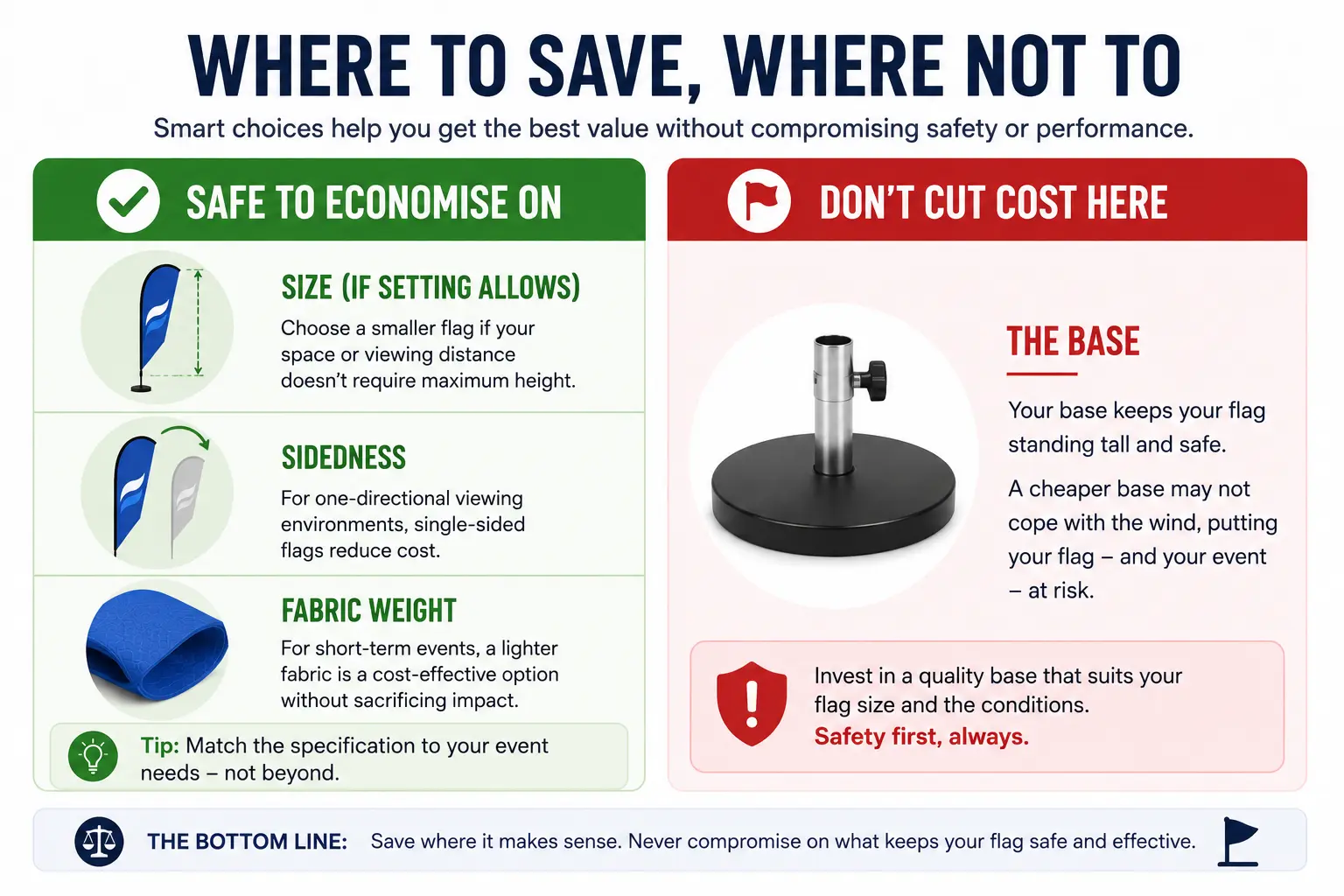
If you’re looking to trim cost, the base is the one place we’d caution against going too basic. A lightweight or undersized base might shave a small amount off the total order, but an under-anchored flag in UK wind conditions is a genuine risk — to the flag itself, and to anyone nearby if it comes down. This is the one area where the cheapest option isn’t really a saving once you factor in a potential replacement flag and the hassle of dealing with it coming down mid-event.
If you need to economise, it’s better to step down a size or choose single-sided than to pair the right flag with the wrong base. Think of the base as the one line item in your order where ‘cheapest’ and ‘best value’ are genuinely different things — everywhere else on this list, they usually overlap.
Bulk & Trade Pricing: Ordering More for Less
If you’re ordering more than one flag — for multiple sites, a franchise, or a season of events — ask about trade and bulk pricing. Ordering as a batch is almost always more cost-effective per flag than placing several separate single-flag orders, and it has the added benefit of keeping your design and colours consistent across every site.
This applies even if your sites need slightly different specs — say, a mix of single- and double-sided flags depending on each location’s layout. It’s still worth placing that as one combined order with your requirements broken down per site, rather than treating each location as a separate transaction.
Cheap vs Affordable: What’s Worth Paying a Little More For
There’s a real difference between choosing affordable and choosing whatever’s cheapest without checking what you’re giving up. A genuinely affordable flag is one that’s specified sensibly for its setting — the right size, the right sidedness, a fabric weight that matches how long it needs to last, on a base that actually holds it up. A cheap flag, in the sense of cutting every corner at once, often ends up costing more overall once you factor in an early replacement or a flag that never really did its job because it was undersized or under-anchored for the site.
The most reliable way to keep cost down without those problems is to be deliberate about which one or two factors you’re economising on, rather than trimming a little off everything at once.
Common Cost Mistakes to Avoid
- Choosing the cheapest base available rather than one properly rated for your flag’s size
- Going single-sided purely for cost without checking whether your site actually needs double-sided
- Ordering a flag too small to be seen properly, then needing a second, larger one later
- Placing several small single-flag orders across multiple sites instead of batching for trade pricing
- Choosing the heaviest, most durable fabric for a flag that’s only ever used for a single weekend event
A Simple Cost-Saving Checklist
- Choose the smallest size that’s genuinely still visible for your setting — not smaller than that
- Go single-sided only if your site has no realistic route behind the flag
- Match fabric weight to how long the flag actually needs to last, rather than always choosing the heaviest option
- Consider the value range if a compact 1.7m flag suits your site
- Batch multiple flags into one order rather than ordering separately
- Never economise on the base — pair it properly to your chosen size
Frequently Asked Questions
What’s the cheapest way to get a teardrop flag?
Our value range in the 1.7m size is the most budget-friendly starting point, particularly single-sided if your setting allows for it.
Will a cheaper flag last as long as a standard one?
It depends what’s been reduced to bring the cost down — check whether it’s the size, the sidedness, or the fabric weight, since each affects durability differently. Ask us directly if you’re not sure what a specific price difference reflects.
Is it cheaper to buy the flag without a base?
Only if you already have a compatible base from a previous order — otherwise you’ll need to buy one separately regardless, so there’s rarely a genuine saving in splitting the order.
Do you offer discounts for larger orders?
Yes — ask about trade and bulk pricing when you request a quote for more than one flag.
Is the value range noticeably lower quality?
No — it’s built to the same core standard, just at the size and spec that keeps the price down. It’s a genuine budget option, not a compromised one.
Should I always choose the cheapest base to save money?
No — this is the one place we’d advise against economising. An under-anchored flag risks damage or injury in UK wind conditions, which costs far more than the small saving on a lightweight base.
Is it cheaper to order flags for multiple sites separately or together?
Together — batching a multi-site order is almost always more cost-effective per flag than placing several individual orders.
Get an Affordable Quote
Browse the value teardrop flag range or the full range of teardrop flags, or get a custom quote and tell us your budget — we’ll help you find the right spec without paying for anything you don’t need.