

PVC banners are the most widely used material for printed outdoor signage in the UK, and for good reason — they’re durable, weatherproof, and among the most cost-effective ways to get a bold message in front of people at scale. This guide covers exactly what PVC banners are, which grade suits your project, and what to expect in terms of price and turnaround.
Whether you’re weighing up PVC against other materials or already know it’s the right fit and just need to choose a grade and finish, this covers everything from the ground up.
What Are PVC Banners?
A PVC banner is a sheet of flexible vinyl, printed in full colour and finished with your choice of edges — trimmed, hemmed, or hemmed with eyelets for mounting. The material’s smooth surface takes print exceptionally well, giving sharp, high-impact colour that holds up under repeated outdoor exposure. It’s the material most people picture when they think of a classic printed banner: a fence-mounted advert outside a building site, a shopfront promotion, or a large format display at an event.
Part of PVC’s popularity comes down to versatility — it works just as well as a one-off event banner as it does as semi-permanent signage, and the same base material scales from a small shopfront strip to a large-format hoarding without losing print quality.
Because PVC banners are made to order rather than sold as a fixed-size product, dimensions are entered directly when you order — up to 10 metres wide and 3 metres high — so the finished banner matches your exact site rather than being constrained to a handful of standard sizes.
PVC Banner Materials: 440gsm vs 500gsm Explained
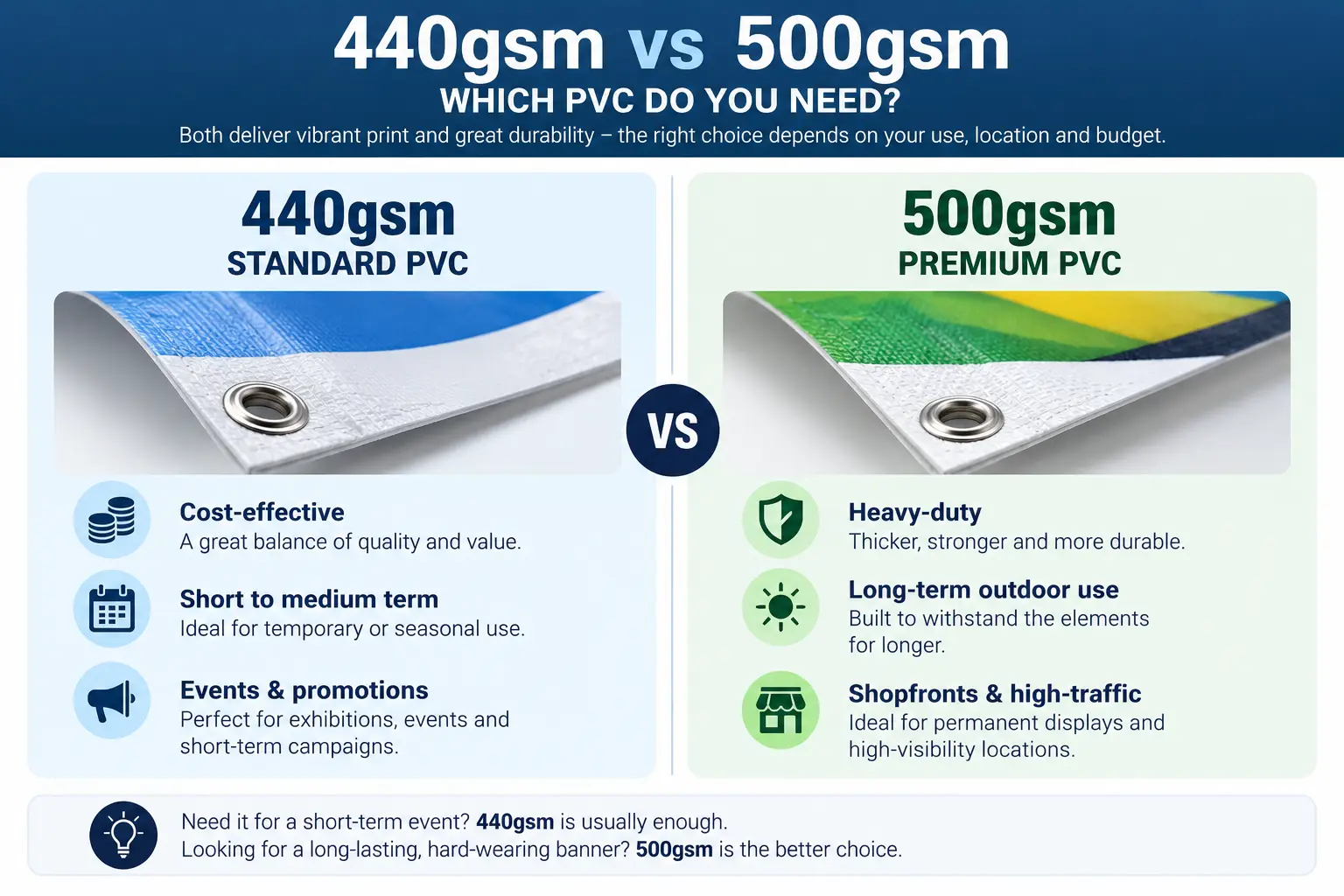
PVC banners come in two standard weights, and the right one depends on how long the banner needs to last and how much wear it’ll take:
- 440gsm Standard PVC — a reliable, cost-effective option for general use. Good all-round performance for short to medium-term display, with a smooth surface for sharp print results. Ideal for events, promotions, and temporary signage.
- 500gsm Premium PVC — a heavier, more robust material for enhanced durability and a higher-quality finish. More resistant to wear, creasing, and harsh weather, making it the better choice for long-term outdoor use, shopfronts, and high-traffic areas.
If you’re not sure which grade your project needs, the simplest test is longevity: a banner going up for a single weekend event doesn’t need the same spec as one that’s staying outside your premises through a UK winter.
It’s also worth thinking about handling — 500gsm’s extra weight makes it feel noticeably more substantial when installing, which some buyers prefer for a more premium look and feel even where 440gsm would technically do the job.
Finishing Options: Trim, Hems & Eyelets
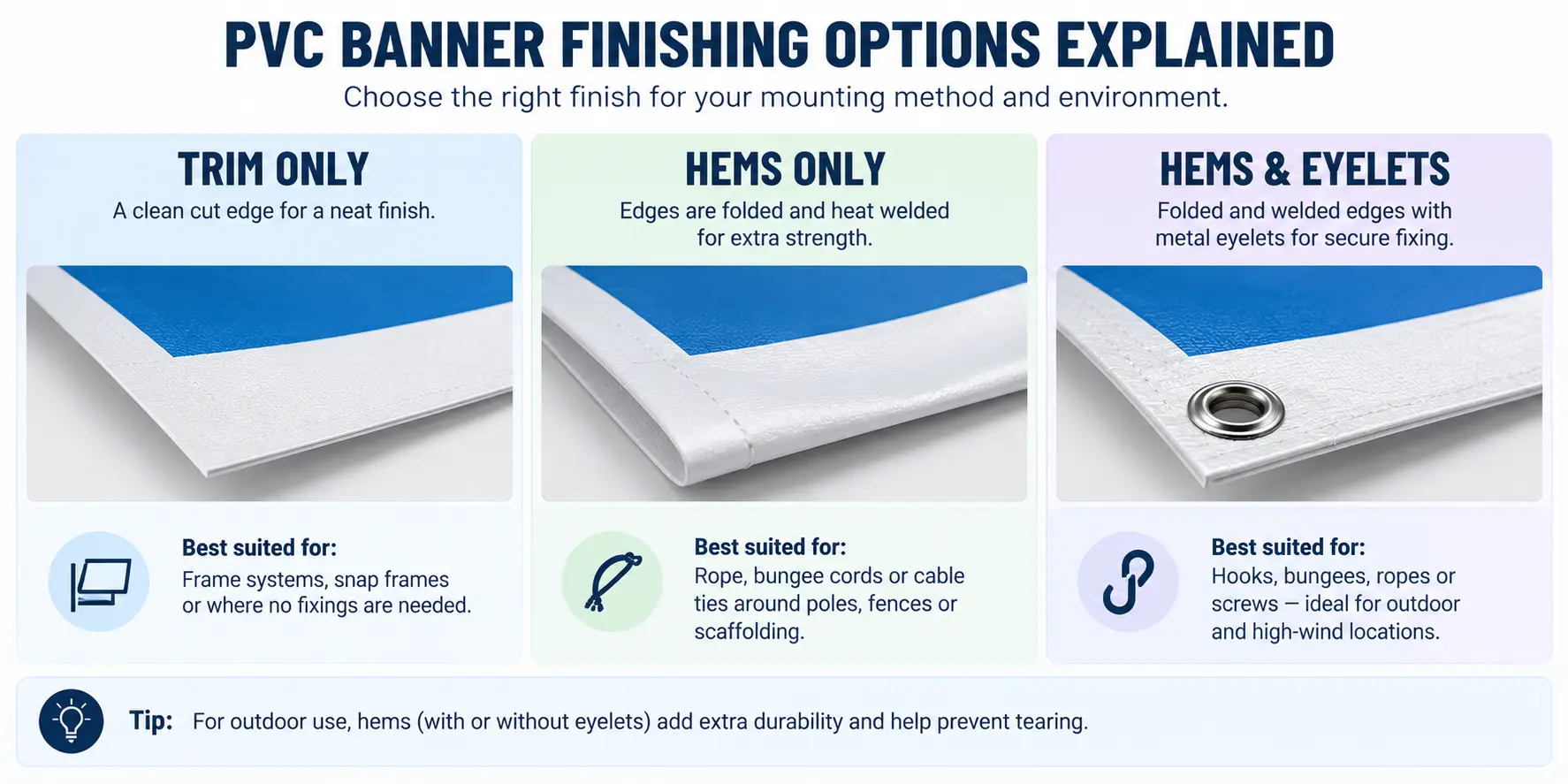
Beyond the material grade, PVC banners can be finished three ways:
- Trim only — the banner is cut cleanly to size with no additional reinforcement. The most affordable option, suited to indoor use or anywhere the banner will be mounted in a frame rather than hung freely.
- Hems only — the edges are folded and welded for extra strength, reducing the risk of tearing at the border over time. A sensible step up for anything staying up longer term.
- Hems & eyelets — hemmed edges plus evenly spaced metal eyelets, making it straightforward to secure the banner to fencing, a wall, or a frame with rope or ties. This is the finish most outdoor, fence-mounted, or wall-mounted banners need.
As a rule of thumb: if the banner is going to be tied, cable-tied, or roped into place outdoors, get eyelets. If it’s dropping into a frame or display system, trim or hems alone is usually enough.
It’s worth deciding on finish before finalising your artwork rather than after, since eyelet spacing can influence how close to the edge your design should sit — our design team will flag this at proofing stage if it’s likely to be an issue, but it saves a round of revisions if it’s considered upfront.
Where PVC Banners Work Best
PVC’s balance of cost, durability, and weather resistance suits a wide range of settings:
- Retail signage: shopfronts, sale promotions, and seasonal offers, where a bold, low-cost banner needs to go up and come down quickly
- Outdoor promotions: product launches, local advertising, and short-term campaigns where PVC’s affordability and durability both matter
- Forecourt and roadside advertising: PVC’s weatherproofing makes it a dependable choice for anything facing the elements long-term
- Construction and site signage: hemmed and eyeleted PVC banners are a common choice for fencing and hoarding around building sites
- Council and community signage: event notices, public information boards, and temporary local authority signage, where cost-effectiveness across multiple banners matters
It’s a genuinely broad-use material — the main situations where you’d reach for something else are indoor exhibitions where a softer fabric finish suits the brand better, or particularly windy sites where mesh’s airflow makes more practical sense.
PVC vs Mesh vs Fabric: Why Choose PVC Specifically
If you’re comparing banner materials generally, our guide to choosing the best material for outdoor banners covers PVC, mesh, and fabric side by side. In short: PVC is the most cost-effective, all-round choice for straightforward outdoor advertising;
mesh (built from perforated PVC) is the better pick for anywhere genuinely windy or exposed, since air passes through rather than catching the banner side-on — see our air mesh banners if that’s your setting; and fabric, printed by dye-sublimation rather than surface ink, gives a softer, more premium finish that suits exhibitions and indoor branding better than outdoor durability — see our fabric banners range for that use case. PVC remains the default choice when you want straightforward outdoor durability without paying for a spec you don’t need.
A useful way to think about it: mesh solves a wind problem, fabric solves a presentation problem, and PVC is the dependable middle ground that handles most everyday outdoor advertising without needing either of those specific trade-offs.
How PVC Banners Are Printed
Unlike fabric banners, which use dye-sublimation printing, PVC banners are printed directly onto the vinyl surface using fade-resistant, UV-stable inks — a process suited to PVC’s smooth, non-porous surface and one of the reasons PVC holds colour so well through prolonged outdoor exposure. The result is bold, high-contrast print that reads clearly from a distance, which is exactly what most banner use cases actually need.
This printing method is also part of why PVC handles large-format work so reliably — the ink sits cleanly on the surface rather than needing to bond into a woven fibre structure, which keeps colours consistent even across a big, continuous print run.
Ordering & Turnaround
Once your artwork is approved, PVC banner orders are typically printed, finished, and prepared within 3–5 working days. Larger quantities or more detailed jobs may take a little longer, and lead times are always confirmed clearly when your order is placed. If you’re working to a fixed date — an event, a campaign launch — flagging that upfront gives the best chance of it being accommodated.
If you don’t have print-ready artwork, that’s not a blocker — a free design service is available to help put your banner together from scratch or refine artwork you already have.
Delivery is handled via tracked courier, typically arriving the next working day within mainland UK once production is complete — worth factoring in alongside production time when planning around a fixed date rather than assuming the two happen simultaneously.
Your banner only enters production once you’ve approved a proof, so build a little time into your planning for that review step too — it’s a quick turnaround in practice, but it’s not instant, and it’s the point where any last corrections are cheapest and easiest to make.
Caring for Your PVC Banner
- Clean with a damp cloth — PVC banners are low maintenance and don’t need special products
- Allow the banner to dry fully before storing, and avoid folding it tightly for long periods to prevent permanent creasing
- Store rolled rather than folded where possible, particularly for banners you plan to reuse
- Check eyelets and fixings periodically if the banner is staying up long-term outdoors
- Avoid abrasive cleaning products or scrubbing, which can dull the print surface over time
None of this requires specialist equipment or products — PVC’s whole appeal is that it’s genuinely low-maintenance signage, which is part of why it remains the default choice for anyone who needs a banner up and working without ongoing fuss.
How Much Do PVC Banners Cost?
PVC banners are priced from around £20, making them one of the more accessible options in the banner range — final cost depends on size, material grade (440gsm vs 500gsm), and finishing choice (trim, hems, or hems & eyelets). Larger sizes and the heavier 500gsm grade cost more, but PVC remains genuinely competitive against other banner materials for straightforward outdoor use, which is part of why it’s the most widely used banner material in the UK.
As a general guide, price scales with both dimensions and spec — a small trim-only 440gsm banner sits at the lower end, while a large hemmed-and-eyeleted 500gsm banner sits toward the top. Getting an exact figure is quick and free through the online configurator or a direct quote request, and there’s no obligation attached to either.
If cost is the main driver, 440gsm with a trim-only or hems-only finish is the most affordable combination — just bear in mind that’s better suited to shorter-term or indoor use than a banner that needs to survive a UK winter outdoors.
For multiple banners — a multi-site campaign, or several sizes for the same event — it’s worth asking about bulk pricing at quote stage rather than ordering each one separately, since batching tends to bring the per-banner cost down.
Frequently Asked Questions
What’s the difference between 440gsm and 500gsm PVC?
Thickness and durability. 440gsm suits general and temporary use; 500gsm is heavier and better suited to long-term or high-exposure outdoor installations.
Are PVC banners suitable for outdoor use?
Yes — they’re weather-resistant, durable, and printed with UV-resistant inks to keep colour vibrant under prolonged outdoor exposure.
What finishing option do I need?
Hems & eyelets for anything being tied or fixed outdoors; trim or hems alone is usually enough for framed or indoor display.
Are PVC banners environmentally friendly?
PVC isn’t the most sustainable material choice, but its durability means a long-lasting PVC banner can reduce the need for frequent replacement compared to less durable alternatives. If sustainability is the priority, fabric banners made from recycled polyester are worth considering instead.
How long do PVC banners last?
It depends on the grade and conditions, but a well-specified PVC banner — particularly 500gsm — is built for long-term outdoor use rather than a single campaign.
Can I get a PVC banner made to a custom size?
Yes — PVC banners are made to your specified dimensions rather than fixed standard sizes, so you can match the banner exactly to your site or display space.
Do I need to provide print-ready artwork? No — a free design service is available if you don’t already have artwork prepared, so this isn’t a barrier to ordering.
What’s the maximum size for a PVC banner? Up to 10 metres wide and 3 metres high as standard — banners are made to your exact dimensions rather than fixed off-the-shelf sizes.
Order Your Custom PVC Banner
Browse PVC banners, see the full custom printed banners range to compare materials, or get a free quote and we’ll help you choose the right grade and finish for your project.
Not sure which material or finish is right for your specific site? Our team is used to talking buyers through exactly this kind of decision — a quick conversation before you order is a lot easier to arrange than a reprint after.