
Bonfire Night Signage
Practical guidance for clearer routes, boundaries and information points
At a busy firework event, visitors should not have to guess where to queue, which areas are out of bounds or how to find the exit. Clear, well-positioned signage helps people understand the site and supports the stewards managing it.
Bonfire Night safety signage is the visual information and wayfinding that helps visitors understand entrances, queues, facilities, restricted areas and exits. It supports a formal event safety plan, but it does not replace risk assessments, stewarding, emergency procedures, fire-safety controls or advice from the relevant authorities.
A bright flag cannot manage a crowd by itself, and a banner does not create a safe exclusion zone. Used properly, though, flags, barrier covers and banners reduce uncertainty where people need to make a decision, particularly once the light drops and an unfamiliar site begins to fill up.
For organisers, the useful question is not simply, “Where can we put branding?” It is, “What does a visitor need to know at this exact point?” Start with the visitor journey, then choose a format that is visible, stable and suitable for the ground and weather conditions.
Visibility and Direction Matter After Dark
Evening firework events are harder to read than daytime festivals. Temporary layouts, muddy grass, changing queue lines, parked vehicles and low light can make a familiar field or sports ground feel quite different. Families arriving for the first time need confidence that they are heading in the right direction before they reach a bottleneck.
Information is not the same as direction
A banner is useful when people need to read an instruction, such as “Tickets This Way”, “Queue Here” or “No Entry”. A flag or repeated marker has a different job: it gives people a recognisable point to aim for from a distance. In practice, many sites need both.
Keep safety and wayfinding messages short. Good examples include:
- Arrival: Entrance, Ticket Collection, Pre-Booked Entry and Pay Here.
- Facilities: Toilets, First Aid, Welfare Point and Lost Children.
- Movement: Queue Here, Viewing Area, Exit and arrows that show the intended route.
- Access control: Restricted Area, Staff Only, Emergency Access and No Public Entry.
Long copy is rarely helpful when visitors are carrying children, looking for friends or trying to stay out of the rain. Use high contrast, a simple layout and consistent colours for related locations. Position directional messages before the decision point, not halfway down the wrong route.
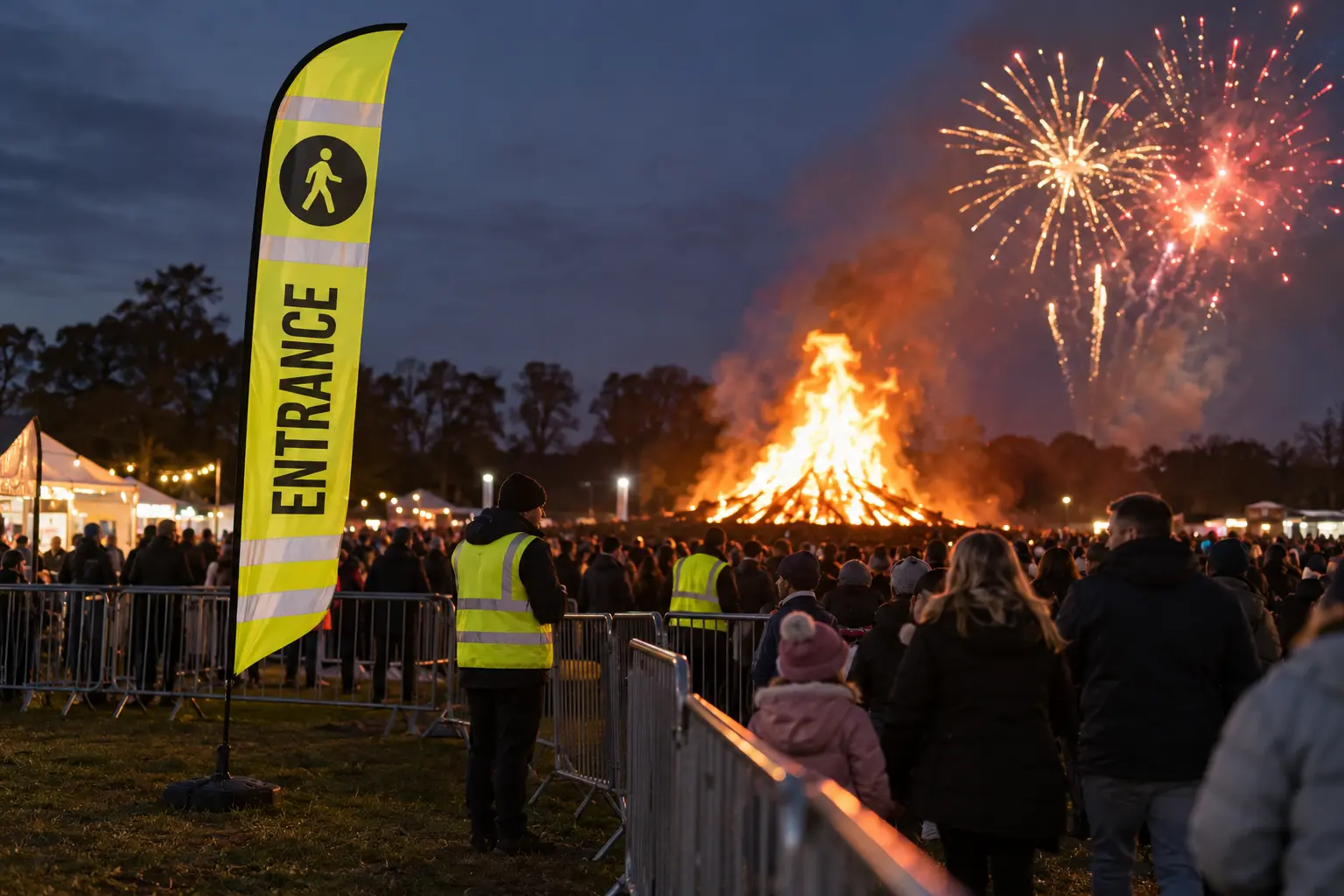
Hi-vis safety flags are a purpose-oriented option for safety messaging and are available from £180.00 to £240.00 ex. VAT. Their practical value comes from clear wording, legibility and placement at a point people can see from a distance, rather than from colour alone.
Walk the route as a visitor would
Before the event, walk from the car park or public drop-off point to the entrance, then through ticket checks, queues, facilities and the viewing area. Do it again after dark if possible, using the lighting conditions expected on the night. This helps identify a sign hidden behind a queue, a route marker facing the wrong approach or an exit message competing with promotional graphics.
Match the Display to the Job
Flags, barriers, banners and gazebos all have useful roles at a Bonfire Night event, but they are not interchangeable. Choose the format around what it needs to communicate and where it will sit within the wider site plan.
| Display format | Best practical use | Key consideration |
|---|---|---|
| Hi-vis flag | Recognisable markers at entrances, steward points and route changes | Must be visible from the direction visitors approach |
| Printed banner | Clear instructions, arrows and longer messages | Do not obstruct sightlines or emergency information |
| Barrier cover | Making an existing boundary more noticeable and consistent | It supports, rather than replaces, physical segregation |
| Printed gazebo | Identifying ticketing, information or welfare points | Needs suitable positioning and secure anchoring |
Flags for recognition, banners for instructions
Place flags at entrances, key route changes, steward points, first-aid or welfare areas, and locations that need to be recognised across a busy site. They are useful where visitors need a visual landmark, such as the end of a queue or where a pedestrian route separates from vehicles.
Use directional banners where people naturally slow down and decide what to do next: before ticket checking, where queues join, on the approach to the viewing area or at the start of the exit route. Make the arrow unambiguous and check that it points the right way from the direction people will actually see it.
Separate safety instructions from general event messaging. Keep commercial branding away from exit signs, steward instructions and restricted-area notices, so visitors do not have to work out which message matters most.
A barrier cover is a message, not a boundary on its own
Crowd barriers, Heras fencing and Chapter 8 barriers can form the physical edge of a queue, service area or restricted zone. Covers make those existing structures more noticeable and can carry an instruction or organiser identity. Sailflags’ fence and barrier covers are listed from £26.00 and are suitable for Heras, crowd and Chapter 8 barriers.
A printed cover is not enough where proper segregation is required. Restricted areas around a bonfire, firework launch location, vehicle route or emergency access point need suitable physical barriers, stewarding and exclusion-zone controls determined by the event plan and competent advice.
Printed gazebos are described as strong and lightweight, making them useful for identifying a staffed ticketing, information or welfare point while offering shelter. Keep them clear of emergency routes, position them so visitors do not create an unplanned queue across a walkway, and secure them in line with supplier guidance and site conditions.
Plan for Movement, Ground Conditions and Changeable Weather
A sensible signage review has four stages: arrival, movement, restricted zones and departure. Mark each on a simple site plan alongside the entrance, check-in point, queue lanes, viewing area, facilities, emergency access and exits. Add bonfire and firework exclusion zones only in accordance with the formal event safety plan.
Plan the visitor journey in stages
- Arrival: Show visitors where to park, walk and enter before they reach the busiest part of the site.
- Movement: Repeat route markers on longer paths so people do not lose confidence after the first sign.
- Restricted zones: Use clear notices and suitable physical barriers at the edge of areas the public must not enter.
- Departure: Make exits easy to identify and keep their routes clear as queues and crowds change after the display.
Agree who is responsible for checking and, if necessary, moving temporary signs during the event. Queues can change shape, an access route may need to close, or weather can make a display unsuitable. Named staff with a simple plan are more useful than signage that was correct at opening but is not checked again.
Understand the sail effect
Solid printed fabric catches wind. This is often called the sail effect: wind pressure loads the fabric, pole, frame and base together. The larger the exposed surface and the more open the location, the more important it becomes to match the display to the conditions.
Do not assume that a larger or heavier display is automatically safer. Consider display height, fabric area, expected wind, how long it will remain in place and whether visitors may brush past it. An exposed car park, raised sports field, coastal venue or open field needs a more cautious approach than a sheltered courtyard.
- Hard standing: Use a weighted or otherwise secured base where ground penetration is not appropriate.
- Grass or compacted ground: Only use suitable ground fixings where the site owner, underground services information and event plan allow it.
- Soft or waterlogged areas: Reassess whether a display can remain stable. Bases can sink and pegs can lose holding strength.
- Slopes and queue lines: Keep feet, ballast, ropes and fixings out of pedestrian routes and pinch points.
- Low-light checks: Make supports and trip hazards visible, and confirm that no display narrows emergency access.
Inspect poles, connectors, hems, eyelets, ballast and fixings before opening. Have replacement parts available where appropriate, plus a clear removal or relocation plan if conditions deteriorate. For unusual, high-risk or complex installations, seek competent professional advice and follow supplier guidance.
Pre-event operational check
This checklist is an operational review, not a certification of safety. It should sit alongside the event’s own formal planning, risk assessment and procedures.
- Route check: Walk every visitor route, including arrivals, queues, facilities, viewing areas and exits.
- Message check: Confirm that each sign has one clear purpose and can be read in the available light.
- Barrier check: Ensure covers fit the barrier type, remain secure and do not conceal important notices.
- Ground check: Inspect for puddles, mud, slopes and soft ground after wet weather.
- Weather check: Review exposed areas and secure, relocate or remove displays if wind conditions make them unsuitable.
- Access check: Keep emergency routes clear and protect any unavoidable trip hazards.
- Staff check: Assign named people to inspect signage before opening, during the busiest period and after significant weather changes.
Bespoke artwork can be proofed before production, which is useful for checking arrow direction, wording and colour contrast. Sailflags provides a free design service and artwork support for custom flags and banners. Custom flag printing is available with delivery within 3–4 days for most standard items, but allow time for approval, production and event planning rather than treating turnaround as a substitute for preparation.
Frequently asked questions
What is Bonfire Night safety signage?
Bonfire Night safety signage is visual information and wayfinding used to help visitors understand entrances, queues, facilities, restricted areas and exits. It supports a wider event safety plan but does not replace risk assessments, stewarding, emergency procedures or fire-safety controls.
Where should hi-vis safety flags be placed at a firework event?
Place them at entrances, key route changes, steward points, first-aid or welfare areas, and other locations that must be recognised from a distance. Their final position should follow the site plan, be visible from the approach route and avoid obstructing access.
Can crowd barrier covers be used to mark restricted areas?
Yes, covers can make existing barriers more noticeable and communicate an instruction or organiser identity. Use them with suitable physical barriers, stewarding and exclusion-zone controls, not as a replacement for them.
What should organisers consider when fixing flags and banners outdoors?
Consider the surface type, wind exposure, fabric area, display height, ballast or ground fixings, trip hazards, low-light visibility and inspection during the event. Follow supplier guidance and seek competent advice for unusual or higher-risk installations.
Are printed gazebos suitable for Bonfire Night information points?
They can identify staffed information, ticketing or welfare areas while providing shelter. They must be correctly positioned, secured for the conditions and kept clear of emergency routes.
Clear signage will not replace good event management, but it gives visitors useful information when they need it most. Review the site plan, identify every point where a person might hesitate or take the wrong route, and choose a display format that does a specific job. Hi-vis flags work well as visible markers, banners carry instructions, barrier covers reinforce recognisable boundaries and gazebos identify staffed points.
For made-to-order flags, banners and event displays, speak to Sailflags about the appropriate format, artwork support and fixing options for your site.