


Picking the right size is the single decision that affects how well a teardrop flag actually works for you — get it wrong and even the best design either disappears against its surroundings or looks oversized and out of place. This guide walks through our three standard sizes in detail, so you can match the flag to the space rather than guessing. If you haven’t already, it’s worth reading our teardrop flags overview for the full picture on materials, sides and pricing — this post picks up where that one leaves off.
Why Size Matters More Than You’d Think
It’s tempting to think bigger is always better, but the right teardrop flag size depends entirely on where it’s going and how far away the people you want to reach will be standing. A flag that’s perfect for a shop doorway will look lost in the middle of a festival field, and a flag sized for a forecourt will tower awkwardly over a small market stall. Size should follow the setting, not the other way round.
There’s also a practical side to this: taller flags need heavier, more capable bases and catch more wind, so choosing a size that actually suits your site avoids paying for stability you don’t need — or worse, under-anchoring a flag that’s too tall for the base you’ve paired it with.
The Three Standard Teardrop Flag Sizes, At a Glance
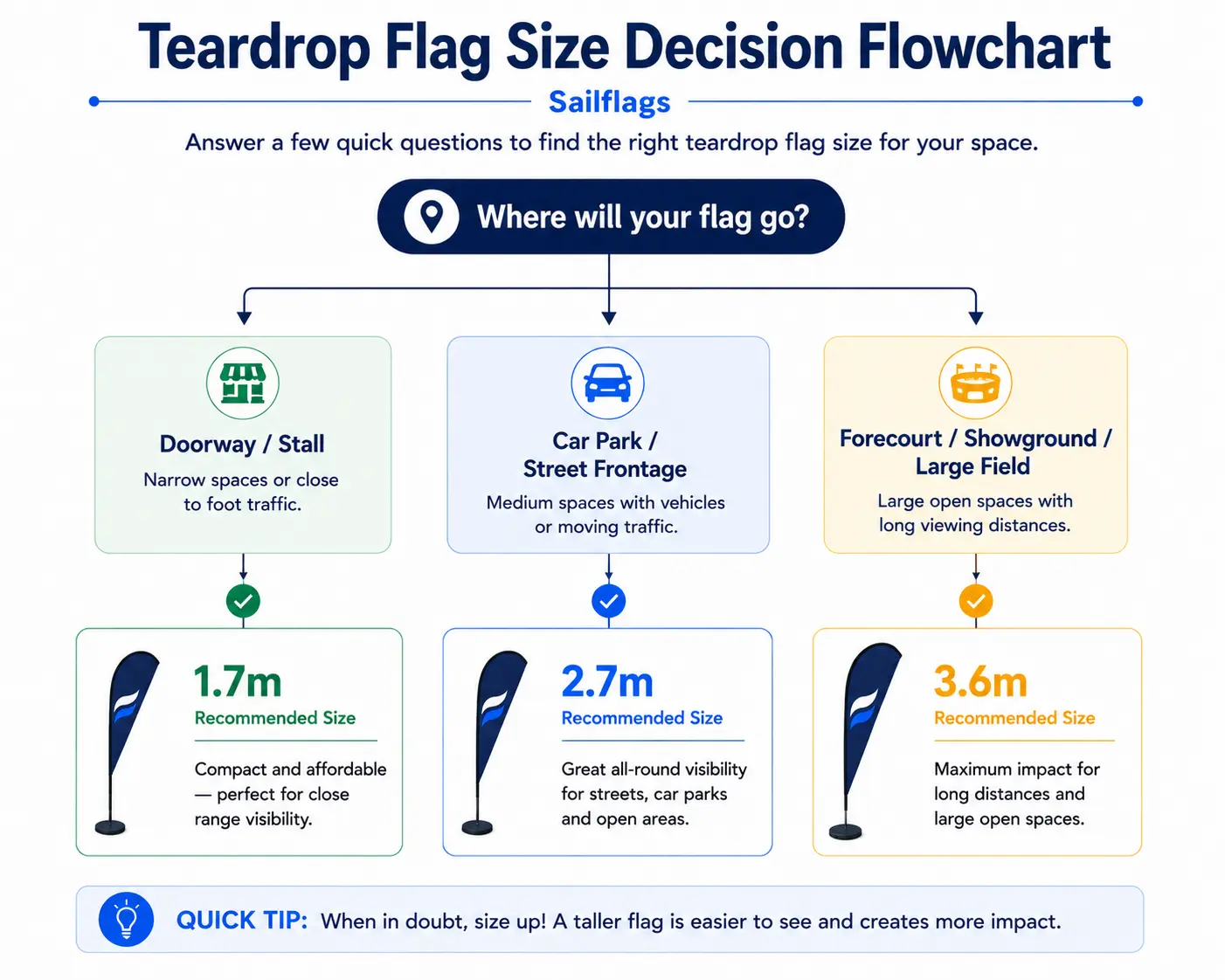
- 1.7m — compact, easy for one person to carry and set up, best for close-range viewing
- 2.7m — the most popular all-round size, visible across a car park or street frontage
- 3.6m — our tallest standard size, built for visibility at real distance across open sites
The sections below go through each in more detail, including exactly the kind of setting each one suits best.
1.7m Teardrop Flags: Best For…
The 1.7m teardrop flag is our smallest standard size, and it earns its place for anywhere space or portability matters more than maximum visibility. Think shop doorways, market stall counters, café entrances, and anywhere a customer will already be within a few metres before they need to notice it.
Because it’s the lightest and most compact option, it’s also the easiest to move — a good pick if you’re setting up and packing down daily, or carrying a flag between multiple small sites in a single day. It pairs well with lighter bases, and it’s the size most often chosen for our backpack carry kits, since the whole setup needs to stay light enough to walk with comfortably.
2.7m Teardrop Flags: Best For…
The 2.7m teardrop flag is the size most businesses land on, and for good reason — it’s tall enough to be seen from across a car park, a high street, or a retail forecourt, without needing the heavier-duty base and pole that our largest size requires.
If you’re only buying one flag and you’re not sure which size to choose, 2.7m is the safest default: it works for most retail frontages, most trade show aisles, and most outdoor pitches without looking undersized or overbearing. It’s also the size we’d recommend if your flag needs to do double duty across a few different settings — say, outside your shop most weeks but at the occasional market or event too.
3.6m Teardrop Flags: Best For…
The 3.6m teardrop flag is built for sites where distance is the whole point — forecourts, large festival fields, exhibition grounds, or anywhere your flag needs to be spotted above parked cars, gazebos, or a crowd of people. If you’ve ever walked across a showground looking for a stand and used a tall flag as your landmark, this is the size doing that job.
This size needs to be taken seriously on the hardware side — a taller flag catches more wind, so it should always be paired with a properly weighted or ground-anchored base rated for the height, never a lightweight base sized for a smaller flag. It’s not the right choice for tight indoor spaces or anywhere height is restricted (more on that below), but outdoors, on an open site, it’s the size that gets noticed from furthest away.
How Size Affects Your Design & Branding
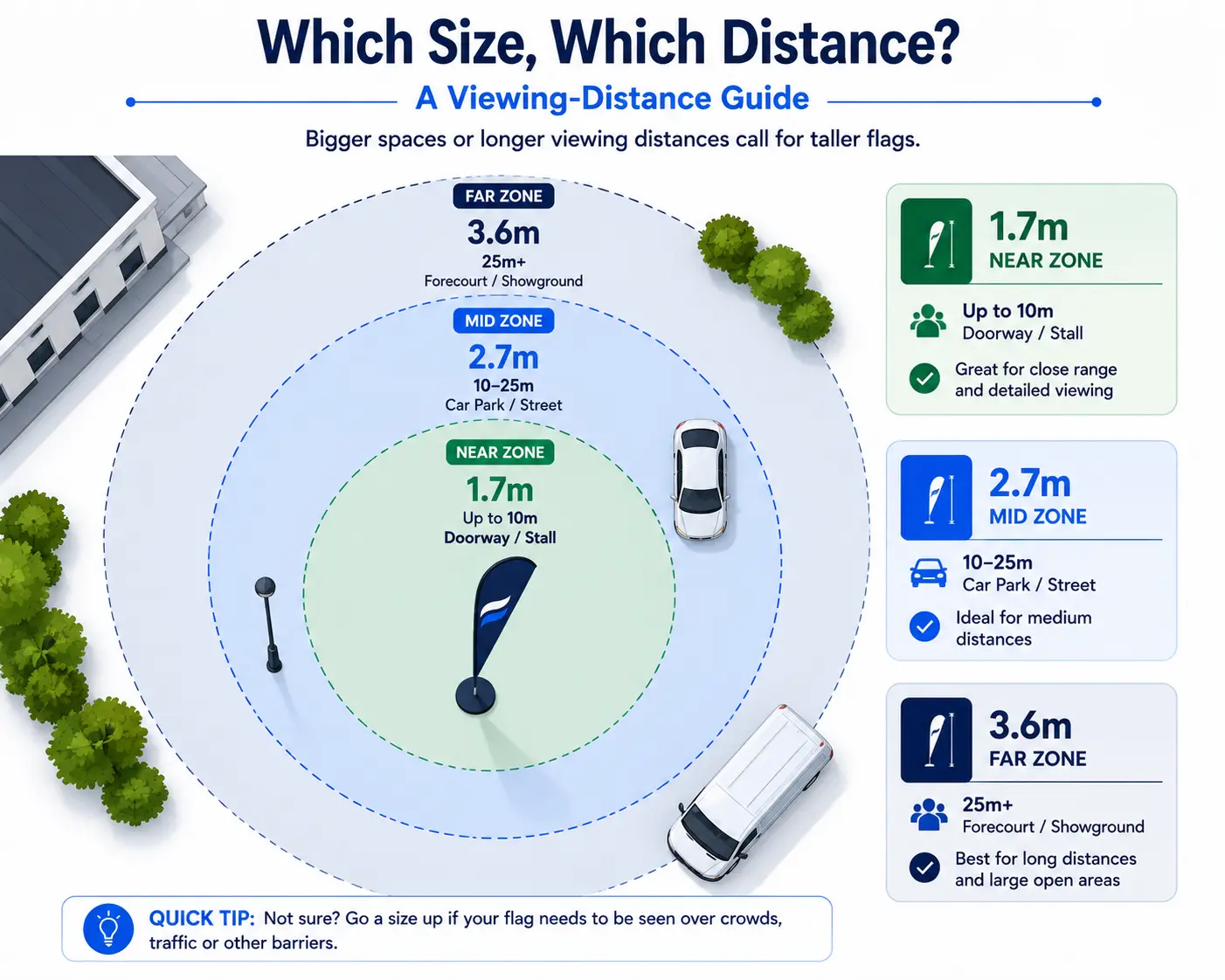
Size doesn’t just change visibility — it changes how much detail your design can actually carry. On a 1.7m flag, viewers are usually close enough to read smaller text and finer logo detail, so you can afford a slightly busier design. On a 3.6m flag, viewers are typically much further away, which means fine text and thin logo lines simply won’t register — bold colours, a large clear logo, and minimal wording tend to work far better at that distance.
A good rule of thumb: if you can’t read your own design comfortably from the distance your flag will actually be viewed at, simplify it. This is one of the most common briefs mistakes we see — a design that looks great up close on a screen but loses all impact once it’s printed at 3.6m and viewed from thirty metres away. If you’re using our online flag creator, it’s worth previewing your design at the size you’re actually ordering, not just the default view.
How to Measure Your Space Before You Choose
A quick, practical way to choose: stand where your audience will typically be, and look toward where the flag will go. If that distance is a few metres — a doorway, a stall counter, a queue line — 1.7m is plenty. If it’s the length of a car park or a shop frontage, 2.7m is the right call. If people could be approaching from right across a field, a showground, or a large forecourt, that’s when 3.6m earns its size.
It’s also worth checking the space above the flag, not just around it — overhanging trees, shop awnings, power lines, and low doorways can all rule out a taller flag on an otherwise suitable site. A five-minute site check before you order saves a size exchange later.
Matching Flag Size to Base & Pole
Every teardrop flag needs a base that can genuinely hold it steady in UK conditions, and the bigger the flag, the more that matters — wind load increases with flag size, so a base that comfortably holds a 1.7m flag may not be enough for a 3.6m one in the same spot.
As a general guide: smaller flags can usually be paired with lighter bases or ground spikes, while our larger sizes are best matched with a heavier option such as our heavy-duty water-weighted base, particularly on hard standing where a ground spike isn’t an option. If you’re not sure which base suits your chosen size and site, it’s worth asking us directly rather than guessing — the wrong base is the single most common reason a flag ends up on the ground.
If you’re regularly moving between sites, our teardrop backpack kit pairs a flag, pole and base into one rucksack-style carry system — worth a look if portability is as important to you as size.
Single Flag vs a Row of Flags
If you’re trying to make an impact across a wider frontage — a forecourt, an event entrance, or a long shop front — a row of two or three smaller flags spaced evenly apart often reads better than a single very tall one. It draws the eye along the whole space rather than to a single point, and it’s usually more cost-effective than jumping to the largest size just to cover more ground.
As a rough guide, a row works best when the flags are a consistent size and spaced a few metres apart — inconsistent heights or uneven spacing tends to look accidental rather than intentional. A good example is a forecourt entrance: three 2.7m flags spaced along the approach road will often catch more attention over a longer stretch than a single 3.6m flag planted at the gate, simply because drivers see the display building as they get closer rather than noticing one flag at the last moment.
The exception is when you specifically want a single landmark point — for example, marking one exhibition stand in a large hall, where a single tall flag serves as a wayfinding marker rather than a branding display along a route. In that case, one larger flag genuinely does the job better than several smaller ones.
Indoor vs Outdoor Considerations
Outdoors, size is mostly about visibility distance and wind. Indoors, it’s usually about ceiling height and venue rules rather than distance alone — many exhibition halls and shell-scheme stands have their own height restrictions, so it’s always worth checking with the venue or event organiser before committing to a taller flag for an indoor show. A 2.7m flag is usually a safe indoor choice; anything at or beyond 3.6m is worth confirming with the venue first.
Wind is the main constraint outdoors, and it varies a lot by site and season — the Met Office’s UK wind map is a useful check if you’re planning to site a taller flag somewhere exposed, like a coastal location or an open field.
A Few Real-World Examples
- Independent café: a single 1.7m flag by the door, moved inside at closing — compact, easy for one person to handle daily.
- Garden centre: 2.7m flags either side of the entrance, left in place for the season on weighted bases.
- Car dealership forecourt: a row of 3.6m flags along the road frontage, visible to passing traffic well before the entrance.
- Trade show exhibitor: a single 2.7m flag at the stand corner — tall enough to be a landmark in the aisle, comfortably within most shell-scheme height limits.
None of these are fixed rules — they’re simply the sizes that tend to work best for those settings based on distance, wind exposure and venue constraints. Use them as a starting point, then adjust based on your own site.
Common Sizing Mistakes to Avoid
- Choosing a size based on the product photo alone, without checking real-world distances at your own site
- Pairing a tall flag with a base sized for a smaller one — a common cause of flags coming down in wind
- Forgetting to check overhead clearance — trees, awnings, and power lines rule out taller flags in some spots
- Assuming bigger is always better — an oversized flag in a small space can look overbearing rather than professional
- Not checking indoor venue height restrictions before ordering a flag for an exhibition or trade show
Frequently Asked Questions
What’s the most popular teardrop flag size?
2.7m — it suits the widest range of settings and is the size we’d recommend if you’re only buying one flag and want it to work well across a few different uses.
Can I use a 1.7m base with a 3.6m flag?
We wouldn’t recommend it — larger flags catch significantly more wind and need a base rated for their height. Mismatched bases are the most common cause of flags falling over.
Is a 3.6m flag suitable for indoor use?
Usually not without checking first — many indoor venues have height restrictions that a flag this size may exceed. Confirm with the venue before ordering.
Do all sizes come in single- and double-sided options?
Yes — sidedness is a separate choice from size, and all three standard sizes are available both ways.
Will a bigger flag always get more attention?
Not necessarily — a flag sized well for its setting reads as intentional and professional, while an oversized flag in a small space can look out of proportion. Matching size to setting matters more than maximising size on its own.
Can I order a custom size outside the three standard options?
Get in touch with our team to discuss your specific site and requirements — while 1.7m, 2.7m and 3.6m cover most settings, we’re happy to talk through anything unusual.
Ready to Choose Your Teardrop Flag Size?
Browse the full range of teardrop flags to compare all three sizes side by side, or get a custom quote and we’ll help you match the right size to your site.