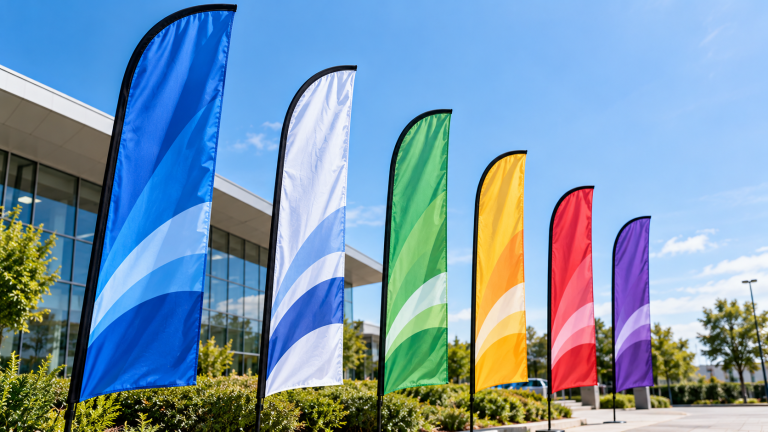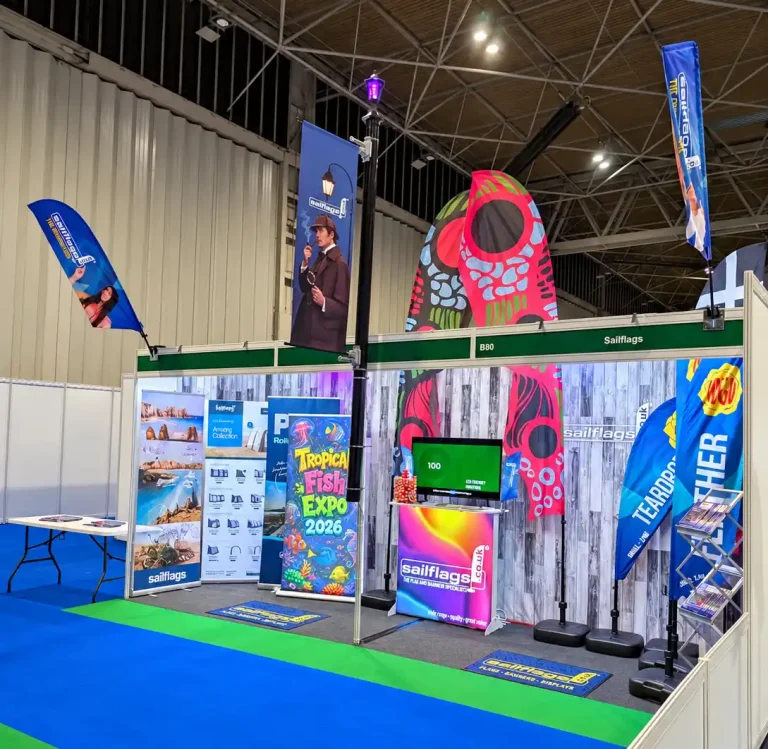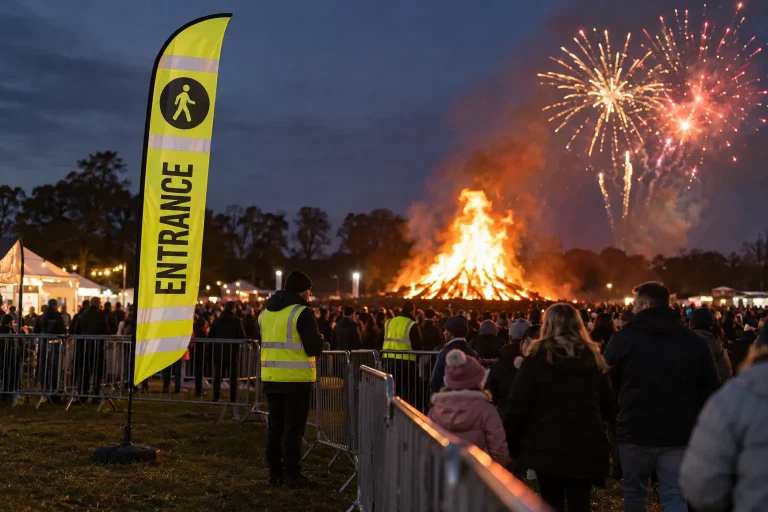


Outdoor events put feather flags through their most demanding test. The controlled environment of a shopfront or exhibition hall gives way to unpredictable ground conditions, shifting wind, summer rain, and the logistical reality of setting up and packing down multiple times across a busy event calendar. Done well, feather flags at outdoor events deliver exceptional visibility — dynamic, tall, and unmissable in a field of competing visual noise. Done badly, they tip over, wrap around the pole in the wind, or need replacing after one weekend.
This guide covers everything you need to know to set up feather flags correctly at any outdoor event — from choosing the right size and fabric for the environment, to ground-type base selection, wind management, and surface-by-surface setup advice for festival fields, beaches, sports events, and outdoor markets.
1. Choosing the Right Flag for Outdoor Use
Size
Outdoor environments typically require larger flags than indoor ones. The combination of crowd density, competing visual stimuli, and the open sightlines of a field or beach means a 3.2m flag that dominates a shopfront can feel modest at a busy festival. As a general rule for outdoor event use:
- Contained outdoor markets and garden events: 3.2m Standard — visible above most crowds, portable, and stable on a range of bases.
- Festival fields and open-air events: 4.2m Long — the minimum for reliable visibility above crowd head height across open ground. From the far side of a typical festival field, a 3.2m flag sits near crowd eye level; a 4.2m clears it.
- Large festivals, race events, and perimeter marking: 5.2m XL — for maximum visibility across open ground, from approach roads, or where the flag needs to act as a landmark rather than just a display.
For a full breakdown of size recommendations by environment, see the feather flag sizes guide.
Fabric
Standard 115gsm dye-sublimation printed polyester is appropriate for most outdoor events — it handles wind, rain, and repeated winding and unwinding across a season of events. For genuinely exposed locations — coastal events, high moorland festivals, multi-day events in unsheltered fields — Sailflags’ ToughTex heavy-duty fabric is engineered to last up to twice as long as standard fabric under sustained outdoor stress. ToughTex flags handle salt air, coastal wind, and extended UV exposure significantly better than standard flag fabric.
Single-Sided or Double-Sided?
For most outdoor events, single-sided is sufficient — the flag faces the direction of the audience, and the back is not the primary view. Double-sided becomes the right choice when the flag is positioned at a junction or central point where audiences approach from multiple directions simultaneously, or when text or QR codes need to read correctly from both sides. See the single-sided vs double-sided guide for the full decision framework.
2. Step-by-Step: How to Assemble a Feather Flag
A complete feather flag kit assembles in under two minutes with no tools. Here is the sequence:
| 1 | Lay the pole sections out on the ground in order, from the bottom spike/connector up to the flexible top tip. Identify each section by size — the widest diameter section goes at the bottom. |
| 2 | Feed the flag fabric sleeve over the pole from the bottom. The sleeve is the channel sewn along the curved outer edge of the flag. The flag hangs free below the sleeve opening. |
| 3 | Connect the bottom section to the next section by pushing the joint firmly until it clicks or seats. Continue connecting sections from the bottom upward. |
| 4 | Attach the flexible top tip last. This is the thinnest, most curved section — it forms the arched top of the flag’s shape. |
| 5 | Insert the bottom of the assembled pole into the base socket. Ensure it seats fully and is vertical before releasing. |
| 6 | For ground spikes: push or twist the spike into the ground to full depth before inserting the pole. For water bases: fill completely before inserting the pole. For cross bases: ensure the water bag is full before use. |
| 7 | Step back and check the flag is vertical and the fabric is hanging correctly. Adjust the base position if the flag is leaning into wind rather than flying across it. |
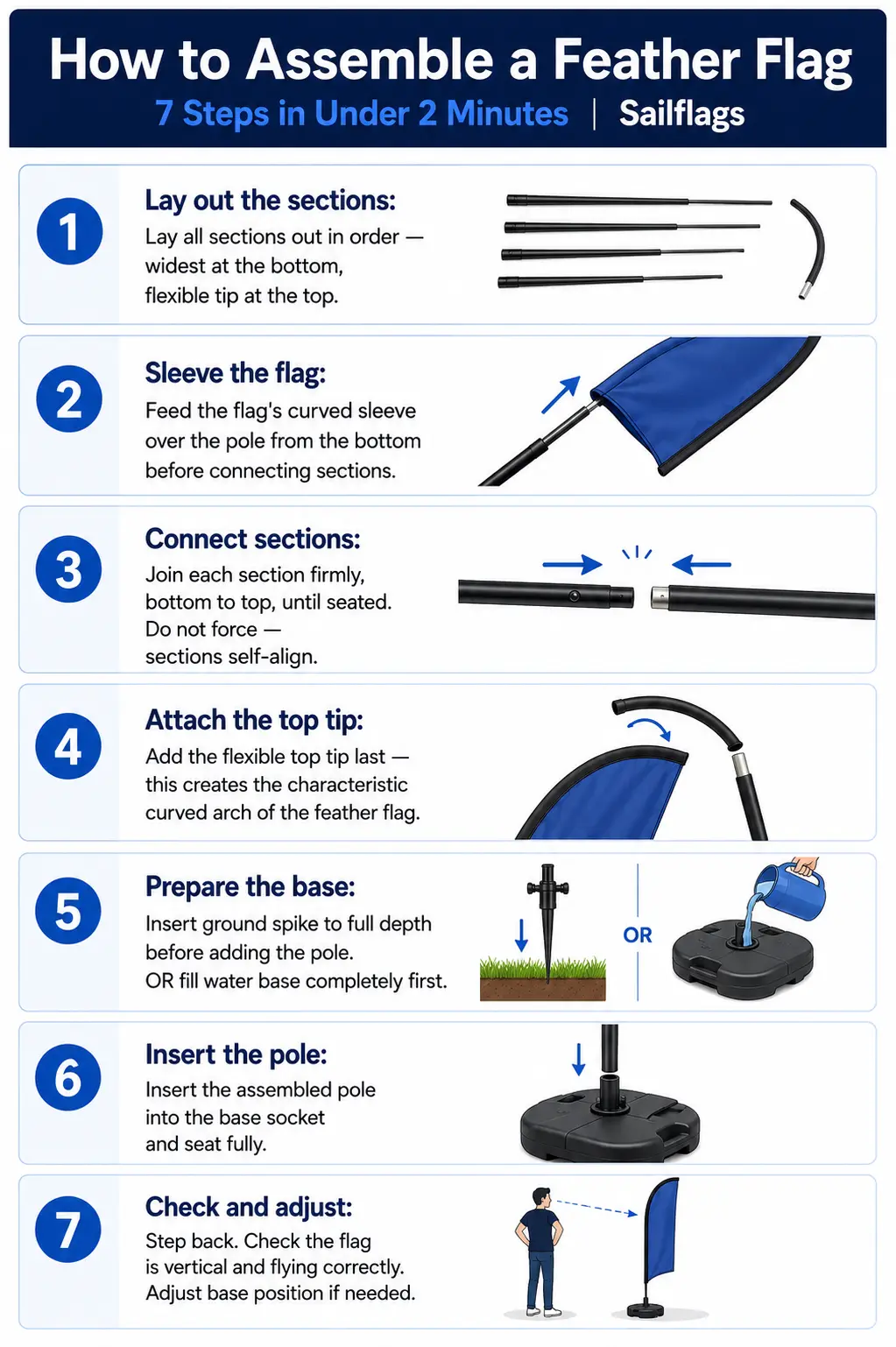
| Common assembly mistake Inserting the pole into the base before connecting all the sections. Always fully assemble the pole first, then insert it into the base. Trying to connect sections while the pole is already in the base risks the pole falling and the base tipping during assembly. |
3. Ground Types and Base Selection
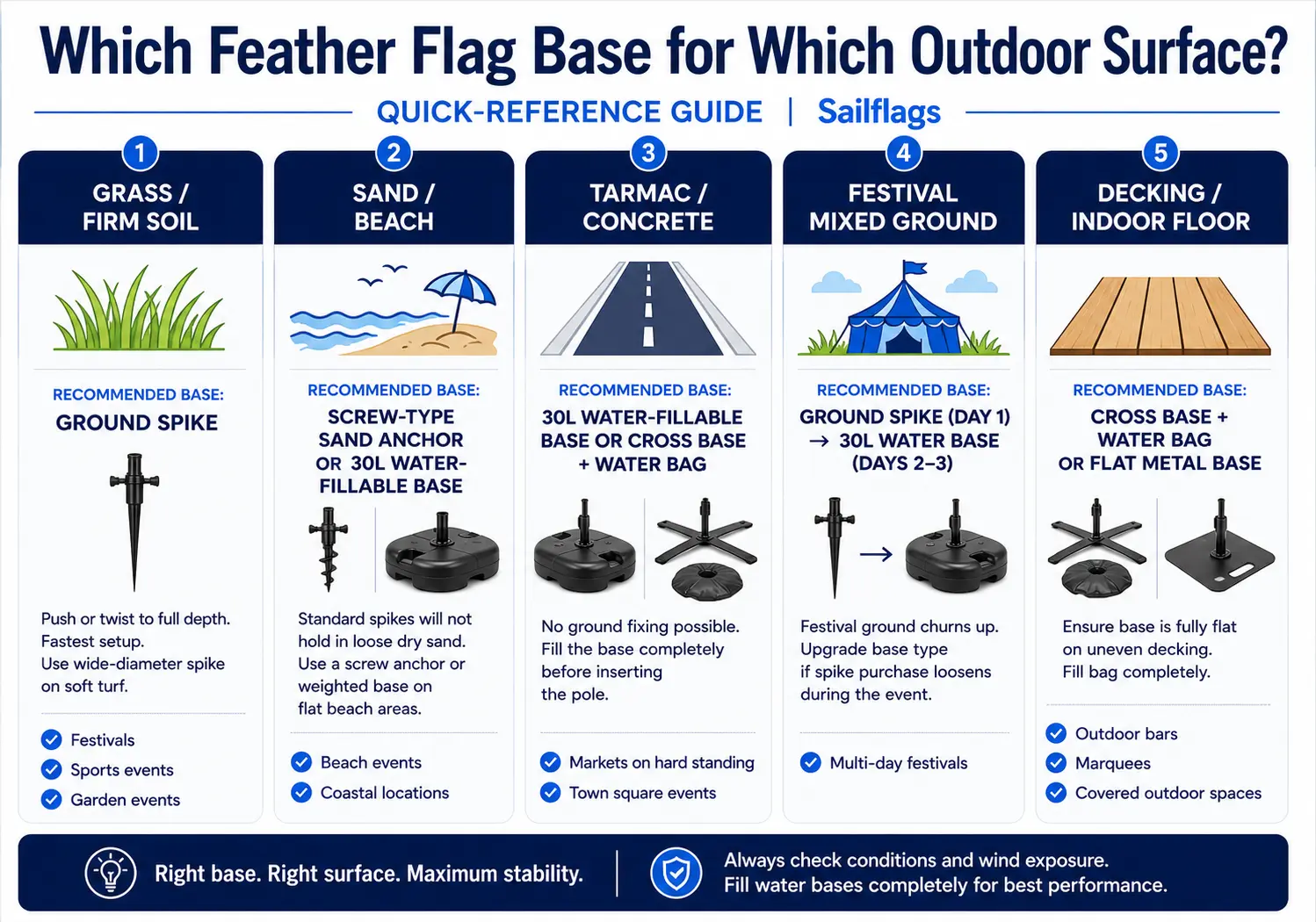
The most common outdoor event setup failure is using the wrong base for the ground type. This is also the most avoidable — the right base for the surface is a straightforward decision once you know what you’re standing on.
3a. Grass and Firm Soil
The ideal surface for feather flags. A ground spike pushed or screwed into firm grass or soil provides secure anchoring with minimal setup time and zero equipment beyond the spike itself. For a standard 3.2m flag on firm grass in light to moderate wind, a 300–400mm spike is adequate. On softer ground or in higher winds, use a longer spike (450–600mm) for greater purchase.
- Best base: ground spike — push or twist to full depth before inserting the pole.
- In wind: drive the spike in at a very slight angle away from the prevailing wind direction. This creates mechanical resistance against the pull of the flag without making the pole lean visibly.
- For larger flags (4.2m+) on grass: a water-fillable base is more stable than a ground spike in exposed conditions — the additional weight at the base resists the higher wind load of a taller flag.
3b. Sand and Soft Ground (Beach Setups)
Beach and sandy ground is the most challenging surface for feather flags. Standard ground spikes are designed for firm soil and will tilt, work loose, or pull out entirely from soft sand within minutes, especially with a flag generating wind load.
- Best base: wide-diameter sand spike or screw-style ground anchor — designed for loose ground, these provide significantly more surface contact than a standard spike. Screw-type anchors are particularly effective in sand as the thread grips surrounding material during insertion.
- Alternative: a 30L water-fillable base placed on a flat, stable area of the beach. This eliminates the ground-fixing problem entirely — the 30kg weight of a full water base provides stability that sand cannot.
- Positioning: avoid placing flags at the high-tide line or in areas of particularly loose dry sand. The firmer, damp sand closer to the waterline (at low tide) provides much better spike purchase than dry loose sand further up the beach.
- Coastal wind: beach locations are almost always windier than inland sites. Size up your base — what works on a calm festival field may tip on an exposed beach. For coastal events, ToughTex heavy-duty fabric combined with a carbon fibre pole and a water-fillable or heavy-duty base is the correct specification.
| Beach setup tip Dig out a small hole before inserting a sand spike — loosening the top 5–10cm of sand first, inserting the spike, then compacting the sand back around it with your foot significantly improves the holding power of any ground spike in sandy conditions. |
3c. Hard Standing — Tarmac, Concrete, Decking
Hard surfaces require a weighted base that can stand without any ground fixing. The two options are:
- Cross base with water bag: the X-shaped base sits flat on the surface; the water bag draped across it provides ballast. Adequate for 1.7m–3.2m flags in light to moderate conditions.
- 30L water-fillable base: self-contained reservoir that provides 30kg of ballast when full. The correct choice for 3.2m+ flags on hard surfaces in any outdoor exposed condition.
On decking or uneven hard surfaces, check the base is sitting completely flat before inserting the pole. A base that rocks or bridges on uneven boards will be less stable than one sitting flush.
3d. Mixed or Unknown Ground
At events where you don’t know what’s under the surface — festival fields that are part grass and part gravel, event sites with hidden hardstanding under thin turf — carry both a ground spike and a cross base with water bag. Survey the intended flag positions before setup and select the base type appropriate to what you find.
4. Wind: The Main Outdoor Challenge
Understanding Wind and Feather Flags
Feather flags are designed to move in the wind — the movement is part of what makes them effective at catching attention. But there is a significant difference between a flag flying cleanly and a flag being overstressed. Standard feather flag pole systems are rated for winds up to approximately 35 mph (Beaufort Scale 7 — near gale). The Beaufort scale provides a practical field reference:
| Beaufort | Wind speed | Description | Flag behaviour |
| 3 | 8–12 mph | Gentle breeze | Flag extends and flies cleanly — ideal conditions |
| 4 | 13–18 mph | Moderate breeze | Flag flies fully — good visibility, minimal stress |
| 5 | 19–24 mph | Fresh breeze | Flag flies hard — monitor base stability |
| 6 | 25–31 mph | Strong breeze | Flag under full load — check base security; consider lower height |
| 7 | 32–38 mph | Near gale | Flag at design limit — bring in if sustained; use heavy-duty base only |
| 8+ | 39+ mph | Gale or above | Take flags down immediately — safety risk |
High-Wind Setup Tips
- Use the heaviest base appropriate to the surface: in exposed conditions, upgrade one base tier. A cross base + water bag that works in calm conditions should be upgraded to a 30L fillable base in forecast winds above 20 mph.
- Use ToughTex fabric at exposed coastal and elevated sites: the heavier weave handles sustained high wind loading significantly better than standard 115gsm fabric.
- Size down the flag in exposed conditions: a 3.2m flag in 25 mph wind creates less load than a 5.2m in the same conditions. If you know the site is exposed, bring a smaller flag than you would for a sheltered event.
- Orientate flags across the wind, not into it: a flag positioned so its flat face catches the wind full-on creates maximum load. Rotated 45–90 degrees, it presents the edge to the wind and reduces load significantly.
- Check bases throughout the day: water bags evaporate in heat; fillable bases can lose water through the cap. Check base weight at midday and top up if needed.
| When to bring flags in The UK Met Office issues wind warnings at three levels: Yellow (possible disruption), Amber (likely disruption), Red (danger to life). At Yellow warnings or sustained forecast winds above 30 mph, reduce flag height or bring flags in. At Amber or above, all flags should be taken down regardless of base type. |
5. Use Case: Festival Fields
Music festivals, arts festivals, and large outdoor events present a specific visual challenge: the environment is saturated with competing signage, structures, and visual stimulation. A flag that would be highly visible in a quieter setting becomes one of dozens competing for attention.
Feather flags work at festivals when they serve a specific navigational or identification function rather than general decoration:
- Zone markers: tall flags (4.2m or 5.2m) at the entrance to specific areas — food courts, stages, camping zones, first aid — help attendees navigate across large sites where views are obscured by tents, stalls, and crowds.
- Stall and vendor identification: a 4.2m flag above a market stall or food vendor is visible from 40 metres across a crowded festival field, bringing footfall to a specific pitch before the visitor can even read the menu board.
- Brand activations: corporate sponsors and brand activations at festivals use flags to mark their territory within a site and create a visual presence consistent with the overall festival aesthetic.
For festival use, the 4.2m Long is the practical minimum for field deployment. Ground spikes on firm festival grass work well, but for multi-day festivals on heavily trafficked ground where the turf becomes churned and loose, upgrade to a 30L water-fillable base by day two.
Printed race arches provide a dramatic entrance point for races, runs, obstacle courses, and event gateways within festival sites — creating a 4m-wide, 3.2m-tall branded archway that functions as both signage and a physical landmark.
6. Use Case: Beach and Coastal Events
Beach events are among the most visually competitive outdoor environments — open skies, natural beauty, competing visual elements, and an audience that is distributed across a wide area rather than channelled along paths. Feather flags at beach events need to be tall, bold, and correctly specified for the conditions.
Specific considerations for beach and coastal setups:
- Salt air and fabric longevity: standard flag fabric degrades faster in salt-laden coastal air than in inland locations. ToughTex is specifically recommended for any event within a few hundred metres of the sea — it handles salt exposure, UV intensity at coastal locations, and the persistent wind loads that coastal environments generate.
- Sand base technique: as covered in Section 3, standard spikes do not hold in dry loose sand. Use screw-type anchors, wide-diameter sand spikes, or a 30L fillable base on flat beach sections. Never leave a flag unattended on sand in wind without a secure base — a tipping flag on a busy beach is a safety hazard.
- Tide awareness: mark flag positions relative to a fixed landmark rather than the tide line. A flag positioned at what appears to be a safe distance from the water at setup can find itself at the tide’s edge within two hours. Check tide times before setup and position flags above the high-tide mark.
- Double-sided for beach events: beach visitors approach from all angles — along the shore, from the sea, from the car park, and from the promenade. Double-sided flags ensure the design reads correctly regardless of approach direction.
- Height: on open beaches with no visual obstructions, a 3.2m flag is often visible from 25+ metres across the flat beach surface. For large beach events with significant visitor numbers, 4.2m provides the additional visibility needed to cut through.
7. Use Case: Sports Events and Race Days
Flags at sports events serve two distinct functions simultaneously: spectator navigation (helping crowds find their way around a site) and sponsor or club branding (creating visible, dynamic brand presence in a high-engagement environment).
For sports use, specific setups to consider:
- Start/finish arches: a custom race arch provides a 4m-wide branded gateway at race start and finish points for running events, cycling events, obstacle courses, and triathlons. Assembled in under 10 minutes, it creates a landmark that runners, spectators, and cameras all focus on.
- Club and team branding: feather flags in club colours at sports grounds, cricket pitches, rugby pitches, and football grounds create a branded atmosphere for match days and tournaments. For grass ground use, a simple ground spike is all that’s needed.
- Spectator stand markers: 4.2m flags at the entry points to different spectator areas help attendees navigate large events where site maps aren’t immediately obvious.
- Sponsor visibility: sponsors at sports events want flags positioned where TV cameras, photographers, and social media content creators are pointing — the start line, the podium, the scoreboard area. Brief your flag positioning around these focal points rather than general site distribution.
- Food and drink concessions: at any sports event, food vendor flags drive footfall between competitive sets, at half time, or at the end of a race. The audience is captive, hungry, and moving — a 4.2m flag above a catering pitch is one of the most cost-effective pieces of event marketing available.
| Sports event setup tip For events with consistent foot traffic patterns — half-time crowds, post-race finishers — position flags facing the primary direction of movement rather than parallel to it. A flag that faces approaching foot traffic creates awareness as the crowd approaches; one parallel to the flow is only seen from one end. |
8. Use Case: Outdoor Markets, Food Festivals & Garden Events
Outdoor markets, food festivals, and garden events share a common characteristic: a contained but visually competitive environment where individual vendors compete for visitor attention over a relatively small area.
For this environment, feather flags serve as vertical identifiers — in a row of stalls where every vendor has a banner, tablecloth, and product display at the same eye level, a flag that extends above the stall tops creates a unique vertical presence that stands out from any position in the market.
- Flag height for markets: 3.2m is typically the right choice for markets and garden events. Taller flags may be out of proportion in a contained environment and can be a nuisance to neighbouring stalls if they swing in wind.
- Food van and trailer use: food vans and trailers operating from a fixed pitch for the duration of an event should use a cross base or water-fillable base positioned at the serving end, facing the primary approach direction. A flag positioned at the back of a van serves only the van operator; one at the front serves every potential customer in the market.
- Garden parties and private events: for private events — garden parties, weddings, anniversaries — flags provide cost-effective decoration and direction. A pair of 3.2m flags either side of an entrance arch creates a formal visual gateway with almost no setup time. Multiple smaller 1.7m–2.4m flags along a path or around a marquee perimeter create atmosphere without requiring heavy bases or extensive ground preparation.
- Farmers markets and craft fairs: these events typically take place on grass or mixed ground where a standard ground spike is appropriate. For vendors attending multiple markets through the season, the complete flag kit packs into a single carry bag and assembles in under two minutes — efficient for weekly pack-down and setup.
9. Flag Spacing: How Many Flags, and Where to Position Them
The impact of feather flags at outdoor events multiplies with quantity — a single flag identifies a point; a row of flags creates a visual corridor, an atmosphere, a brand environment. Here is practical spacing guidance for common outdoor setups:
| Application | Recommended size | Spacing | Notes |
| Festival stall / vendor pitch | 4.2m | Single flag | Positioned facing primary approach |
| Festival zone entrance | 4.2m or 5.2m | Pair either side | Creates a gateway effect |
| Festival perimeter / boundary | 4.2m | 8–12m apart | Creates visible barrier/line across field |
| Beach brand activation | 4.2m | 5–8m apart | Visible from across beach; creates territory |
| Sports event: start/finish | Race arch + flags | Flanking the arch | Arch centre, flags 1–2m either side |
| Sports ground boundary | 3.2m or 4.2m | 8–10m apart | Along touchline or perimeter fence |
| Outdoor market stall | 3.2m | Single or pair | 1 at serving end; 2 for corner pitches |
| Garden party / event entrance | 3.2m | Pair at entrance | 1.5–2m apart for gateway effect |
| Food festival road frontage | 4.2m | 6–8m apart | Along road frontage for drive-by visibility |
The ‘pair at entrance’ setup is consistently the highest-impact single investment at any outdoor event — two matching flags either side of an entrance point create an instant, professional gateway that frames the arrival experience. For maximum effect, flags at an entrance pair should be identical in design and the same height, positioned symmetrically.
10. Looking After Flags at Multi-Day Outdoor Events
Multi-day outdoor events put significantly more stress on flags than single-day use. Here is a daily maintenance routine that extends flag life and prevents failure during the event:
Each Morning Before Opening
- Check pole sections are fully seated in joints; vibration can cause connections to loosen overnight.
- Inspect the flag fabric for any small tears or snagging that occurred the previous day and repair or tape if necessary.
- Ensure the base remains secure and stable; top up water or adjust ground fixings if the ground has shifted or dried out.
During the Event
- Monitor wind speed throughout the day; if gusts exceed recommended limits, lower the flag height or remove it.
- Regularly check base stability, especially in high-traffic areas where accidental kicks or bumps can shift the base position.
Each Evening or When the Event Closes
- If the event is multi-day and the site is unsupervised, disassemble and store flags securely overnight to prevent theft or weather damage.
- At beach and coastal locations, always bring flags in at the end of each event day. Salt air and overnight dew accelerate fabric degradation; storing dry extends flag life meaningfully. Rinse poles with fresh water after coastal use to prevent corrosion at the joints. See the full maintenance guide in the hardware and bases blog.
11. Frequently Asked Questions
How do I stop my feather flag from spinning in the wind?
A flag that spins continuously on its pole rather than flying cleanly is usually caused by one of two things: the pole is not fully inserted into the base socket (allowing it to rotate), or the base socket has a loose fit with the pole diameter. Ensure the pole is seated to its full depth. For sites with consistent swirling wind, a base with a locking collar (which prevents pole rotation within the socket) provides the most stable presentation.
Can I leave feather flags out overnight at a multi-day event?
This depends on weather and security. In calm overnight conditions with no forecast wind, flags can generally remain out. In any forecast wind above 15 mph overnight, or at coastal and elevated sites, bring flags in. The risk is not just damage to the flag — a flag that falls in wind on an unmonitored site can be a safety hazard to early-morning attendees or staff.
What is the best feather flag for windy beach conditions?
The combination recommended for exposed beach and coastal use is: ToughTex heavy-duty fabric, carbon fibre pole (standard on all Sailflags kits), and a 30L water-fillable base or wide-diameter sand screw anchor. This setup is specifically designed for sustained wind loading and salt air exposure.
How do I assemble a feather flag quickly at an event?
The fastest setup routine is to lay the pole sections in order before arrival so they only need to be connected on-site. Pre-feeding the flag fabric sleeve over the pole sections at home means on-site assembly is just: connect the sections, insert into the base, and go. Most experienced event users get from bag to flying flag in under 90 seconds.
Can feather flags be used at the same time as a gazebo or marquee?
Yes — flags and printed gazebos work well as a combined setup. The gazebo provides shelter and a branded canopy structure; flags positioned 1–2m in front of the gazebo extend the brand’s visible footprint and attract attention from further away. The flags draw people in; the gazebo gives them a reason to stay.
Are there restrictions on using feather flags at events?
Most outdoor events have vendor guidelines that cover signage height, positioning, and materials. Before ordering flags for an event, check the organiser’s exhibitor pack for any restrictions on flag height, base types (particularly whether ground-fixing is permitted), or positioning relative to neighbouring stalls. Some events restrict flag height in covered or semi-enclosed areas; others require all bases to be non-ground-penetrating on sensitive turf. Planning ahead avoids arriving with equipment that cannot be used.
How many flags do I need for a typical festival pitch?
For a standard 3×3m market or festival stall, one 4.2m flag positioned at the front-facing corner of the pitch provides strong visibility from the main walkway. For a 6×3m double pitch or for a vendor wishing to increase standout, two flags — one at each front corner — create a visual frame that is significantly more impactful than a single flag and clearly marks the full extent of the pitch.
Set Up Right — Stand Out on the Day
Outdoor events reward preparation. A feather flag set up correctly — right size for the environment, right base for the ground, correctly positioned relative to the wind direction and the audience flow — delivers exceptional visibility over the full event day. One that tips over in the first gust, wraps around its pole, or sits too low to be seen over the crowd delivers none of it.
The setup principles in this guide apply across every outdoor environment. The variables change — grass versus sand, calm festival versus exposed coastal beach — but the underlying logic is consistent: match the hardware to the conditions, and the flag will perform.
At Sailflags, every custom feather flag comes with a carbon fibre pole system and carry bag as standard. The full range of bases, ground spikes, and accessories is available to match any event surface. For exposed and multi-day outdoor events, ask about ToughTex heavy-duty fabric when ordering. For large event kits and multi-flag orders, the trade account programme provides volume pricing and priority production.