

Ordering a custom teardrop flag for the first time raises a fair few practical questions: what artwork do you actually need, how does printing onto that curved shape work, and how long will it take? This guide walks through the whole process so there are no surprises between placing your order and unrolling the finished flag.
This is a companion piece to our teardrop flags buyer’s guide and sizes guide — read those first if you haven’t already settled on a size and finish, since those decisions happen before the ordering process below begins.
Ordering a Custom Teardrop Flag: The Process, Step by Step
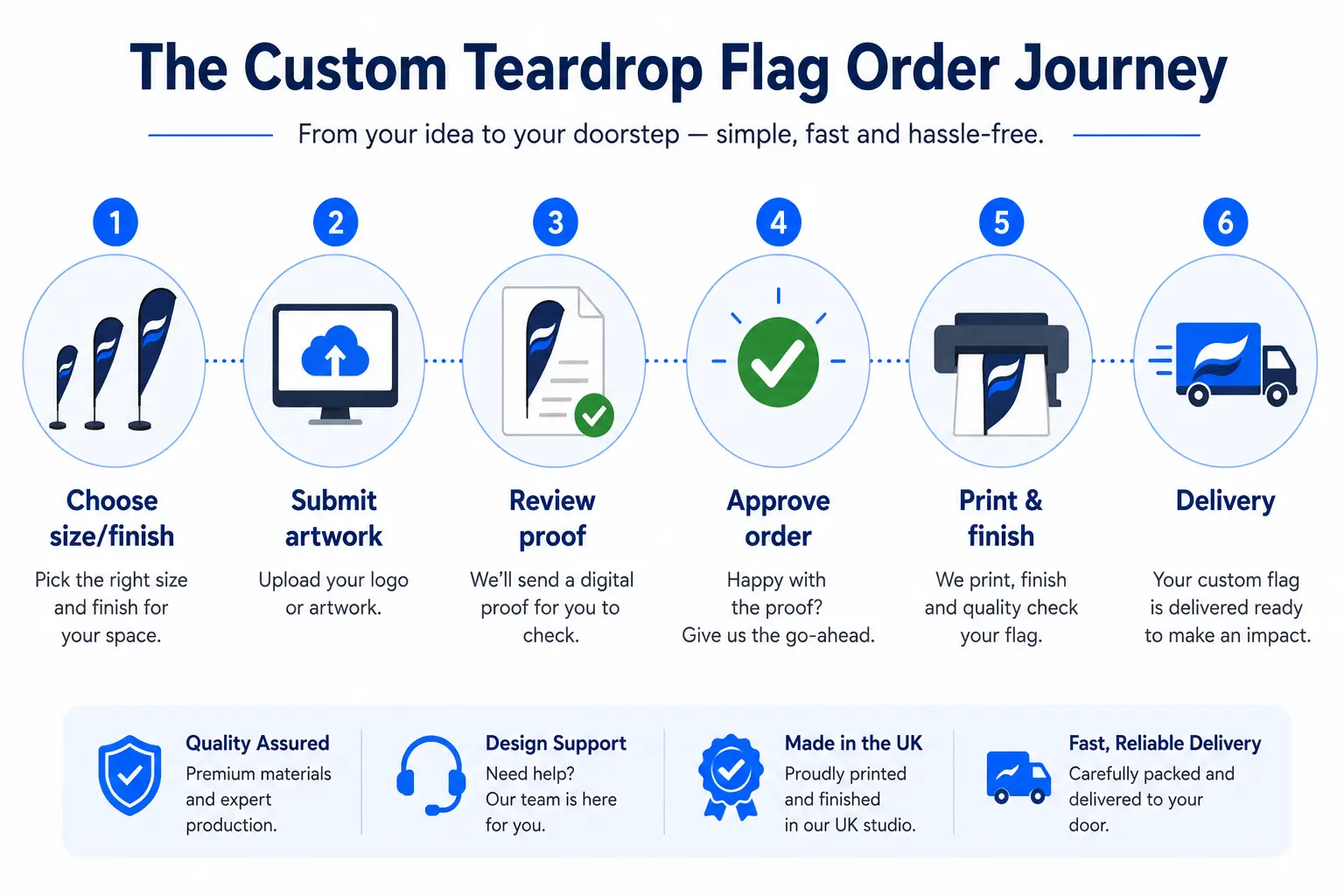
The process is broadly the same whether you’re ordering one flag or a batch for multiple sites:
- 1. Choose your size and finish. Pick your height and single- or double-sided print — see our size guide and buyer’s guide if you haven’t already.
- 2. Provide or create your artwork. Either upload existing brand artwork or build a design using our online flag creator.
- 3. Review a proof. You’ll see how your design looks on the actual teardrop shape before anything is printed.
- 4. Approve and confirm your order. Once you’re happy with the proof, production begins.
- 5. Printing and finishing. Your design is printed, the fabric is cut and hemmed, and the pole sleeve is finished.
- 6. Delivery. Your flag arrives ready to attach to its pole and base.
The one step that genuinely varies most between orders is the second — how ready your artwork is — which is also the single biggest factor in how smoothly (and quickly) everything after it goes.
Artwork & Design Requirements
The better prepared your artwork is when you submit it, the faster and cleaner the rest of the process goes. As a general guide:
- Vector files (AI, EPS, PDF with outlined text) reproduce most cleanly at large print sizes — logos in particular should be supplied as vector artwork wherever possible
- High-resolution raster images (PNG, JPEG) can work for photographic elements, but check resolution carefully — an image that looks sharp on a screen can appear pixelated once blown up to flag size
- Include any specific brand colours (Pantone references, if you have them) so we can match as closely as the print process allows
If you don’t have print-ready artwork, that’s what our online flag creator is for — it lets you build a design directly, so there’s no separate design software or file format to worry about.
Understanding the Teardrop Print Area
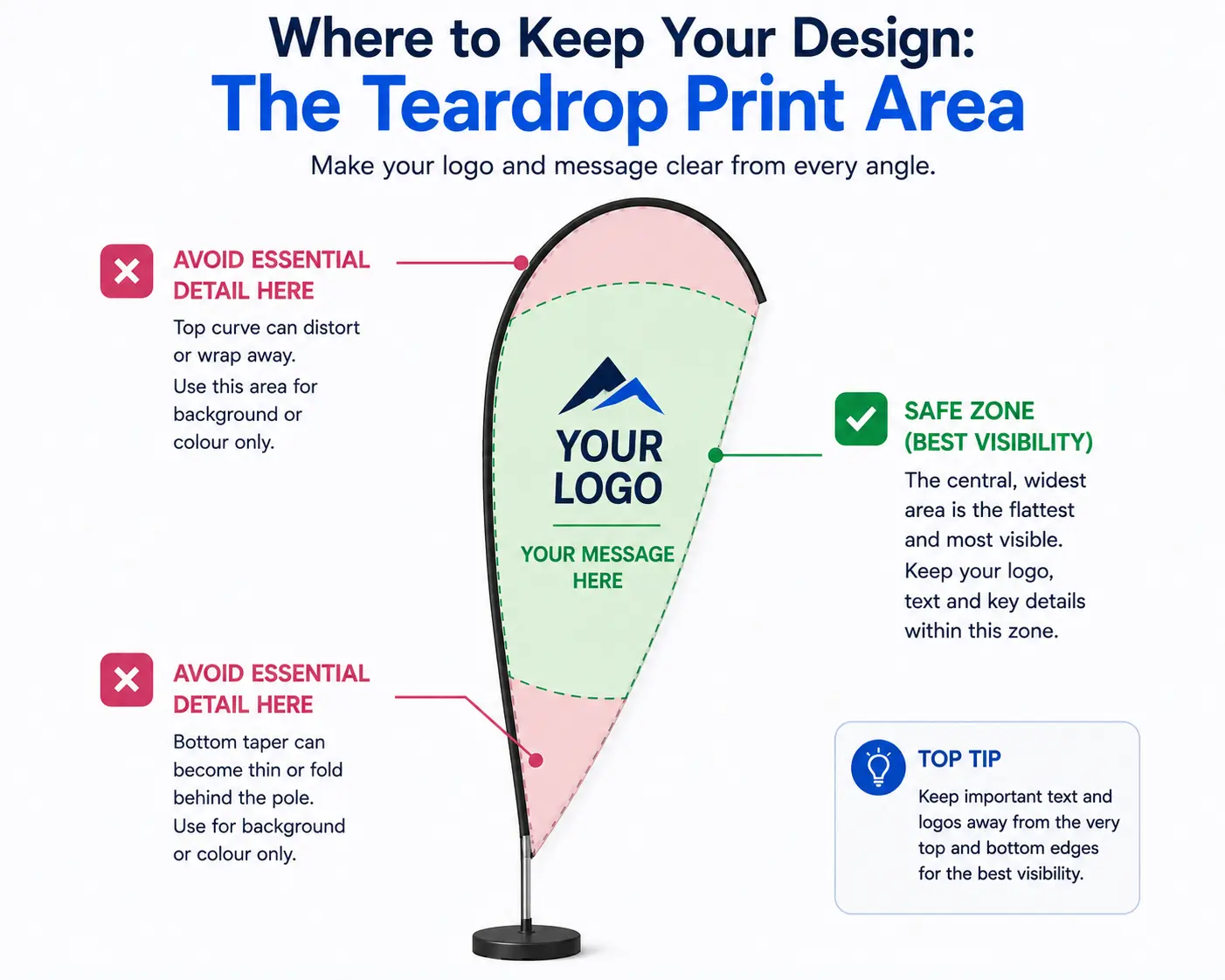
This is the detail that catches out a lot of first-time buyers: because a teardrop flag tapers to a point at the top and bottom, a design that’s centred and readable on a rectangular canvas doesn’t automatically translate well onto the curved shape. Logos and text placed too close to the taper can end up looking cramped, cropped, or oddly proportioned once printed.
The safest approach is to keep your primary logo and any essential text within the widest, central part of the flag, and treat the tapering top and bottom sections as background or supporting colour rather than somewhere to place detail you need people to read. If you’re working from existing brand artwork not designed with this shape in mind, it’s worth asking for guidance on repositioning before you approve a proof, rather than after.
Print Method & Colour: What to Expect
Flag fabric is typically printed using a dye-based process that infuses colour directly into the weave, rather than sitting on top of it as ink would — this is part of why printed flags stay flexible and don’t crack or peel the way a rigid printed sign might. One practical consequence worth knowing: colours on fabric can render slightly differently from how they appear on a screen or in a standard office print, since screens (RGB) and fabric printing (a different colour process entirely) don’t always match one-to-one. If exact brand colour matching matters for your business, flag this at the ordering stage and provide a Pantone reference if you have one, so it can be matched as closely as the process allows.
It’s also worth thinking about contrast, not just colour accuracy. A design that relies on subtle tonal differences — pale grey text on white, for instance — can lose definition once printed at flag scale and viewed from a distance. Bold contrast between your background and your logo or text reads far more reliably outdoors than it does on a backlit screen.
Proofing: Why It Matters Before You Print
A proof is a preview of your design as it will actually appear on the finished flag shape, sides, and sizing — and it’s the point in the process where it’s cheapest and easiest to catch a mistake. Check for: text or logos positioned too close to the taper, colours that look substantially different from what you expected, and anything that reads correctly on one side but is mirrored or missing on the reverse if you’ve ordered double-sided.
It’s worth taking the time to review a proof properly rather than rubber-stamping it — once you’ve approved it and production starts, changes are no longer straightforward, for reasons covered in the rights section below.
What Affects Turnaround Time
There’s no single fixed turnaround that applies to every order, because a few different factors genuinely change how long production takes:
- How ready your artwork is when you submit it — print-ready vector files move faster than artwork that needs rework or a back-and-forth on colours
- How many proof revisions you need before approving — each round adds time
- Order size — a single flag typically moves faster through production than a large multi-site batch
- Time of year — turnaround can extend during seasonally busy periods, much like most UK print businesses
Because of this, the most accurate turnaround estimate you’ll get is the one confirmed at quote or order stage for your specific job, rather than a generic figure — if timing is critical for an event or launch date, say so upfront and we’ll flag whether it’s achievable before you commit.
It’s worth building in a small buffer between your expected delivery date and when you actually need the flag on site, particularly for weather-dependent outdoor events — a few spare days gives you room to sort out any last-minute base or pole issues without it becoming a scramble.
Rush Orders & Multi-Site Rollouts
If you’re working to a fixed date — a launch, an event, or an exhibition — tell us as early in the process as possible, ideally before you’ve finalised artwork, since that’s the step with the most flexibility to speed up. For multi-site rollouts (the same design across several locations, or several different designs for different branches), it’s worth batching the order together rather than placing it site by site — it’s easier to keep designs consistent and usually more cost-effective as a single order.
For genuinely time-critical orders, being upfront about the constraint early is far more useful to us than leaving it until checkout — it gives us the chance to flag any part of the process (artwork prep, proofing, delivery method) that might need adjusting to hit your date, rather than discovering a problem after you’ve already committed.
Custom vs Ready-Made: Which Should You Choose?
Not every use case needs a fully custom design. If you need a flag in a hurry, or you’re testing whether teardrop flags work for a particular site before committing to a branded design, a simpler stock or template-based option can be a sensible starting point. Custom printing comes into its own once you know exactly what you want to say and how you want your brand to look — for most ongoing business use, the branding value of a fully custom flag over a generic one is usually worth the extra step of getting artwork sorted properly.
Your Rights When Ordering Custom-Made Flags
One thing worth knowing before you order: because a custom-printed teardrop flag is made specifically to your design, it falls into the category of bespoke or personalised goods under UK consumer law. According to UK government guidance on the Consumer Contracts Regulations, bespoke and personalised goods are generally exempt from the standard 14-day cancellation right that applies to most online purchases, since once production starts on something made to your specification, it can’t simply be resold to someone else. This is exactly why the proofing stage matters so much — it’s your opportunity to catch and fix anything before production begins, rather than after.
This doesn’t affect your separate rights if a flag arrives faulty, damaged, or not as described — those protections apply regardless of whether an item was custom-made. It specifically affects the right to change your mind for a reason unrelated to a fault, once you’ve approved a proof and production is under way.
What’s Included When Your Flag Arrives
A finished teardrop flag typically arrives ready to attach to its pole — the pole sleeve is sewn along one edge so the fibreglass pole threads straight through, and the flag itself needs no further assembly. What’s included alongside the flag depends on how you’ve ordered: some buyers order the flag alone (useful if you already own poles and bases from a previous order), while others order the full kit — flag, pole, and base together. If you’re not sure which you need, it’s worth checking what you already have in storage before ordering, since mismatching an old pole with a new flag size is one of the more common avoidable hiccups.
Trade & Multi-Site Ordering
If you’re ordering regularly — a franchise, a multi-site retailer, or an agency ordering on behalf of clients — it’s worth setting up a more structured way of working with us rather than placing each order from scratch. Keeping master artwork on file means repeat orders can move faster, since the design and colour-matching questions have already been resolved on the first order. If this sounds like your situation, mention it when you place your first order so we can flag your account accordingly.
Common Ordering Mistakes to Avoid
- Approving a proof quickly without checking text and logo placement near the taper
- Submitting low-resolution artwork and expecting it to look sharp at full flag size
- Leaving a fixed event date until late in the process, when artwork still needs work
- Ordering sites separately for a multi-location rollout instead of batching for consistency and cost
- Assuming screen colours will match fabric print exactly without flagging brand colour requirements upfront
Frequently Asked Questions
Can I supply my own artwork? Yes — vector files are preferred for the sharpest results, but our team can advise on what you’ve got if you’re not sure it’s print-ready.
What if I don’t have a logo or design ready? Use our online flag creator to build something from scratch, or get in touch and we can talk through options.
Can I change my design after I’ve approved a proof? Once production has started this becomes difficult, which is exactly why it’s worth reviewing your proof carefully before approving it.
Do you offer rush turnaround for urgent orders? Let us know your deadline as early as possible — turnaround depends on several factors, and we’ll tell you upfront whether your date is achievable.
Can I order the flag on its own without a pole and base? Yes — useful if you already have compatible hardware from a previous order. Just double-check the pole and base you have match the size you’re ordering.
Will my colours look exactly like they do on my screen? Very close, but not always identical — screens and fabric printing are different colour processes. Provide a Pantone reference if exact colour matching is important to you.
Ready to Order Your Custom Teardrop Flag?
Browse the full range of teardrop flags to start choosing your size and finish, or get a custom quote and we’ll talk you through artwork and timing for your specific order.