

It’s a small-sounding choice that makes a bigger difference than people expect. Whether your teardrop flag is single- or double-sided affects how it looks from different angles, what it costs, and how well it actually does its job once it’s up. Here’s how to choose properly, rather than defaulting to whichever option is cheaper.
This is one of the quicker decisions in the ordering process, but it’s also one that’s genuinely hard to change your mind about after the fact — so it’s worth the five minutes it takes to think through properly before you order, rather than assuming it won’t matter.
What ‘Single-Sided’ and ‘Double-Sided’ Actually Mean
A single-sided teardrop flag is printed on one face of the fabric. Because flag fabric is thin enough to let light through, your design is still faintly visible from the back — but mirrored, back-to-front, and noticeably less crisp than the front. It reads fine head-on; it doesn’t read well from behind.
A double-sided teardrop flag is built so that both faces show your design correctly — the right way round, not mirrored — no matter which side someone’s viewing it from. There’s more than one way to achieve this, which is worth understanding before you order.
It’s worth saying clearly: this is purely about how the flag is printed and constructed, not about size, shape, or the pole and base you pair it with. You can choose single- or double-sided at any of the three standard sizes, and it doesn’t change how the flag is set up or taken down.
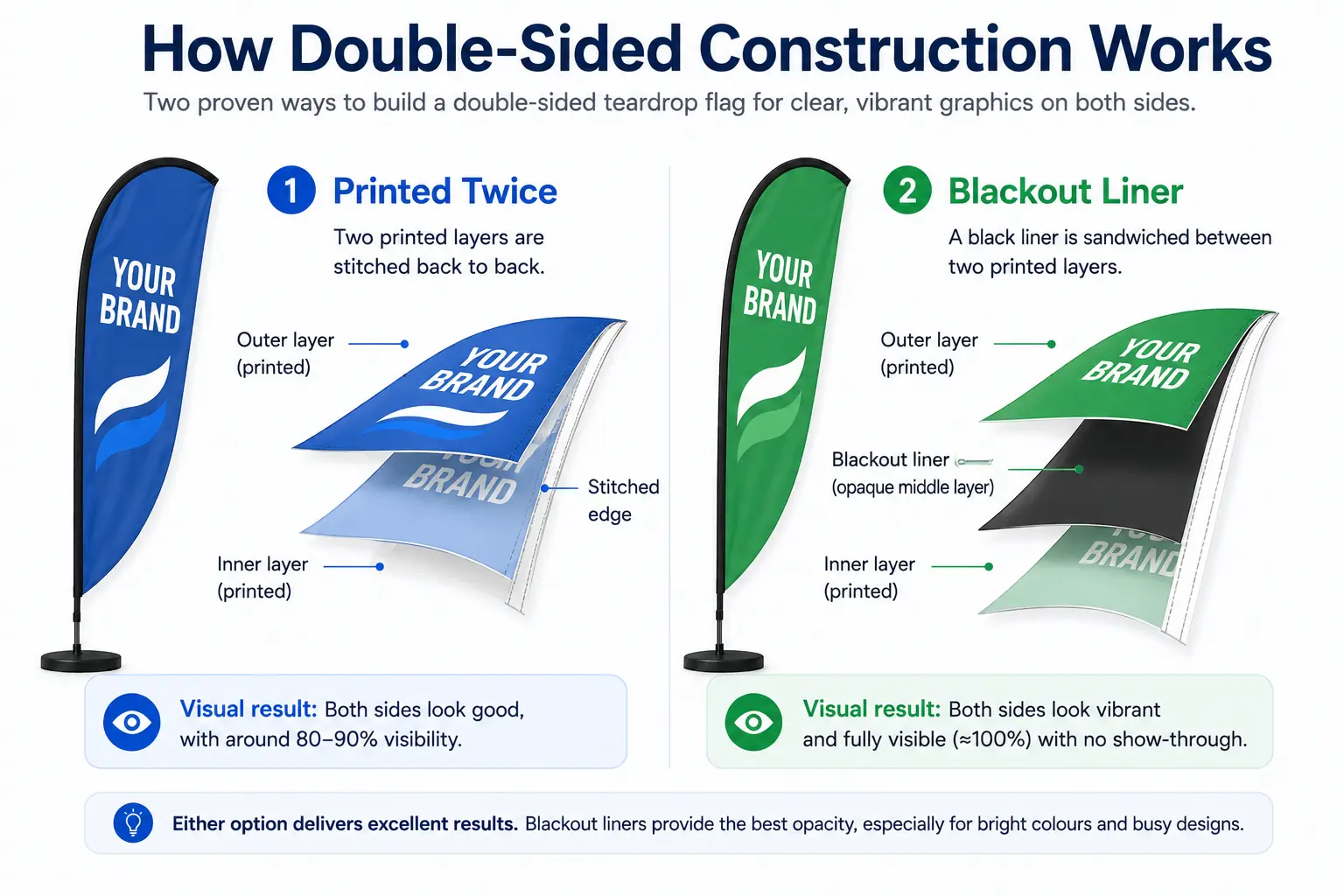
How Double-Sided Flags Are Made: Two Methods
Printed twice: two separate prints, one for each face, sewn together so each side reads correctly independently. This is a straightforward way to get two correctly-oriented sides.
Blackout liner construction: a layer of opaque fabric is sewn between two printed layers, which stops light — and therefore the mirrored ghost of the opposite side’s design — from showing through at all. This tends to give the crispest, most solid-looking result on both faces, since neither side has to compete visually with light bleeding through from the other.
Either method gets you a flag that reads correctly from both sides — the practical difference for most buyers is less about the exact construction and more about the result: a properly double-sided flag looks fully finished and deliberate from every angle, which a single-sided flag simply can’t do once someone’s behind it.
If it matters to you which construction method is used, it’s worth asking at quote stage — for most standard business use, either method delivers a flag that does the job well, but if you’re after the crispest possible result on both faces for a premium, permanent installation, the blackout liner method is generally the stronger choice. Neither method affects how the flag is set up, packed down, or cared for day to day — those steps stay exactly the same regardless of which construction sits behind your chosen finish.
Does Ordering Double-Sided Affect Turnaround?
Double-sided flags involve more construction than single-sided ones, which can be a small factor in overall production time alongside the other variables covered in our guide to ordering custom teardrop flags — artwork readiness and proofing rounds tend to matter more than the single-vs-double-sided choice on its own. If you’re working to a fixed date, it’s worth flagging your finish choice alongside your deadline when you request a quote.
Real-World Examples by Setting
A few common settings and the finish that tends to suit them, based purely on how people move around each one:
- Estate agent flag against the office window: single-sided — there’s no route behind it, so a second printed face would never be seen.
- Car dealership forecourt: double-sided — customers and passing traffic approach from multiple directions around parked stock.
- Market stall in an open field: double-sided — shoppers walk the full circuit of a market, approaching stalls from every angle.
- Flag fixed to a wall bracket at a fixed event entrance: single-sided is usually fine, provided the wall genuinely blocks any route behind it.
- Festival or exhibition stand in open ground: double-sided — visitors approach stands from the aisle on either side, not from one fixed direction.
None of these are hard rules — they’re simply the finish that tends to suit each setting based on how people actually move around it. If your situation doesn’t map neatly onto one of these, the walk-around test further down is the more reliable check.
Can Each Side Show a Different Design?
Yes — because a double-sided flag is either two separate prints or two printed layers either side of a blackout liner, there’s no technical reason both faces need to carry the same design. Some buyers use this to run two different messages on the same flag: a seasonal offer on one face and a standard brand design on the other, for example, or two languages for a bilingual audience.
It’s worth deciding this upfront rather than after ordering, since it affects how your artwork is prepared — two distinct designs need to be supplied and proofed as two separate faces, not one design duplicated. If you want this, mention it clearly when you submit your artwork.
When Single-Sided Is the Right Choice
Single-sided is the right call whenever your flag genuinely will only be seen from one direction — for example, positioned flush against a shopfront window, a wall, or a fixed backdrop where nobody will ever walk around behind it. In that setup, paying extra for a second printed face that no one will ever see properly is money that could go elsewhere — a larger size, a heavier base, or simply a lower total cost for the same visual impact where it matters.
It’s also a sensible starting point if you’re testing whether flags work for a particular site at all, before committing to the fuller double-sided spec for a longer-term rollout.
When Double-Sided Is the Right Choice
Double-sided earns its extra cost the moment people can view your flag from more than one side — which, in practice, covers most outdoor settings. Forecourts, open market pitches, festival fields, roundabouts, and anywhere with footpaths or traffic passing on both sides are all double-sided territory. Even settings that seem one-directional at first glance — like a shop entrance on a corner plot — often have more sightlines than they first appear.
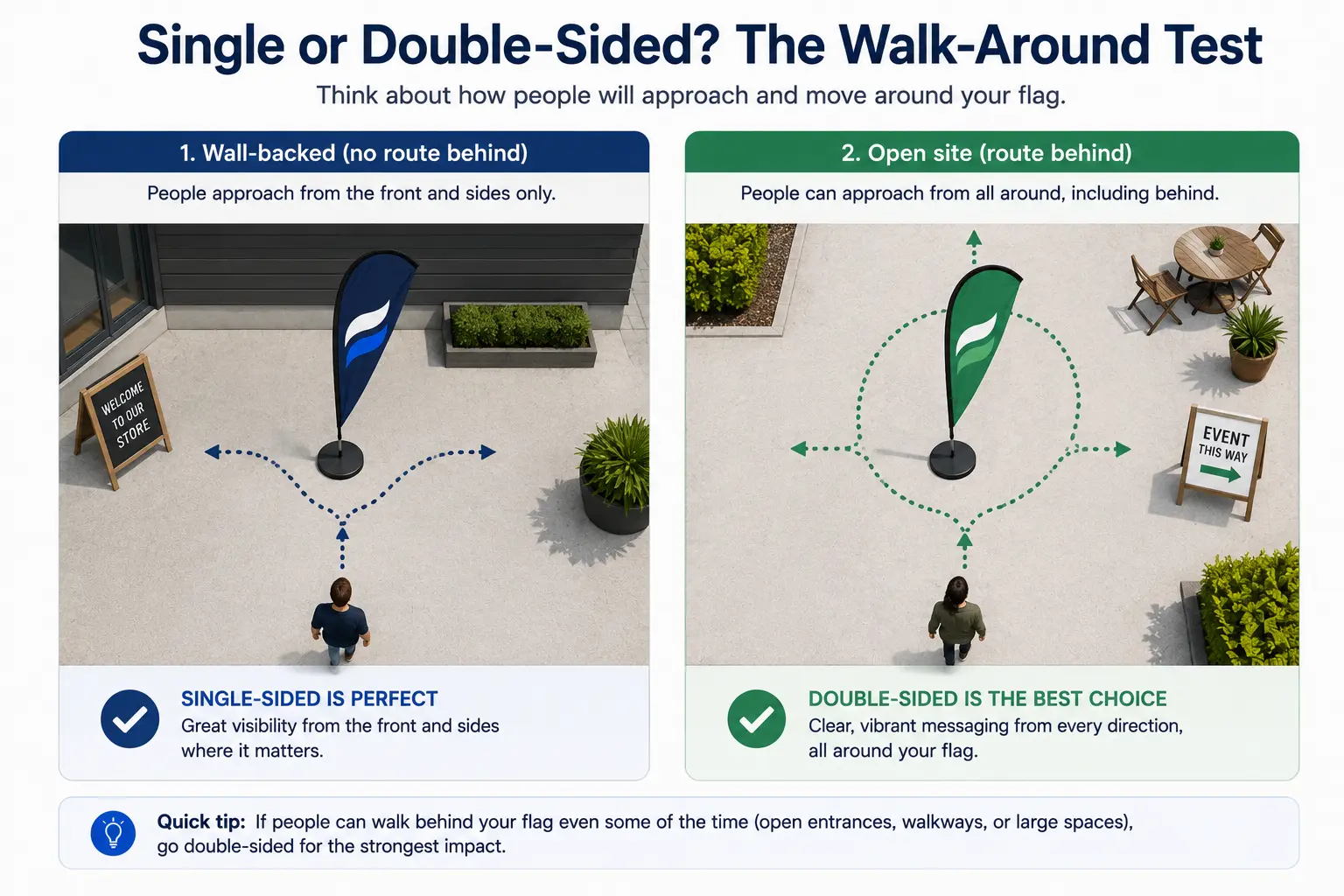
The test that cuts through most of the decision: if you can picture someone walking behind your flag and still needing to read it, it should be double-sided. A mirrored, back-to-front logo doesn’t just look unfinished — it actively undermines the professional impression you bought the flag to create in the first place.
Does It Cost More? What You’re Paying For
Yes, double-sided flags cost more than single-sided ones of the same size — you’re paying for either a second print pass or the extra fabric and construction of a blackout liner, both of which use more material and more production time than a single-sided flag. The cost difference is proportionate to the extra work involved rather than an arbitrary premium.
Whether that extra cost is worth it comes down entirely to your setting, not your budget in isolation. A double-sided flag in a spot where only single-sided viewing ever happens is money spent on something nobody will ever see the benefit of. A single-sided flag in a spot with all-round visibility is a false saving — half your audience sees a mirrored, unfinished-looking flag, which works against the reason you bought branded signage in the first place.
As with sizing, it’s rarely worth choosing based on price alone without checking the setting first — the cheaper option only saves money if the flag is genuinely only ever going to be viewed from one side.
If budget is genuinely tight and your site has mixed visibility — mostly one direction, but occasionally viewed from behind — it’s worth weighing the actual cost difference against how often that secondary viewing angle happens. For a flag that’s up permanently in a high-traffic double-sided location, the extra cost is recovered many times over in consistent branding; for a flag used a handful of times a year in a mostly one-directional spot, it’s a closer call.
Common Misconceptions
- “Double-sided just means it’s printed darker.” Not quite — the difference is about which sides read correctly, not overall print intensity. A well-made single-sided flag can look just as bold from the front.
- “You can always tell from a distance.” You can’t, until someone’s actually behind the flag. From the front, single- and double-sided flags of the same design look identical.
- “Single-sided is always the false economy.” Not if the setting genuinely only ever gets viewed from one angle — in that specific case, single-sided is the sensible, not the cheap, choice.
- “A single-sided flag looks bad even from the front.” Not at all — from the correct viewing side, a well-made single-sided flag looks identical to a double-sided one. The difference only shows up from behind.
- “Double-sided flags need different care.” No — caring for a double-sided flag is the same as any other teardrop flag: bring it in during storms, let it dry before storing, and keep it loosely rolled rather than tightly folded.
A Simple Way to Decide
Stand at the exact spot your flag will go, and physically walk around where it will be planted, the way a passer-by realistically could. If there’s any route — a footpath, a car park aisle, an open field, a market walkway — that takes someone behind the flag, go double-sided. If it’s genuinely backed against a wall, window, or fixed structure with no way to walk behind it, single-sided will do the job just as well for less.
If you’re ordering for a site you haven’t visited yet, or a location that’s still being finalised, it’s worth erring toward double-sided rather than guessing — it’s the safer default for any setting with genuine uncertainty about foot traffic patterns, and the cost difference is usually smaller than the cost of a flag that doesn’t work properly once it’s up.
Frequently Asked Questions
Can I upgrade a single-sided flag to double-sided later?
Not on the same physical flag — the two are built differently from the start. If you’re not sure which you’ll need long-term, it’s worth choosing double-sided upfront rather than reprinting later.
Does double-sided affect how the flag performs in wind?
Not meaningfully — the difference is in the print and construction, not the aerodynamics of the shape. Size and fabric weight are the bigger factors for wind performance; see our teardrop flags buyer’s guide for more on that.
Is the backpack kit available double-sided?
Yes — the double-sided backpack kit pairs a double-sided flag with the same portable pole-and-base carry system as the standard kit.
Which is more popular, single- or double-sided?
Double-sided is the more common choice for outdoor and open-site use, simply because most outdoor settings have visibility from more than one direction.
Is a double-sided flag heavier or harder to set up?
Marginally heavier due to the extra fabric layer, but the setup process is identical — same pole, same base, same assembly time.
Can I mix single- and double-sided flags in the same order?
Yes — if you’re ordering multiple flags for different sites, it’s fine to specify a different finish per flag based on where each one is going.
If I’m not sure, should I default to double-sided?
For most outdoor settings, yes — it’s the safer choice when there’s any doubt about visibility from multiple angles, and the cost difference is generally modest compared to the risk of an unfinished-looking flag once it’s up.
Ready to Choose Your Finish?
Browse the 2.7m and 3.6m double-sided teardrop flags, or browse the full range of teardrop flags to compare both finishes, or get a custom quote if you’re not sure which one your site needs.